ancient Greek comedy
Ancient Greek Comedy
Surviving Greek comedy reveals two powerful modes: public, fantastical ridicule and tightly plotted domestic complication.
Enter the Greek theaterComedy through time
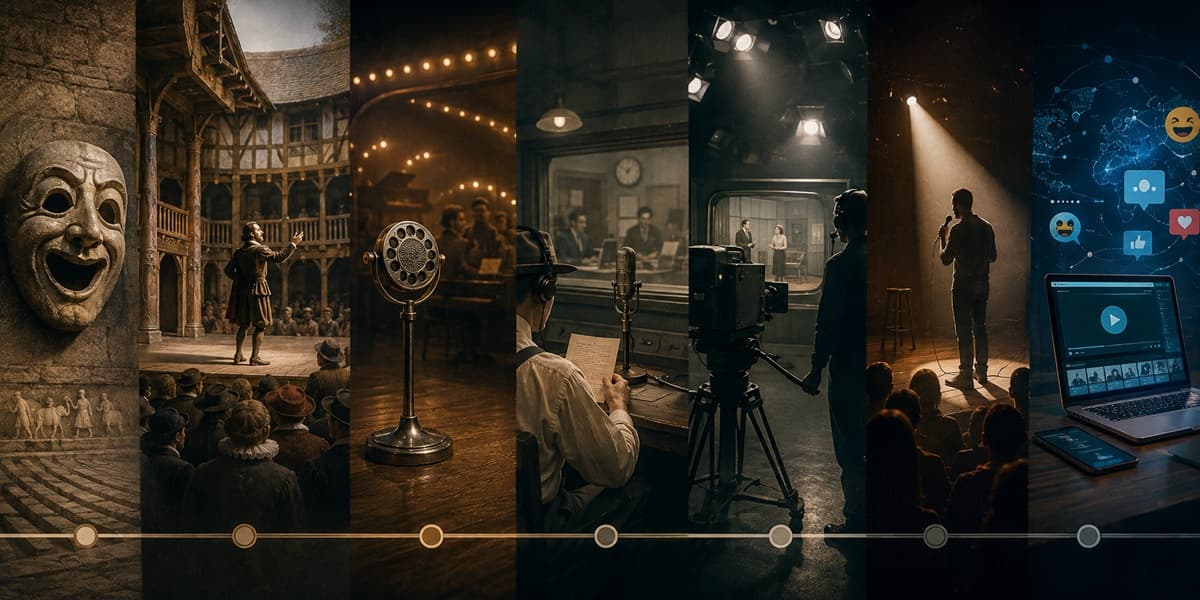
Comedy has never belonged to one medium, one style, or one audience. It has moved through public festivals, theaters, printed texts, touring stages, radio studios, film, television, clubs, recordings, and networked screens. Each medium changes what a joke can do. A theatrical aside, a radio voice, a television reaction shot, a stand-up pause, and a looping internet clip all organize comic attention differently.
ARTFunny’s history section follows those changes without treating comedy as a neat march from primitive forms to modern sophistication. Surviving evidence is uneven. Written works preserve some traditions better than improvised performance. Recorded media preserve voices and timing that text cannot. Archives reflect what institutions chose to keep. Any history of comedy therefore includes both material that survives and gaps that should not be filled with confident invention.
Historical archive
Eleven chronological guides trace how comic forms moved from public theater to print, broadcast, recorded performance, and networked culture.
ancient Greek comedy
Surviving Greek comedy reveals two powerful modes: public, fantastical ridicule and tightly plotted domestic complication.
Enter the Greek theaterhistory of comedy
Comedy has no single birthplace or straight line of progress. Its history is a series of forms reshaped by audiences, media, power, and performance.
Trace comedy's evolutionhistory of radio comedy
Radio removed the visible stage and made voices, acoustic space, repeated characters, and listening habits carry the joke.
Tune into radio comedyhistory of sketch comedy
Sketch comedy makes a premise legible quickly, develops its game, and leaves before the temporary world needs to become permanent.
Trace sketch comedyhistory of stand-up comedy
Stand-up emerged through monologue traditions, but became distinctive when the speaking persona and point of view moved to the center.
Trace stand-up comedyhistory of television comedy
Television assembled older comic traditions into a new domestic medium shaped by cameras, schedules, sponsors, and recurring access.
Trace television comedyhistory of the sitcom
The sitcom turns recurrence into an engine: audiences know the people and place well enough to recognize every new disruption.
Follow the sitcominternet comedy history
Internet comedy makes circulation visible: audiences do not only receive jokes but copy, alter, contextualize, and rank them.
Trace internet comedyRoman comedy
Roman playwrights adapted Greek comic inheritance into performance machines powered by deception, recognizable roles, and rhythmic language.
Enter the Roman stageShakespeare comedy
Shakespeare's comedies make language and identity unstable, then use performance to turn confusion into social experiment.
Study Shakespearean comedyvaudeville comedy
Vaudeville turned comedy into an adaptable repertoire of monologues, bits, sketches, songs, and physical business.
Enter the vaudeville circuitAncient comic traditions demonstrate that ridicule, parody, exaggeration, bodily humor, social conflict, and theatrical play have long histories. Surviving Greek and Roman works give historians substantial evidence about some formal traditions, but they do not provide a complete census of what every audience laughed at.
Comedy exists in performance, and performance is difficult to preserve. A surviving script shows wording and structure but cannot fully recreate delivery, audience knowledge, staging, or a particular night.
Early modern theater offers another rich archive of comic devices: disguise, mistaken identity, status reversals, verbal play, romantic complications, fools, misunderstandings, and characters who know less than the audience does. These devices remain recognizable because they exploit durable features of expectation and social interaction.
Yet the language and references of an earlier period can also demonstrate how context ages. A line once immediate may need explanation centuries later. Comedy history is partly what remains legible and what needs reconstruction.
Variety traditions and vaudeville helped organize comedy into acts that could travel, repeat, sharpen, and adapt to changing rooms. Physical routines, songs, character pieces, monologues, wordplay, and ensemble performance could coexist on one bill.
This environment rewards economy. A performer may have limited time to establish a persona and create a response. Repetition can polish timing, while audiences and venues still change.
Radio removes the visible performer and makes voice, rhythm, sound effects, recurring characters, and imagined space central. A listener has to construct more of the scene mentally. That constraint can become a comic advantage: the unseen can be exaggerated without needing to be physically built.
The medium also highlights how strongly comedy can depend on cadence and vocal identity. Words that seem flat in transcription may become funny through pacing, hesitation, interruption, or the audience’s familiarity with a character’s voice.
Television brings visual performance into domestic space and combines theatrical traditions with camera framing, editing, sets, audience response, and recurring formats. Early television variety and comedy programs inherited stage and radio techniques while creating new opportunities for close-up reaction, visual timing, and repetition across episodes.
The camera can direct attention with precision. A glance that an audience in a large theater might miss can become the entire punchline. Editing can compress timing or delay a reveal. The medium becomes part of the joke’s mechanism.
Stand-up appears simple: a person, a microphone, an audience. That simplicity is deceptive. Persona, point of view, timing, wording, confidence, vulnerability, crowd response, topic selection, and the management of tension all become unusually visible.
The form also makes iteration easy to observe. Material can be rewritten after real audience response. A pause can grow longer. A premise can be compressed. A word can disappear. The final routine may look spontaneous even when its rhythm has been refined repeatedly.
Situation comedy adds a powerful resource: accumulated familiarity. Characters, relationships, habits, and locations become comic infrastructure. A line can work because the audience knows what a particular character normally does. A callback can reach across scenes or episodes. Escalation can rely on expectations built over time.
This makes sitcom comedy an especially useful example of context dependence. The same sentence can be ordinary to a new viewer and funny to someone who knows the character history behind it.
Sketch comedy often has to establish a world quickly. A premise is introduced, a rule becomes visible, and the scene explores how far that rule can be pushed before the idea exhausts itself. Repetition, escalation, reversal, character, parody, and absurdity can all operate within a compact structure.
Once the audience understands the game of a sketch, part of the pleasure comes from anticipating how it will mutate.
Online humor travels through memes, short video, screenshots, remixes, comments, reaction formats, and references that can spread faster than their original context. A joke may be collaboratively transformed by thousands of people rather than attributed to one stable performer.
That speed also makes context fragile. Formats can become stale quickly, platform conventions can change, and a reference that feels universal inside one online community may be invisible elsewhere. Internet humor is a useful reminder that comedy can be both highly standardized and highly local at the same time.
Continue exploring
Visit Learn for the structures that recur across eras, Mechanisms for a technique-focused view, Comedians for craft-centered profiles, and AI & Comedy for the newest technological pressure on an old human activity.
Try an Experiment: Visit the experiment lab