About the investigation
About ARTFunny
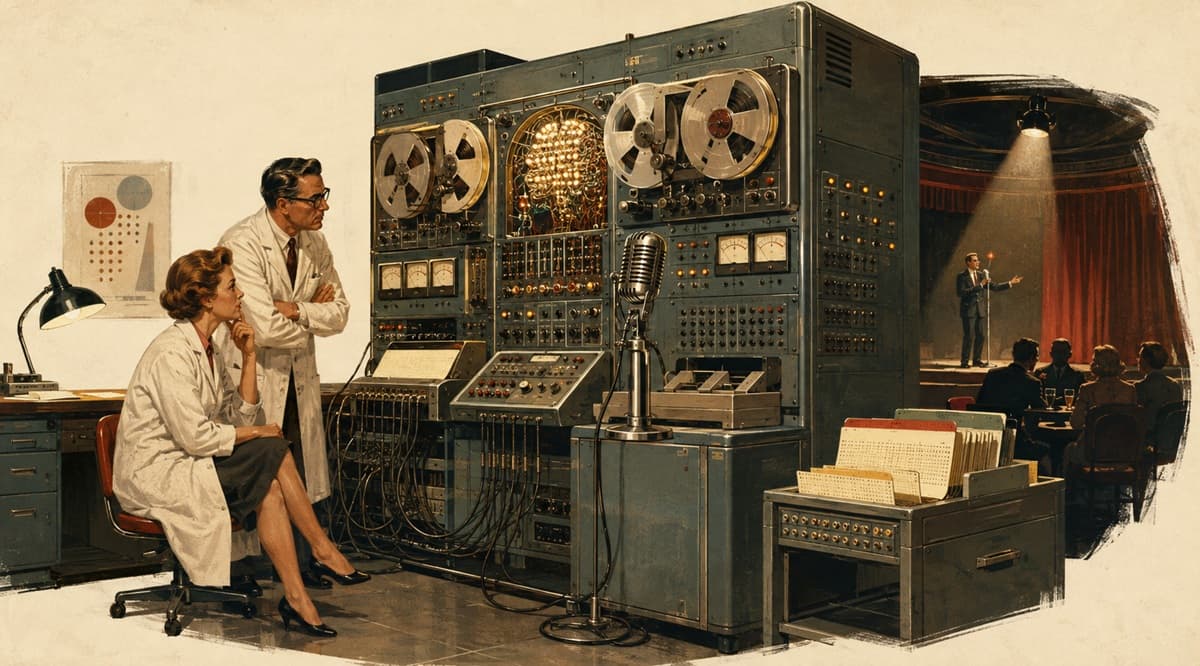
ARTFunny begins with a question that sounds simple enough to put on a laboratory clipboard: can a machine have a sense of humor? The trouble begins as soon as anyone tries to define the terms. A computer can produce a sentence that resembles a joke. A person can laugh at it. Neither event, on its own, tells us exactly what happened between pattern, context, intention, expectation, and response.
That uncertainty is the point of the site. ARTFunny explores comedy as a human craft and cultural practice while using artificial intelligence as a revealing test case. The project combines explanatory writing, historical context, structured examples, and interactive experiments. It is less interested in declaring a winner in a contest between people and machines than in asking what comedy requires in the first place.
Why Comedy Is a Difficult Test
Humor is unusually demanding because it often depends on more than literal language. A joke can require a shared assumption that is never stated. A sarcastic sentence can mean the opposite of its surface wording. A pause can matter as much as a phrase. A reference may be obvious to one audience and invisible to another. A tiny shift in tone can turn affectionate teasing into hostility, or a clever observation into a confusing one.
That makes comedy a useful lens for examining language and intelligence. Systems that are good at predicting and generating text may learn recognizable joke forms, recurring comic mechanisms, and stylistic patterns. They may also produce lines that work for real people. But comedy puts pressure on context, cultural knowledge, audience modeling, timing, ambiguity, and judgment—areas where fluent output can look more certain than the underlying interpretation deserves.
ARTFunny treats that gap as something to investigate rather than conceal.
What the Site Does
The site is organized around several connected kinds of material. Learn explains ideas such as joke structure, laughter, timing, misdirection, incongruity, wordplay, and major humor styles. History looks at comedy as a changing practice shaped by performance spaces, media, audiences, and cultural conventions. Comedians approaches major performers and writers through craft: what they did with persona, language, timing, structure, and influence rather than reducing them to generic biography.
The AI & Comedy section focuses directly on machine-generated humor. It separates observable capabilities—such as producing a plausible one-liner or identifying a likely mechanism—from larger claims about understanding, intention, emotion, or consciousness. Experiments turns many of these questions into things visitors can inspect, compare, classify, and test with live AI-assisted tools.
ARTFunny also maintains an Editorial Policy and AI Disclosure so that factual material, interpretation, generated examples, and AI-assisted production are not blurred together.
Complete Without Community Metrics
ARTFunny does not depend on visitor totals, public voting, or community leaderboards. Its core value comes from published editorial material, curated examples, interactive challenges, historical context, mechanism explanations, and transparent analysis.
That design choice matters. Interactive sites can become empty shells when community activity is treated as the content. ARTFunny instead makes every experiment useful through curated specimens, local interaction, and explanatory results.
Dataset experiments use prebuilt examples and local session scoring, while live tools use OpenAI through secure server routes. Neither format relies on fabricated visitor percentages or pretend research results.
What a Successful AI Joke Would—and Would Not—Show
If a machine produces a joke that someone genuinely enjoys, that is an interesting result. It can show that the system generated language with an effective comic structure for that person in that context. Repeated success could also tell us something about how well statistical pattern learning captures forms people associate with humor.
It does not settle every philosophical question. A humorous output does not establish that a system experienced amusement, intended the joke in a human sense, understood the audience as a person would, or possesses consciousness. Those are separate claims requiring separate evidence and clearer definitions.
The reverse is also true. A bad joke proves very little. Humans routinely produce bad jokes despite having subjective experience, cultural knowledge, and years of practice. Failure can reveal something about the attempt without becoming a verdict on an entire category of intelligence.
ARTFunny keeps the central question open because closing it prematurely would make the site less interesting and less accurate.
What ARTFunny Is Not
ARTFunny is not a generic joke generator with a science-themed coat of paint. Live generation is one part of the project, but the larger purpose is to examine humor rather than endlessly manufacture punchlines.
It is not fake science. The site may borrow the visual language of laboratories, analog meters, experiment numbers, and deadpan research notes, but editorial observations are not presented as statistical findings unless real evidence supports them. A joke rating is not converted into a universal law of comedy.
It is also not a machine for declaring which comedian, style, or joke is objectively funniest. Comedy judgments are shaped by audience, context, language, taste, timing, and culture. ARTFunny can analyze why something may work, compare mechanisms, and describe patterns without pretending taste has been solved.
Continue exploring
Continue the Investigation
Start with Learn for the mechanics and theories of comedy, visit AI & Comedy for the machine question, or explore Experiments to see how the ideas become interactive. For the standards behind the work, read the Editorial Policy and AI Disclosure.
The investigation is deliberately unresolved. That is not a missing feature. It is the subject.