Comedy as a civic performance
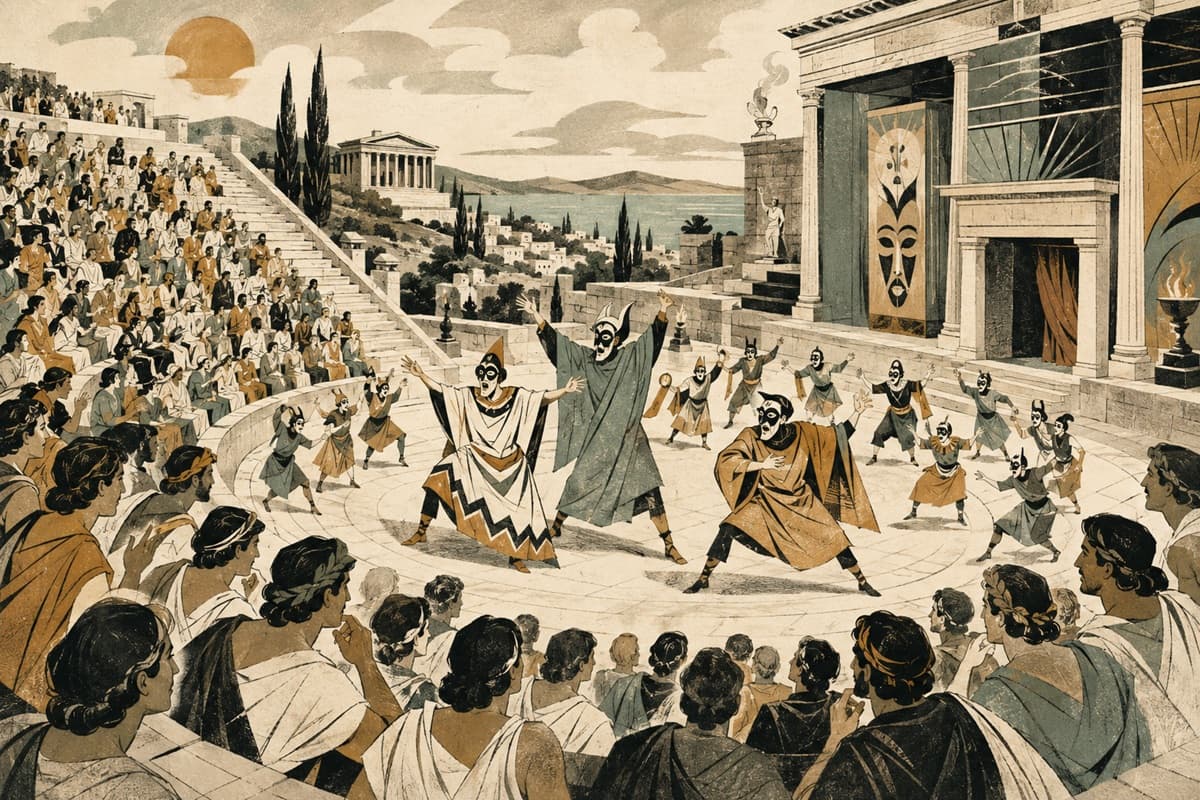
Ancient Greek comedy survives most visibly through plays presented at festivals in Athens. These were public events, not private reading exercises. Masks, costume, movement, music, chorus, and the architecture of an open-air theater all shaped the experience. The surviving scripts are therefore blueprints for performances whose sound and physical scale can only be partly reconstructed.
The genre was not one stable formula. Scholars commonly distinguish Old Comedy, especially associated with the fifth century BCE and Aristophanes, from the later New Comedy represented by Menander. The shift shows comedy moving between two modes that remain familiar: unruly topical spectacle and structured social plotting.
Old Comedy: ridicule with impossible machinery
Old Comedy could address recognizable public affairs while abandoning realism. A hero might pursue an absurdly literal solution to war, politics, philosophy, or civic frustration. Choruses could embody unlikely groups; prominent people and institutions could become explicit targets. The comic world made room for grotesque costume, bodily humor, parody, direct address, and sudden changes in dramatic frame.
Its mechanism is often a collision between a real grievance and an impossible plan. The fantasy does not remove politics; it gives political irritation a theatrical machine. Exaggeration makes an argument visible. Reversal gives an ordinary citizen implausible leverage. Parody borrows serious styles and applies them to improper material.
New Comedy: households, types, and recognition
New Comedy narrowed the frame. Its surviving examples favor invented domestic situations, love plots, family obstacles, mistaken identities, and recognizable character types. The result was less dependent on naming current political figures and more portable across time and place.
This is not necessarily a move from bold comedy to harmless comedy. Household plots can expose rules governing money, marriage, age, class, and authority. Their engines are information and status: one character knows what another does not, someone appears to occupy the wrong social position, or a recognition reorganizes relationships at the end.
What the archive cannot reproduce
Only a small fraction of ancient Greek comedy survives, and survival is not a neutral sample of what audiences enjoyed. Translation adds another filter. A pun, meter, accent, topical reference, or cultural assumption may require explanation, and explanation changes comic timing.
The plays nevertheless establish a durable lesson: comedy is simultaneously structure and event. A readable plot can show reversal and recognition, but the laugh also depended on bodies in masks, shared civic knowledge, collective attention, and a specific performance day.
Why it still matters
Old and New Comedy are not evolutionary stages that modern comedy simply outgrew. Their contrasting tools remain active. Political satire still enlarges public frustration into fantasy. Sitcoms still build intricate problems from households, desire, secrets, and recurring types. Modern comedy repeatedly travels between the public square and the private room.