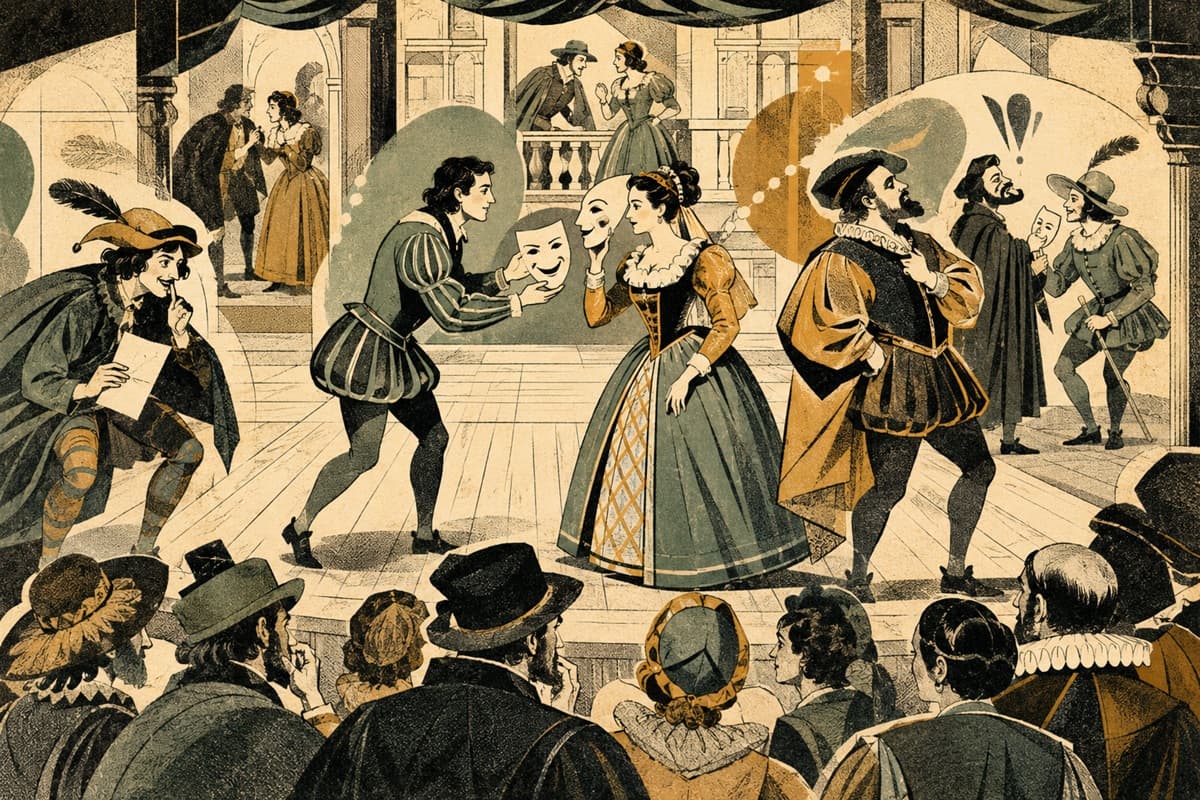
Comedy built from unstable knowledge
Shakespearean comedy is not one recipe. The label gathers plays with different tones, settings, risks, and endings. Yet many share an obsession with incomplete knowledge. Characters mistake one person for another, hide a name or gender presentation, misread language, overhear selectively, or believe an authority that the audience knows is unreliable.
That gap between audience knowledge and character knowledge is a durable comic resource. It lets spectators anticipate collisions. The laugh can arrive before a revelation because the audience sees the machinery moving toward it.
Mistaken identity and the double
The Comedy of Errors intensifies a Roman source by giving the plot two sets of twins. The premise is mechanical in the best sense: every entrance can place the right body before the wrong interpretation. Repetition increases pressure, while small changes keep the confusion from becoming static.
Disguise in other comedies creates more than plot difficulty. It changes what a character is permitted to say, tests the stability of desire, and exposes how much social judgment depends on appearance. A restored identity may organize the ending, but the play has already demonstrated that identity can be performed and misread.
Puns as forks in the road
Shakespeare's wordplay is not decorative frosting. A pun makes one utterance support multiple routes of interpretation. Characters use verbal ambiguity to flirt, evade, compete, insult, and display intelligence. The effect depends on pronunciation, historical meaning, and pace; a footnote can identify the branches but cannot recreate the instant in which both meanings become active.
The fool often has special permission to manipulate those branches. Low status may provide cover for criticism, while “folly” becomes a position from which supposedly sensible behavior can be diagnosed.
Status and temporary worlds
Many comedies move characters away from an ordinary social environment into a forest, festival, night, or unfamiliar city. The alternative space loosens rules. Rank becomes uncertain, desire can be rehearsed under disguise, and a normally subordinate figure may control the scene.
Comic endings often return toward marriage, recognition, or civic order. That restoration should not erase the experiment. The audience has watched the social system operate under altered information and knows it could have arranged itself differently.
Reading versus performance
On the page, readers can pause over a pun. In performance, voice, gesture, blocking, costume, and audience response decide whether the moment is playful, cruel, anxious, or intimate. The same line may function differently when a production changes period, casting, or pace.
This is also why mechanical imitation has limits. A model can reproduce a pattern of ornate insult or mistaken identity. It cannot infer a definitive performance from text alone, because no definitive performance is stored there.