Field questions
Frequently Asked Questions
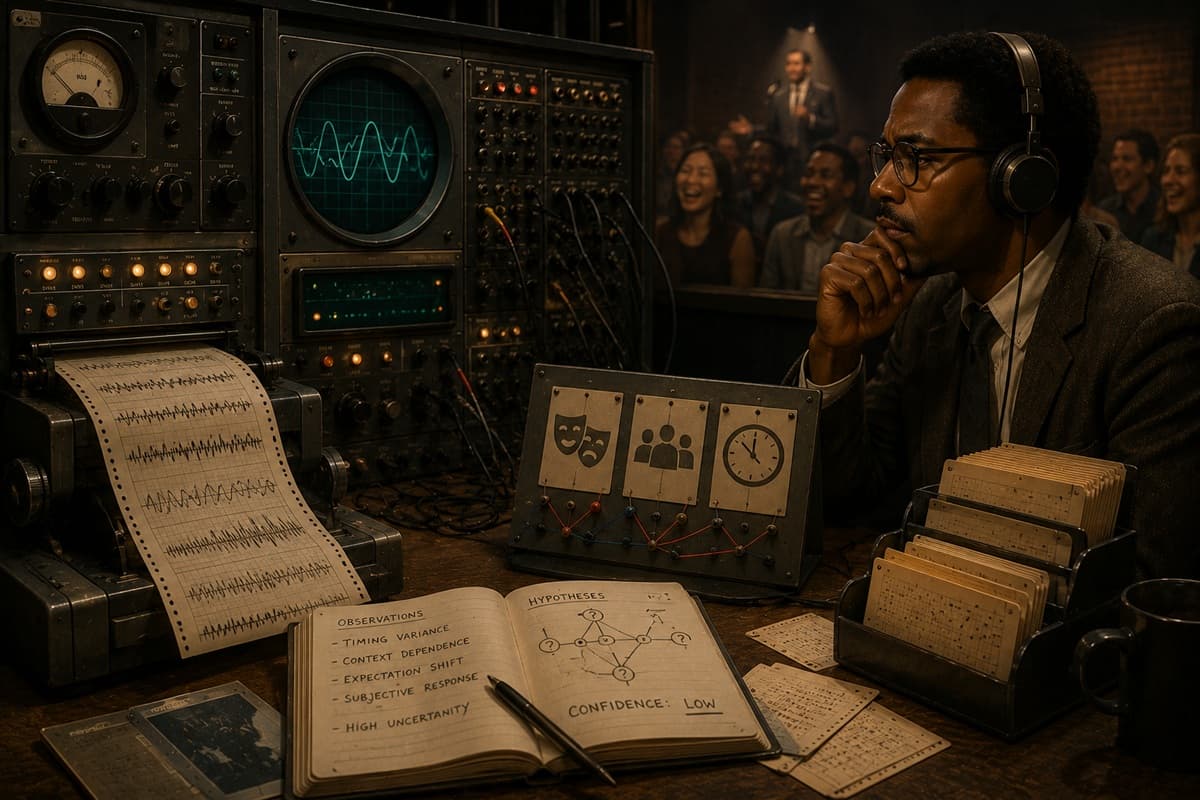
ARTFunny is an editorial website and interactive comedy laboratory. It studies how jokes work, how comedy changes across people and media, and what artificial intelligence can and cannot reveal about humor.
This page explains the site's purpose, current technology, interactive AI features, privacy posture, and limits. The short version: ARTFunny uses modern web software and carefully labeled AI tools to make comedy easier to inspect without pretending that funniness has become an exact science.
What is the purpose of ARTFunny?
ARTFunny investigates the question, "Can a machine have a sense of humor?" by first asking what humor requires from anyone. The site combines comedy theory, joke structure, history, performer studies, mechanism guides, and interactive experiments.
The goal is not to declare humans or machines the winner. It is to help visitors notice setup, expectation, timing, misdirection, context, wordplay, persona, and audience response. AI is both a subject of that investigation and a tool used in several clearly labeled experiments.
What can visitors do on the site?
Visitors can read the Learn, History, Comedians, Mechanisms, and AI & Comedy collections. They can also use eight stations in the Experiments laboratory.
Some experiments present curated examples and keep temporary scores in the browser. Others accept a topic, premise, or joke and request a live AI-generated result. No account is required.
What technology powers ARTFunny?
ARTFunny is built with the Next.js App Router, React, TypeScript, and custom responsive CSS. Next.js renders the public pages, metadata, sitemap, server components, and secure server endpoints used by the live tools.
Editorial pages are stored as Markdown with validated frontmatter and rendered with Gray Matter and Remark. Structured experiment content and fallback examples use JSON. Zod validates live tool inputs and structured AI responses. Images are served through the Next.js image system, and JSON-LD supplies structured metadata for search engines.
The site does not require a visitor account or a community-results database. Its published articles, curated datasets, and prebuilt demonstrations remain useful independently of visitor traffic or model availability.
Which experiments use live AI?
Four experiences can request live OpenAI output:
- Comedy Lab generates a joke from a subject, comedy type, tone, and surprise level.
- Make It Funnier transforms an ordinary premise into several comic treatments.
- Explain a Joke produces structured, interpretive analysis of a submitted joke.
- Comedy DNA offers optional live profiling using the same dimensions shown in its curated examples.
Human or AI?, Joke Autopsy, Humor Dial, and Sarcasm Test use curated datasets rather than calling a model for each interaction.
What happens when I submit text to a live AI tool?
The browser sends the form to an ARTFunny server endpoint. The server checks that the request came from the site, applies input-size and field validation, enforces a request limit, and sends the submitted text through OpenAI moderation before generation or analysis.
If the input passes those checks, the server calls the OpenAI Responses API and requests a structured result matching the tool's schema. The validated result is returned to the browser and labeled as live AI output. The OpenAI API key remains on the server and is never included in browser code.
Which AI model does the site use?
The provider is OpenAI. The current deployment is configured to use gpt-5.6-luna through the server-only AI_MODEL environment variable. That configuration can change as models and site requirements evolve, so the live response metadata is the most direct record of the provider and model used for a request.
OpenAI's omni-moderation-latest model is used separately to screen visitor input before a generation or analysis request proceeds.
Does ARTFunny save submitted jokes or premises?
ARTFunny does not create accounts, maintain a visitor submission history, or store live tool requests in a site database. OpenAI Responses API calls are made with application storage disabled through store: false.
Visitor text still passes through the site's hosting infrastructure and OpenAI. Normal security logs, provider abuse-monitoring practices, legal requirements, and provider retention controls may apply. Do not submit confidential, identifying, or sensitive information. See the Privacy Policy and AI Disclosure for the controlling details.
How does the site handle safety, abuse, and unreliable output?
Live endpoints use same-origin checks, input limits, schema validation, moderation, request throttling, timeouts, and handled error states. The current application limit is ten AI requests per network address during a ten-minute window, although deployment architecture can affect how that limit is applied.
These controls reduce risk; they do not make generated content perfectly safe or correct. AI jokes and explanations can be dull, inaccurate, culturally insensitive, overconfident, or simply unfunny. Live responses are not reviewed before they appear, and analysis is presented as interpretation rather than fact.
How is Today’s Machine Joke selected?
The homepage selects one original, editor-reviewed machine specimen from ARTFunny's local collection using the current UTC day. The first specimen remains stable throughout that day, and visitors can browse the rest of the curated set with the Next specimen control. No third-party joke feed or live model request runs while the homepage renders.
Are the experiment results scientific research?
No. ARTFunny uses the visual language of a retro-futurist research bureau, but its experiments are educational demonstrations and interpretive tools. Local scores do not become community statistics, and the site does not infer population-level conclusions from visitor interactions.
Comedy varies with audience, context, culture, language, delivery, and taste. The site can identify plausible mechanisms and patterns without turning those observations into universal measurements of funniness, intelligence, or understanding.
Continue exploring
Continue the Investigation
Read About ARTFunny for the broader mission, the AI Disclosure for provenance and model limitations, the Privacy Policy for data practices, and the Editorial Policy for publication standards. To try the technology directly, visit Experiments.