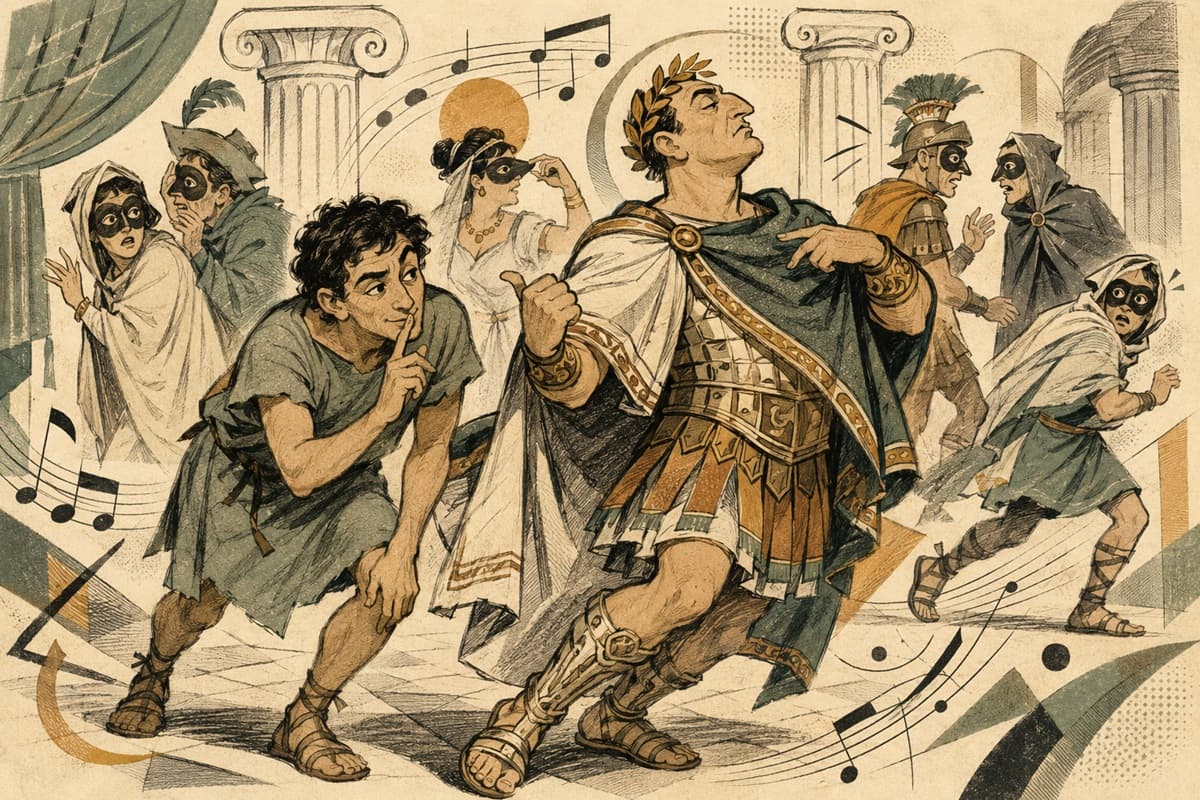
Adaptation as invention
The best-known surviving Roman comedies are associated with Plautus and Terence. They drew heavily on Greek New Comedy, but “adaptation” should not imply passive copying. A plot changes when it moves into another language, performance culture, and civic setting. Roman comedy made inherited situations work through Latin verbal texture, music, pacing, and audience expectations.
The plays commonly involve young lovers, obstructive authority figures, courtesans, parasites, boastful soldiers, mistaken identities, lost children, and clever enslaved characters. Those roles are not neutral. They reflect a hierarchical society in which status controlled freedom and vulnerability. A modern reading can examine the brilliance of the comic construction without treating its social order as innocent scenery.
The scheme as comic engine
Roman plots frequently run on unequal information. A clever character invents a story; another accepts it; the audience watches both the deception and the threatened exposure. This creates two tracks of attention. Inside the scene, the false account must appear credible. Outside it, viewers enjoy seeing how narrowly the construction avoids collapse.
That structure supports rapid escalation. One lie requires another, a prop becomes evidence, and a character enters at the least useful moment. Reversal is built into the social arrangement: a person with little formal authority may temporarily direct everyone else because they understand the situation better.
Language, music, and performance
Plautine comedy is especially associated with energetic language and varied musical form. Alliteration, repeated sounds, insults, lists, invented words, and changes of register can create effects that no plot summary captures. Translators must decide whether to preserve literal meaning, recreate a verbal trick, or build a new joke that performs a similar function.
Masks and conventional character types helped spectators recognize roles quickly. Recognition made variation possible: once an audience understood the boastful soldier or cunning servant, a playwright could satisfy, stretch, or reverse the expectation attached to the type.
A long afterlife
Roman comedy supplied plots and character relationships that later playwrights repeatedly transformed. Shakespeare's The Comedy of Errors draws on Plautine twin-confusion. European stage comedy, farce, musical theater, and situation comedy all reuse versions of the blocked romance, false identity, overheard plan, and status reversal.
The influence is structural rather than a claim that every later writer directly read the same plays. Comic forms travel through translation, teaching, performance, imitation, and familiar convention. By the time a device seems obvious, its route may be difficult to see.
What an AI can and cannot take from it
A model can identify roles, map who knows what, and produce variations on a deception plot. The harder problem is performance judgment: how long confusion remains pleasurable, when a stereotype becomes merely stale or harmful, and how sound and social context make a line work for a particular audience.