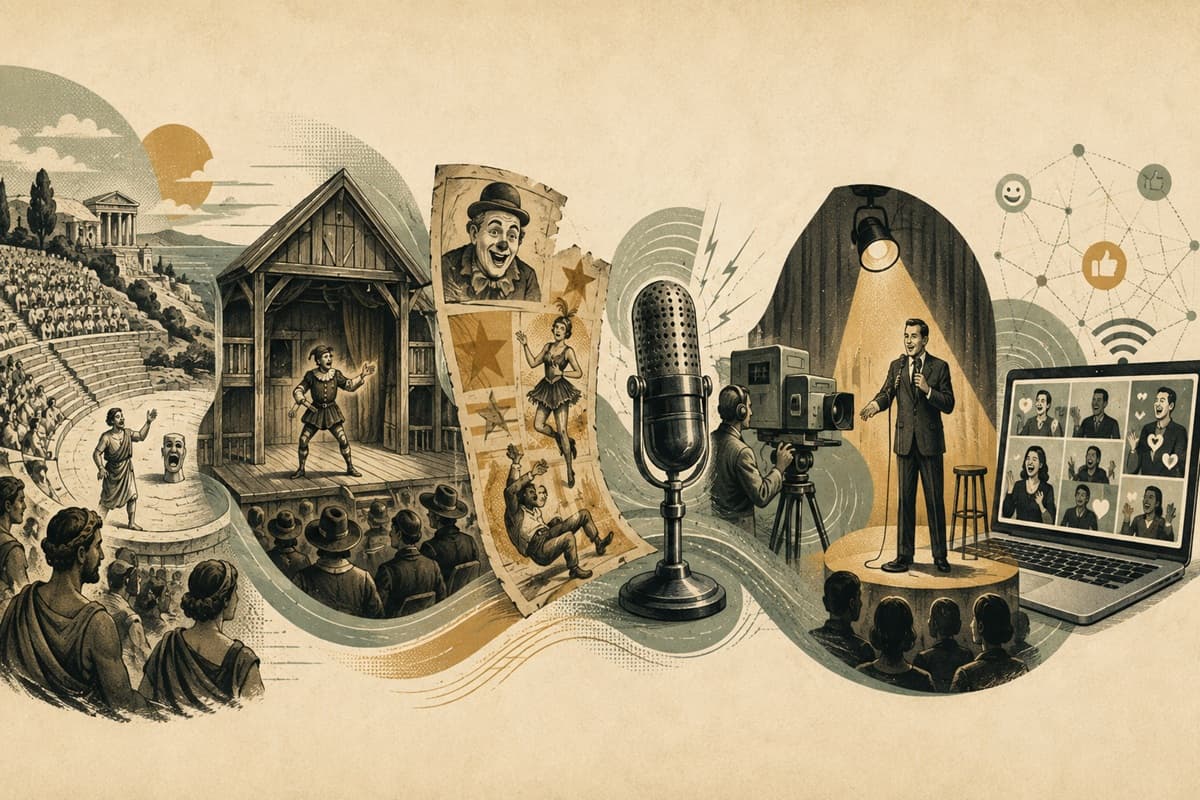
A history with missing pages
Comedy is older than any surviving comedy archive. People almost certainly teased, imitated, exaggerated, and played with language long before anyone preserved a comic script. What remains is selective: plays copied by later readers, printed joke books, recordings, films, broadcasts, and digital traces. A history of comedy must therefore describe evidence, not pretend that the evidence contains every laugh.
The surviving record also reflects power. Institutions preserved some writers and performers while routine, local, domestic, and marginalized comic practices disappeared. Comedy history is not a march from primitive jokes to sophisticated ones. It is a set of recurring techniques—misdirection, parody, reversal, bodily mishap, status play—adapted to new rooms and social rules.
Public theater and literary comedy
Ancient Greek festivals gave comedy a formal theatrical setting. Old Comedy, associated with Aristophanes, could be fantastical, topical, and openly mocking. Later New Comedy shifted toward household plots, recognizable character types, romance, and social complication. Roman playwrights including Plautus reworked Greek models for Roman audiences, helping circulate plots built around disguise, blocked desire, clever servants, and mistaken identity.
European comic traditions later mixed classical inheritance with popular performance. Shakespeare's comedies combine wordplay, disguise, misrecognition, status reversals, and endings that restore a changed social order. Print made scripts and comic prose easier to preserve, but comedy remained inseparable from live bodies, accents, timing, and audience response.
Stages, circuits, and mass audiences
Nineteenth- and early twentieth-century variety stages assembled short acts: monologues, sketches, songs, dances, impressions, and physical business. Vaudeville rewarded portable material and reliable timing. Its performers and routines moved into recorded sound, film, radio, and television. That transition was creatively fertile, but it also carried stereotypes and discriminatory traditions that modern histories must identify rather than nostalgically edit away.
Silent film made visual action legible across language boundaries. Charlie Chaplin, Buster Keaton, and other screen comedians developed precise relationships among body, camera, prop, and cut. Radio then removed the visible body and made voice, rhythm, recurring characters, sound effects, and the listener's imagined scene central.
Television, stand-up, and the networked joke
Television combined domestic intimacy with mass distribution. Sitcoms built comedy from recurring characters and situations; variety and sketch shows condensed ideas into repeatable formats. Recorded stand-up placed a distinct persona and point of view at the center. By the mid-twentieth century, performers such as Mort Sahl were treating current affairs and social criticism as material for a modern conversational monologue.
Internet comedy changed distribution again. A joke can now be copied, captioned, remixed, and detached from its first author within hours. Memes often behave less like finished works than shared templates. Short video restores voice and gesture, while comment threads create rapid feedback and collaborative variation.
What persists
Media change, but several problems remain: how to build an expectation, when to break it, what an audience already knows, who is allowed to ridicule whom, and how performance makes language mean more than its literal content. Comedy's history is most useful when it shows those continuities without flattening cultural difference.