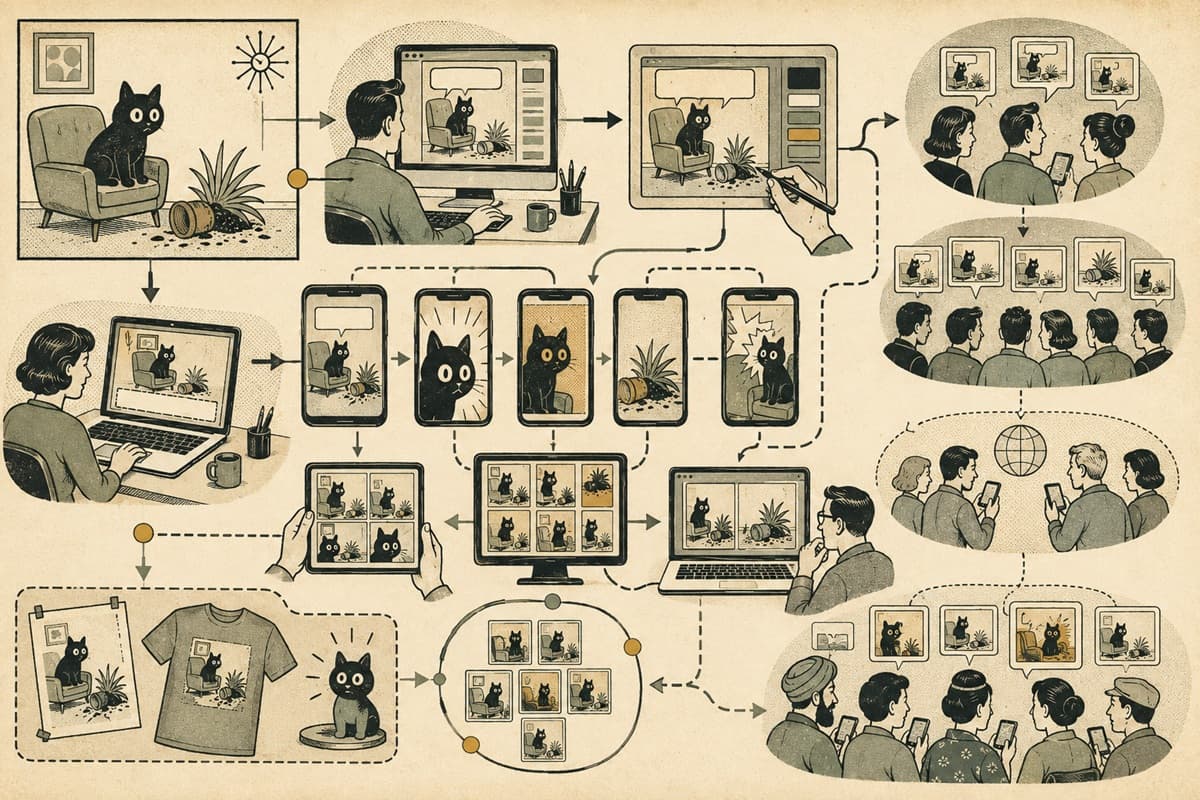
Distribution becomes part of the form
The internet did not invent short jokes, visual captions, parody, or participatory humor. It changed their speed, scale, traceability, and mutability. A comic object can be published, copied, detached from its source, recaptioned, translated, and fed back into another community while the original moment is still unfolding.
“Internet comedy” therefore describes an environment as much as a genre. It includes text posts, forums, webcomics, animated loops, image macros, reaction images, edited clips, podcasts, short video, livestreams, and forms that disappear with the platforms that hosted them.
Animal video culture is one recognizable branch of online entertainment: curated cat clips at Kitty Vids and dog and puppy clips at Puppy Vids show how simple subjects become renewable, highly shareable short-form collections.
The meme as template and behavior
Media scholar Limor Shifman's account of internet memes emphasizes groups of related digital items that circulate through imitation and transformation. The unit is not only one successful image. It is a family of versions and the shared practice of making another.
Template knowledge functions like stored setup. A viewer who recognizes the image, sound, or format arrives with expectations. A creator can then change one variable. For outsiders, the same post may be unreadable because the setup lives in earlier versions rather than in the object itself.
Platform-shaped timing
Feeds, ranking systems, character limits, vertical screens, autoplay, and moderation rules influence comic form. Creators learn how quickly a premise must become visible, where captions remain readable, and which sounds or formats a platform currently distributes. Metrics supply immediate but incomplete feedback: views and shares do not reveal one stable reason that people responded.
Context collapse creates further risk. Material intended for a small group can reach an audience that lacks the shared assumptions that made it playful. Irony markers fail, satire is read literally, and a joke's target can become ambiguous when reposted without its first speaker.
Authorship, remix, and labor
Online humor often depends on collective variation, yet platforms can obscure origin and reward aggregators. Remix complicates simple ownership narratives without eliminating creative labor. Moderation, harassment, and unequal visibility also shape who can participate safely.
Archives face technical problems: link rot, deleted accounts, changing interfaces, and interactive material that a screenshot cannot preserve. The Library of Congress Web Cultures Web Archive treats memes, GIFs, emoji, and related vernacular forms as cultural records worthy of preservation.
AI enters the circulation loop
Generative systems can produce captions, images, voices, and variations at enormous volume. That makes selection and provenance more important. Pattern imitation can recreate a format while missing why a community used it, whether the reference is current, or who becomes the target when context changes.
Internet comedy makes one thing especially clear: a joke is not finished when it is generated. Meaning continues to change through circulation.