A temporary world
A sketch creates a comic situation for minutes rather than seasons. It must teach the audience enough to recognize the ordinary pattern and whatever is wrong with it. Once that “game” is legible, repetition, escalation, reversal, and character commitment can develop it.
Short comic scenes long predate modern sketch institutions. Vaudeville bills included bits and sketches alongside monologues, songs, and physical acts. Revue, music hall, radio variety, and theatrical ensembles supplied additional routes. The form's history is therefore a network of practices rather than a single invention.
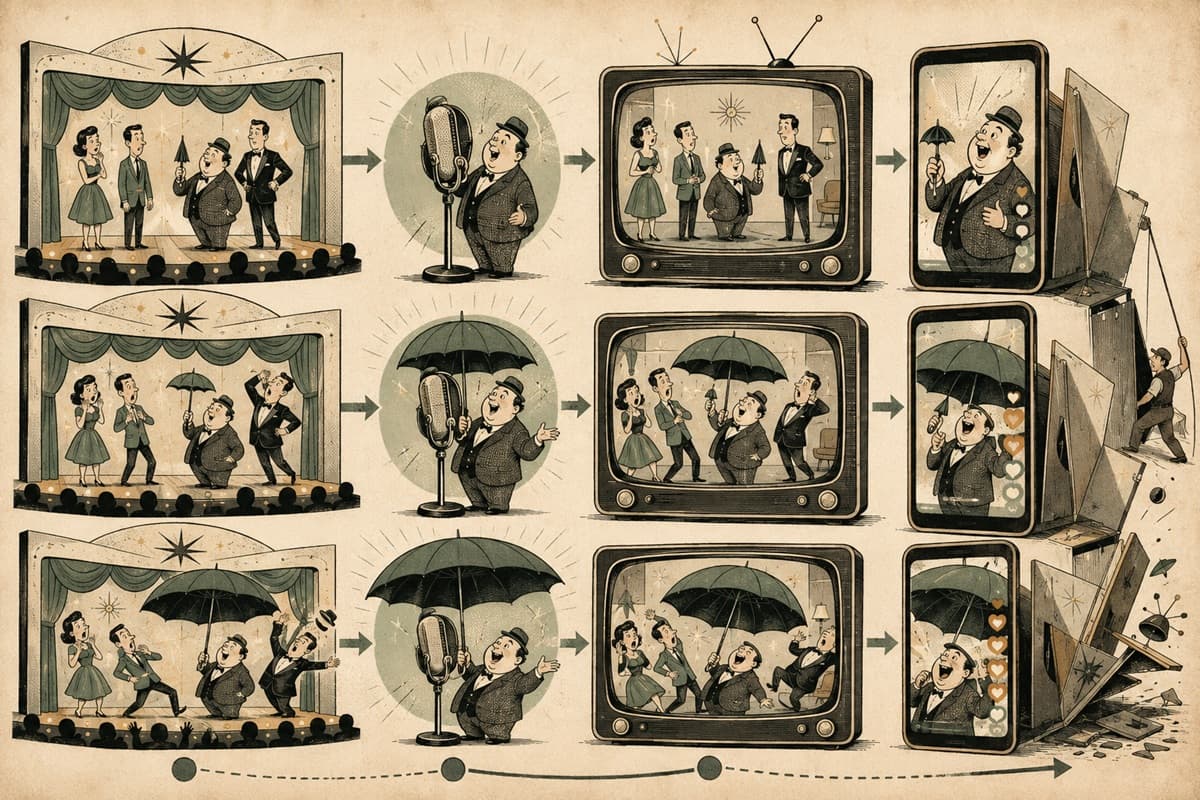
From variety stage to broadcast
Radio sketches used vocal character and sound to establish worlds quickly. Television restored the body and added camera, costume, set, edit, and prerecorded insert. Variety programs placed sketches among music and monologue; ensemble shows developed recurring characters and shared performance languages.
Topical television sketch faces a special clock. It may be written, rehearsed, and performed while a news event is still fresh. Immediacy produces energy but also increases the risk of shallow premise, unexamined assumption, or a reference with a very short shelf life.
Repetition, escalation, exit
Many sketches begin by repeating an abnormal behavior until every participant's relationship to it is clear. Escalation can increase stakes, introduce an even stranger consequence, or reveal that the apparent exception governs the entire world. The ending is difficult because the form cannot always resolve its premise; it may instead find the strongest final turn and stop.
Recurring characters complicate this compactness. Recognition allows a later sketch to begin faster, but familiarity can harden into catchphrase delivery. Strong recurrence adds a new pressure rather than merely reproducing the first success.
Institutions and voices
Sketch is often collaborative. Writers, performers, directors, designers, and editors shape the same few minutes. Company culture affects whose premise is developed and whose experience is legible to the room. Accounts centered only on famous performers miss that production network.
Online video lowered distribution barriers and removed fixed broadcast length. A sketch can be thirty seconds or twenty minutes, designed for vertical framing, or discovered through a recommendation feed. The basic challenge remains: establish the temporary rules quickly enough that their violation is perceptible.
A machine-readable form—with limits
Sketch structure is attractive to generative systems because a premise can be stated and varied. But literal escalation is not sufficient. The form needs selection: which repetition deepens the idea, when a social target has shifted, and whether the performers' commitment makes an absurd world feel coherent.