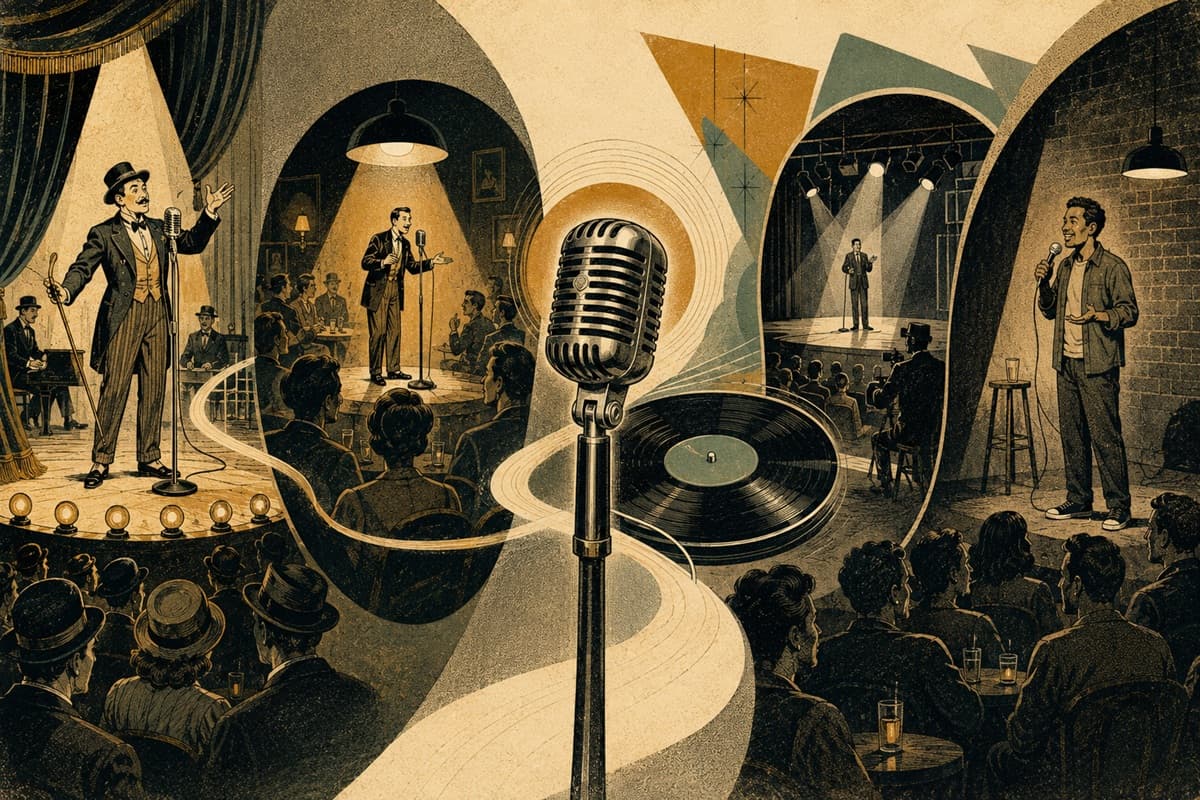
One person, one audience, many ancestors
Stand-up has no uncontested starting point. Comic monologues existed in variety theater, music hall, vaudeville, minstrel performance, recorded routines, radio, and nightclub entertainment. What became modern stand-up drew from those traditions while changing the apparent relationship between speaker and material.
The performer increasingly appeared to speak as a distinctive self—or a carefully constructed version of one—rather than simply recite detachable jokes. Persona, social point of view, confession, argument, and observation could organize a set.
From routine to point of view
Vaudeville monologists often relied on compact, repeatable material. Radio and comedy records allowed a voice to reach people outside a room. Nightclubs supported longer, more conversational performances. The Library of Congress identifies Mort Sahl's 1955 album At Sunset as a landmark of modern stand-up and describes Sahl, Lenny Bruce, and Lord Buckley as part of a more thought-provoking vanguard.
That history does not replace joke craft with seriousness. It changes what can count as the setup. A performer's politics, biography, mood, or ongoing relationship with an audience may provide the frame in which a line works.
Albums, clubs, and broadcast
Comedy albums made sets replayable and helped establish national reputations. Clubs created testing grounds where material could be revised through repeated performance. Television offered exposure but imposed time limits and content standards. Later cable specials allowed longer forms and broader language; streaming and online video altered distribution again.
These media shape writing. A short television appearance rewards quick legibility. A club set can refer back to an earlier exchange. An album can be heard without facial information. A filmed special can use editing and camera selection even when it presents itself as a direct record of a live event.
Persona, truth, and construction
Stand-up invites audiences to treat the speaker as unusually direct, but apparent spontaneity can be extensively prepared. A story may compress events, a pause may be rehearsed, and a conversational tangent may return to a planned line. This does not make the form dishonest. Construction is one of the ways a performer creates the experience of presence.
At the same time, identity and social position affect how material is heard. The identical sentence does not become the identical act when the speaker, audience, or historical moment changes.
What the form tests
Stand-up strips comedy down without making it simple. It tests language, timing, authority, trust, and room reading in public. A machine can generate lines in the surface form of a set. The harder challenge is sustaining a coherent persona, responding ethically to a live audience, and knowing when the room has changed the meaning of prepared material.