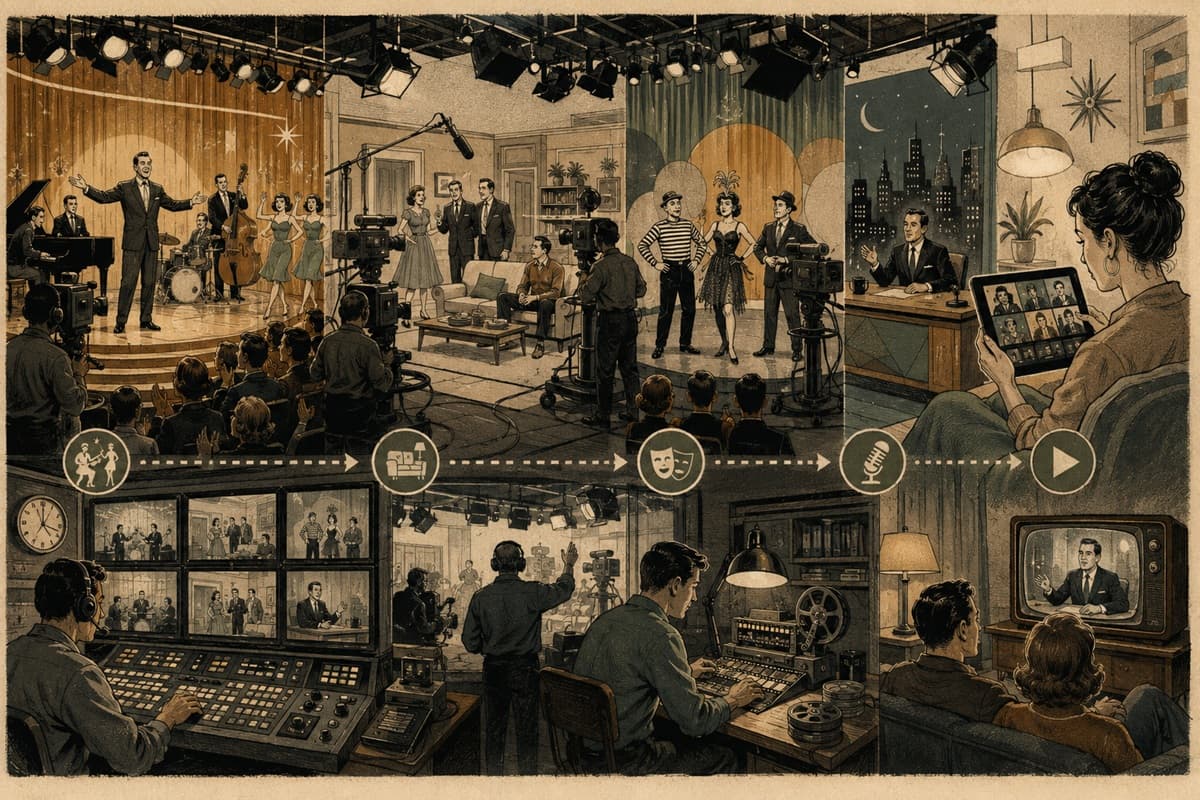
A new room for older forms
Television comedy inherited monologues, sketches, characters, musical variety, situation plots, and physical performance from stage, radio, and film. Its novelty lay in how those forms entered the home through a scheduled visual broadcast. A performer could become nationally familiar without sharing a physical room with most viewers.
Adoption was rapid in the United States: Library of Congress research notes that television ownership rose from a small minority of households in 1950 to a large majority by 1960. That scale gave comic programs enormous cultural reach while concentrating decisions in networks, sponsors, standards departments, and production systems.
Live pressure and recorded control
Early programs often preserved the energy and risk of live variety. Television also developed production practices that made comedy repeatable. I Love Lucy is closely associated with a three-camera approach before a live audience and with the preservation of episodes on film. Multiple cameras could retain performance continuity while giving editors usable angles.
The laugh track and studio audience became contested signs. Laughter can function as evidence of a shared event, a rhythm cue, a production convention, or manipulation. Its presence does not prove a joke worked universally; its absence does not make a format more authentic.
Sitcom, variety, sketch, satire
Television supported several comic architectures. The sitcom accumulated meaning across recurring relationships. Variety shows presented changing acts under a host's stable identity. Sketch shows moved quickly among premises and characters. Satirical programs used topical imitation, fake news structures, and political caricature.
Scheduling influenced form. A fixed episode length encourages multiple story beats and act breaks. Weekly production makes topical material possible but creates pressure. Reruns reward durable character dynamics; late-night monologues reward immediate recognition.
Who appeared and who decided
Television comedy also records changing, incomplete access to production and representation. Casting, ownership, advertising assumptions, and broadcast standards shaped which lives appeared as ordinary and which became the object of a joke. Later cable, independent channels, and streaming widened some routes while creating new forms of gatekeeping.
Fragmentation and streaming
The mass simultaneous audience has partly fragmented into channels, clips, archives, and on-demand viewing. A sketch may reach more people as an isolated online video than in its original broadcast. Binge viewing changes the distance between callbacks. Streaming removes some scheduling constraints but adds platform metrics and global circulation.
Television's history shows that comedy technique cannot be separated from delivery infrastructure. The joke on the page is only one component; cameras, edit points, audience sound, release schedule, and social context all participate.