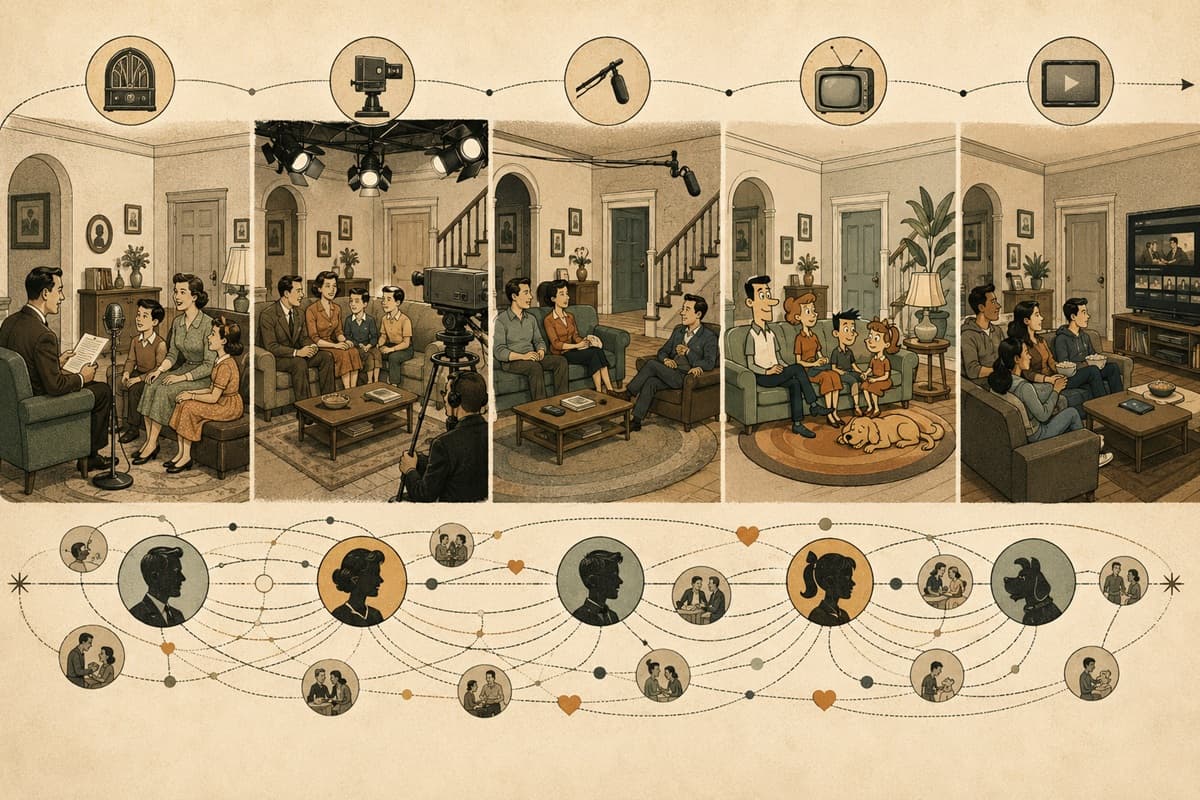
The repeatable comic world
“Situation comedy” names a durable structure: recurring characters encounter new complications within a familiar social world. The situation is not simply an apartment, workplace, or family. It is the network of expectations attached to those people and places. Once viewers understand what a character wants and habitually does wrong, a small deviation can carry a large payoff.
Radio helped establish recurring domestic and workplace comedies before television gave those worlds visible sets. The transfer was sometimes direct: the radio program My Favorite Husband formed part of the development history of I Love Lucy.
Production becomes form
The Library of Congress credits director Marc Daniels and cinematographer Karl Freund with helping establish I Love Lucy's three-camera filming before a live audience as a standard sitcom practice. This was more than a technical footnote. It supported continuous ensemble performance while capturing different framings, and film preservation made high-quality rebroadcast practical.
Multi-camera and single-camera sitcoms developed different rhythms rather than a simple hierarchy. Multi-camera production can emphasize entrances, exits, stage geography, and audience response. Single-camera production can use location, close detail, montage, and editing as comic tools. Animation removes physical production limits while retaining recurring character logic.
Character as stored setup
A pilot must teach viewers a world. Later episodes can spend that accumulated knowledge. A character's confidence, anxiety, vanity, or literalness becomes a stored setup that needs only a cue. Running gags and callbacks reward memory, but repetition without development can reduce a character to a device.
The form also balances change against reset. Some series return close to the original arrangement after each episode. Others serialize relationships and consequences. Streaming has made longer arcs easier to follow, while syndication historically rewarded episodes that could be watched in many orders.
The “ordinary” household is political
Sitcoms repeatedly define what counts as a normal family, workplace, friendship, neighborhood, or life problem. Those definitions change. Representation can expand the set of lives treated as central, but a series can also use difference as a shortcut or stereotype. The domestic scale does not make the form socially trivial.
Why sitcom mechanics matter to AI
A language model can reproduce scene-level patterns: misunderstanding, escalation, entrance, reveal. Sustaining a sitcom is harder. It requires consistent character memory, controlled change, relationship-specific language, and judgments about when continuity should outweigh the immediate joke. A locally funny line can damage the long-term world that gives future lines meaning.