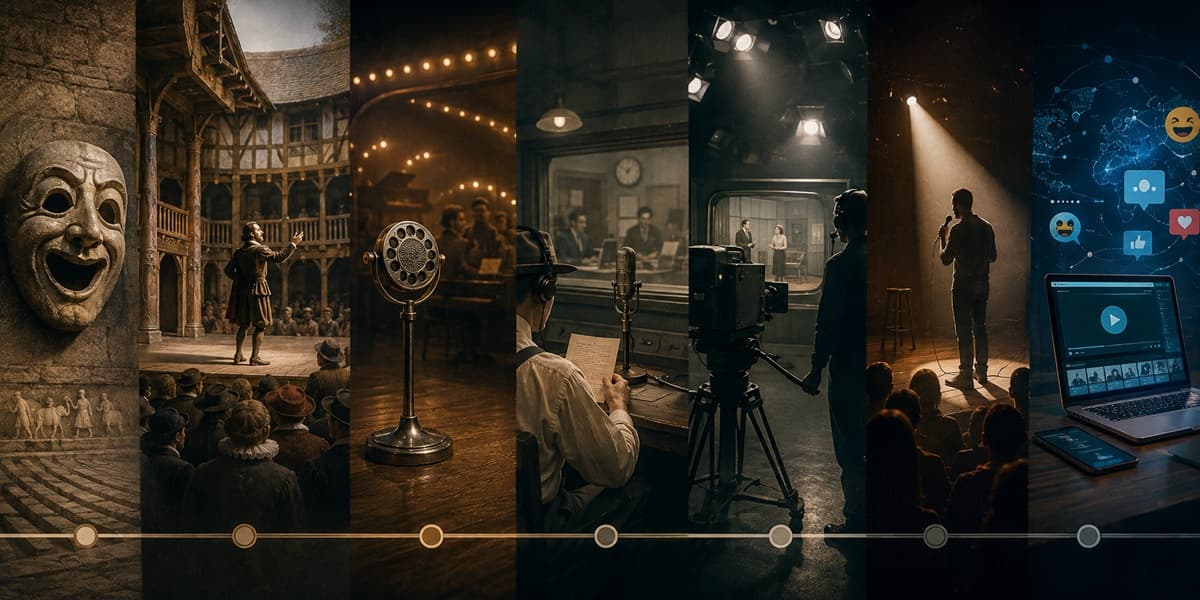
The invisible stage
Radio comedy did not merely transmit stage comedy without pictures. It created a medium-specific relationship among voice, microphone, sound effect, music, silence, and listener imagination. A door did not need to exist physically if the right sound and response made an audience construct it.
Network broadcasting brought recurring programs into homes on schedules. Familiarity became a comic resource. Listeners learned a character's vanity, thrift, confusion, or catchphrase, so a small cue could activate a larger history.
Inherited forms, changed tools
Radio drew performers and formats from vaudeville and variety entertainment: monologues, comic teams, musical interludes, sketches, and character routines. The microphone changed delivery. Intimacy could replace projection, and vocal difference had to establish people who could no longer be distinguished by costume or blocking.
Sound effects made objects and settings available, but they also exposed the artificiality of the scene. Comedy could use a sound literally, exaggerate it, delay it, or let a character misunderstand it. Silence became visible in the listener's mind.
Recurrence and the running gag
Serialized listening supported repetition. A character might enter with a familiar pattern, and the audience could enjoy both prediction and variation. Catchphrases are sometimes dismissed as automatic laughs, but their effect depends on placement and accumulated relationship. Recognition supplies pleasure; deviation restores surprise.
Programs such as Fibber McGee and Molly, The Jack Benny Program, and Duffy's Tavern illustrate different balances of situation, character, wordplay, and performance. The Library of Congress's NBC collections document how comedy shared the schedule with music, drama, news, and variety.
Limits in the surviving record
The archive is incomplete. Some broadcasts were never recorded; others survive in formats requiring preservation. Scripts can reveal structure but not exact performance. Surviving programs also contain racial, ethnic, and gender stereotypes that reflect broadcasting institutions and audience assumptions of their periods.
From radio to television and podcasting
Many radio formats and performers moved to television, where recurring characters gained visible environments. My Favorite Husband, for example, became part of the development path toward I Love Lucy. Yet audio comedy never disappeared. Recorded albums, public radio, and podcasts continue to exploit a listener's willingness to build a scene from voices.
For AI, audio comedy illustrates why a transcript is incomplete data. A system may parse the words while missing vocal identity, acoustic expectation, and the precisely measured silence that made them funny.