callback in comedy
Callback
A callback makes the past suddenly useful: an earlier detail returns in a new context and proves that the performance remembers itself.
See callback at workAn encyclopedia of comic technique
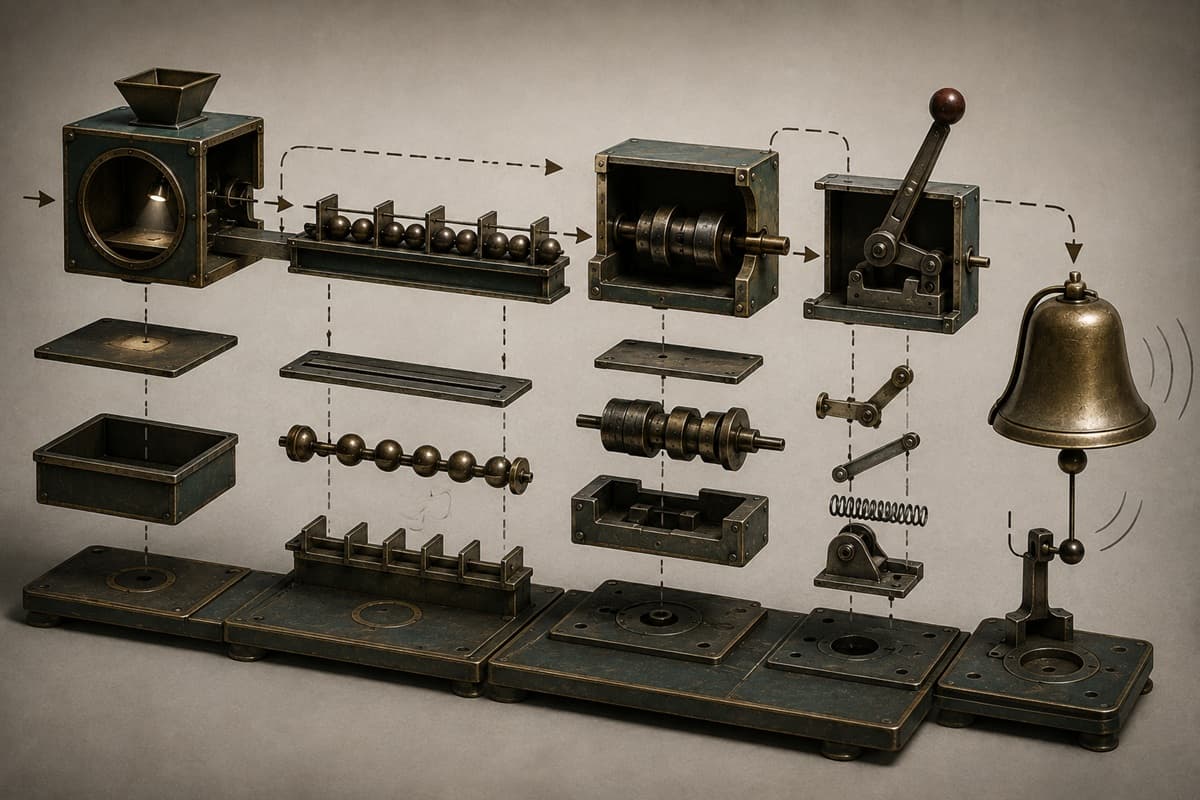
Comedy mechanisms are recurring ways of arranging expectation, language, information, rhythm, and response. They are useful because they give us something more precise to discuss than “that part was funny.” They are also dangerous if treated like recipes. Misdirection does not guarantee laughter. Repetition can build a callback or merely repeat a weak line. Exaggeration can sharpen an observation or bury it.
ARTFunny uses mechanisms as analytical tools. A joke may contain several at once, and different readers may reasonably emphasize different ones. The point is to describe what the material is attempting, not to stamp it with a laboratory certification of funniness.
Mechanism index
Ten practical entries define recurring comic mechanisms, show how they work, identify common failure modes, and connect them to larger theories.
callback in comedy
A callback makes the past suddenly useful: an earlier detail returns in a new context and proves that the performance remembers itself.
See callback at workexaggeration in comedy
Exaggeration changes degree until a hidden attitude or pattern becomes impossible to ignore.
See exaggeration at workincongruity in comedy
Incongruity is a perceived mismatch, but comedy depends on how that mismatch is framed, resolved, and judged by an audience.
See incongruity at workmisdirection comedy mechanism
Misdirection does not simply hide information; it makes the audience help build the wrong but reasonable interpretation.
See misdirection at workrepetition in comedy
Repetition converts an event into a pattern; comedy emerges from recognition, intensification, or the precise moment the pattern changes.
See repetition at workreversal in comedy
Reversal makes a relationship travel in the opposite direction: controller becomes controlled, judge becomes judged, or solution becomes problem.
See reversal at workrule of three comedy
The comic triple is compact pattern engineering: establish, confirm, then use the third beat for a satisfying variation or break.
See rule of three at workcomic timing
Timing is information architecture in time: when the audience receives a cue, how long it predicts, and where response is allowed to happen.
See timing at workunderstatement in comedy
Understatement creates a gap between visible scale and verbal response, inviting the audience to supply the missing intensity.
See understatement at workwordplay in comedy
Wordplay makes language display more than one usable path at once, turning ambiguity from a problem into the event.
See wordplay at workA reversal can also create incongruity. A rule-of-three structure can use repetition to make the third item feel predictable before misdirection breaks the pattern. A pun can depend on ambiguity while timing controls when the second meaning becomes visible. Deadpan delivery can make exaggeration funnier precisely because the performance refuses to acknowledge the absurd scale.
This overlap matters when comparing human and machine comedy. A model may correctly identify several mechanisms yet still miss which one the audience actually experienced as central. Analysis is therefore best treated as a map, not a verdict.
Many comic techniques manipulate expectation. The audience predicts what a sentence, story, list, character, or social situation is likely to do next. Comedy can reward that prediction, violate it, delay it, expose an assumption inside it, or establish a new rule and then break that rule.
Expectation does not require a formal joke. An ordinary situation can become comic when a speaker notices a gap between how people say they behave and how they actually behave. A physical routine can create a pattern of movement and then interrupt it. A callback can make an old detail unexpectedly relevant.
Mechanisms become easier to see when we ask what the audience was led to expect and what changed.
Wordplay makes multiple meanings explicit, but much comedy depends on language doing double duty. A phrase can be literal and implied at once. Sarcasm can say one thing while intending another. Understatement can describe an extreme event in language far too small for it. Exaggeration can describe an ordinary inconvenience as if it were a historic catastrophe.
These techniques depend on the audience recognizing the gap between surface wording and intended frame. That is one reason context matters so much: without the right shared assumptions, the mechanism may not become visible.
A mechanism can exist on paper and still require rhythm to work. Repetition creates expectation only if the audience can feel the pattern. A callback works because enough time has passed for the earlier detail to become dormant but not forgotten. A pause can make the wrong interpretation settle before a turn arrives.
Timing is therefore both a mechanism and a delivery condition for other mechanisms. It demonstrates why comedy analysis cannot be reduced to word choice alone.
The catalog below introduces the focused mechanism pages. Each term names a recurring tool, not an exclusive genre. The same joke can appear under several entries because comedy is not obligated to respect a filing system.
A common analytical mistake is to find a mechanism and assume the joke should therefore work. That reverses the relationship. Mechanisms describe how an attempt is organized. They do not force an audience response.
Misdirection can feel cheap if the alternative interpretation was never fairly available. A rule of three can become obvious. Wordplay can be technically valid but emotionally inert. Exaggeration can overshoot so far that the original observation disappears. Timing can be wrong for a particular room.
ARTFunny’s datasets therefore pair mechanism labels with reasons an example may work and reasons it may fail. The second half is not an apology; it is part of the analysis.
Machines are particularly good at producing recognizable forms when the form can be described. Ask for a pun, a reversal, an anti-joke, or an exaggerated observation and a language model has a clearer target than if asked merely to “be funny.”
That makes mechanisms useful for controlled experiments. We can compare how different attempts use the same structure, how reliably a model explains its own output, and whether a formally correct mechanism produces something people actually enjoy.
The limitation remains important: naming the parts of a joke is not the same as sharing the audience’s experience of it.
Continue exploring
Visit Learn for theory, construction, timing, and styles; Experiments to see mechanisms used in structured comparisons; AI & Comedy to examine what models can imitate; and History to see how the same tools recur across changing media.
Try an Experiment: Visit the experiment lab