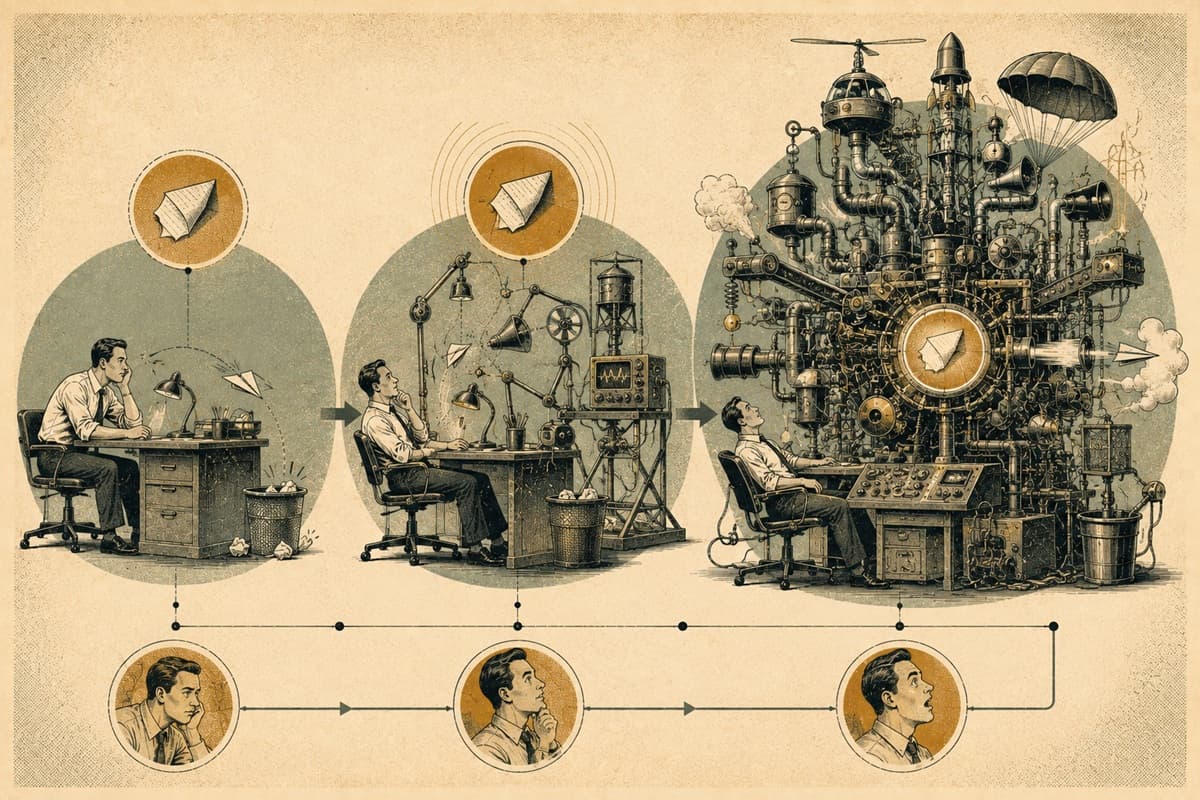
Definition
Exaggeration enlarges or intensifies a feature beyond literal plausibility. It can increase size, duration, specificity, emotional response, institutional procedure, or consequence. The audience recognizes the departure from reality and uses it to infer an attitude toward the underlying truth.
How it works
Good exaggeration has an anchor. If a meeting feels bureaucratic, the joke may imagine a subcommittee formed to select the subcommittee's font. The invention is impossible or disproportionate, but it extends something observable: procedure replacing purpose.
The mechanism often follows a vector. First establish what is increasing, then keep the direction consistent. Random additions create clutter; coherent additions make the scale itself funny.
Forms of exaggeration
- Hyperbole: a verbal claim exceeds literal truth.
- Escalation: successive beats increase stakes or difficulty.
- Overprecision: absurd detail treats a rough judgment as measurable science.
- Emotional disproportion: a tiny event receives epic grief or triumph.
- World extension: one familiar rule governs everything in an imagined reality.
Why specificity matters
“It took forever” communicates frustration. “The loading screen asked whether my heirs wanted to continue” supplies an image, implication, and point of view. Specificity gives the audience evidence from which to reconstruct the exaggerated scale.
Failure modes
Maximum volume is not maximum comedy. Beginning at the highest possible intensity leaves nowhere to move. If the anchor is not recognizable, the result feels arbitrary. If the real subject is traumatic or vulnerable, playful distance may not exist; scale can intensify harm instead of clarifying a pattern.
Relationship to other mechanisms
Exaggeration creates incongruity through degree. Understatement changes degree in the opposite direction. Repetition can build escalation, while the rule of three can reserve the largest departure for the final item.
What AI can learn
AI can identify an attribute, propose a progression, and generate specific consequences. It should preserve the causal anchor and vary more than adjectives. The difficult part is restraint: knowing the smallest departure that reveals the idea and whether the target can bear the enlargement.
A practical test
State the literal observation in one plain sentence, then identify exactly one dimension to enlarge. If the comic version no longer lets a reader recover that observation, the exaggeration has lost its anchor. If replacing the specific image with “very” plus an adjective leaves the joke unchanged, the draft probably needs a more concrete consequence.