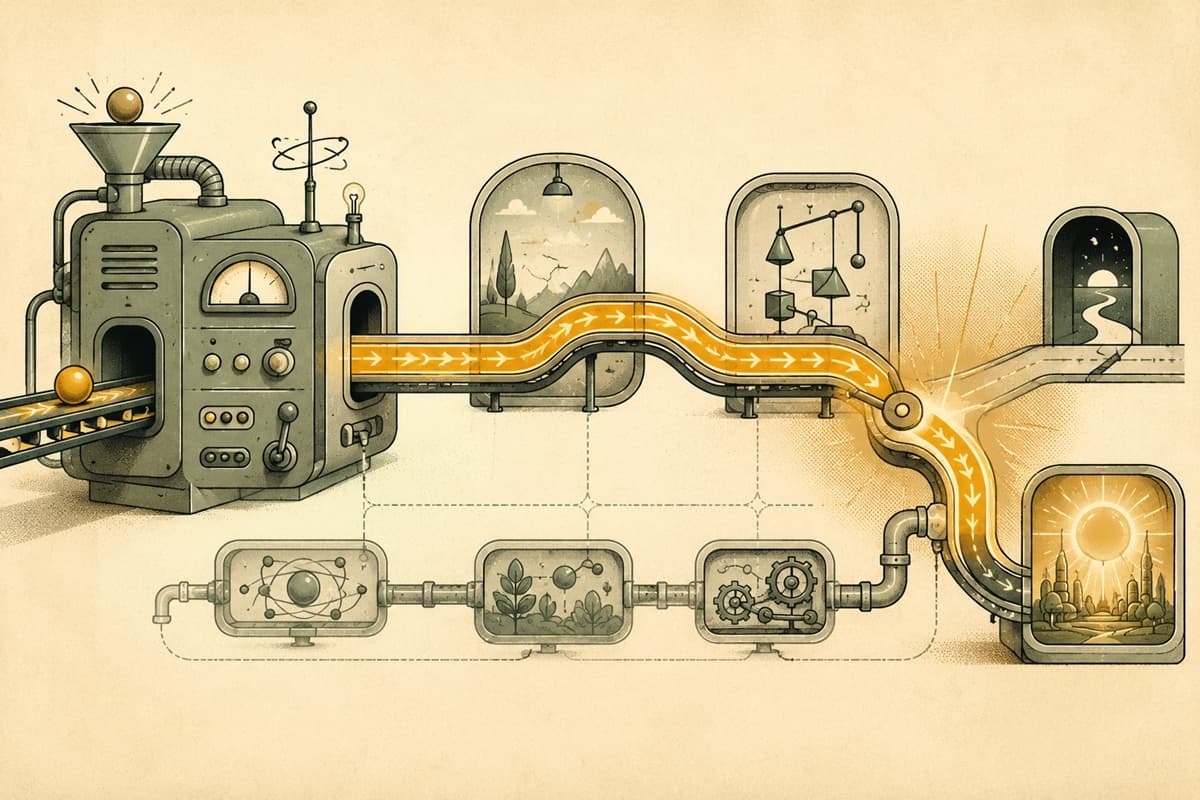
Definition
Misdirection is the controlled management of interpretation. A setup supplies cues that favor one reading. The turn reveals another reading that also fits the words or situation, forcing a quick revision. The audience was not given nothing; it was given enough to make a confident prediction.
How it works
Effective misdirection usually has three parts. First, establish a frame the audience recognizes. Second, omit or delay a detail that would expose the alternative. Third, reveal that detail in a position where reinterpretation is fast enough to feel like discovery rather than correction.
Consider an original miniature: “The museum guard said my drawing showed promise, especially once I returned it to the evidence locker.” The first clause encourages an art-school reading. The final location reclassifies the drawing as part of an incident. The words do not become false; their frame changes.
Common forms
- Lexical misdirection: an ambiguous word activates its more likely meaning first.
- Narrative misdirection: the audience assumes the wrong relationship, location, or goal.
- Status misdirection: a person appears to have authority that later proves borrowed or misunderstood.
- Visual misdirection: framing hides the object or spatial relation that explains the action.
Failure modes
A turn can fail because the first reading was never strong, the second reading requires missing knowledge, or the reveal contradicts rather than reinterprets the setup. Randomness is not misdirection. The audience should be able to look back and see why both the assumption and the correction were available.
Over-signaling is another problem. If every word announces that a twist is coming, attention shifts from the apparent story to twist detection. The mechanism survives, but surprise weakens.
Relationship to other mechanisms
Misdirection frequently produces incongruity, but the terms are not identical. Incongruity describes a mismatch; misdirection describes how attention was guided before the mismatch appeared. A reversal changes direction or roles, while misdirection may reveal that the audience had described the direction incorrectly from the beginning.
What AI can learn
A model can list assumptions implied by a setup, identify ambiguous words, and propose alternate frames. It should then test fairness: does the reveal fit the original language, and is the necessary context likely to be shared?
The hard part is predicting which interpretation a particular audience will choose first. Frequency statistics help, but culture, current events, and conversational context can make the “obvious” reading unstable.