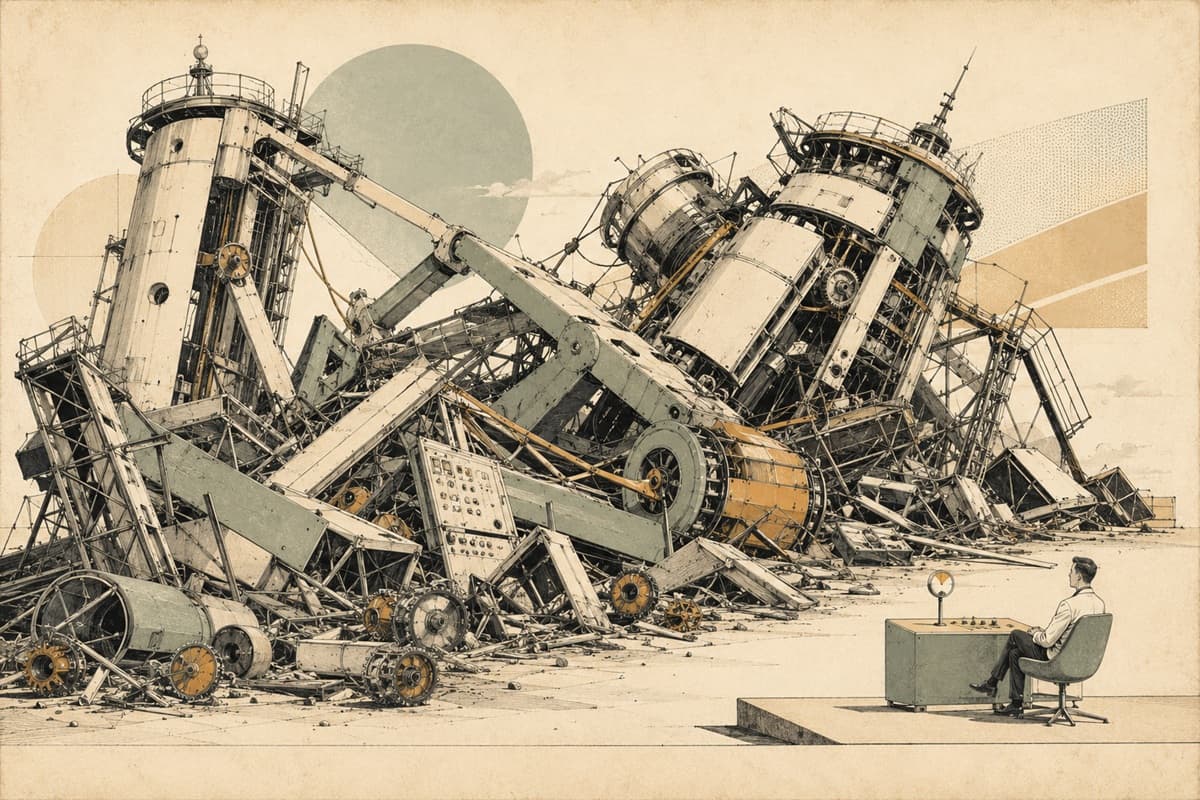
Definition
Understatement presents something as smaller, milder, simpler, or more ordinary than context suggests. The audience perceives the suppressed scale and reconstructs the stronger judgment. The speaker's refusal to match the expected reaction becomes the comic event.
How it works
The context must make the real magnitude legible. Then the language reduces it.
Original example: after a robot vacuum drags a birthday cake through every room, its owner says, “The floor-cleaning feature has become a little interpretive.” “A little” and the abstract word “interpretive” are conspicuously inadequate to the visible mess.
Understatement often conveys character. Calm response may suggest denial, discipline, social awkwardness, exhaustion, or confidence that disaster is routine.
Forms of understatement
- Scale reduction: catastrophe becomes “an inconvenience.”
- Emotional restraint: a character responds to enormous news with administrative calm.
- Litotes: a positive meaning is expressed by negating its opposite, such as “not ideal.”
- Bureaucratic abstraction: vivid harm is translated into bloodless process language.
- Delayed recognition: the speaker reports only the smallest symptom of a larger problem.
Understatement and deadpan
Understatement describes the relation between words and situation. Deadpan describes a delivery or persona with limited overt emotional signaling. They often combine, but an excited speaker can also understate, and a deadpan speaker can deliver exaggeration.
Failure modes
Without sufficient context, reduced language is merely vague. In high-stakes real situations, understatement may read as evasion or cruelty rather than play. The mechanism can also become predictable if the same phrase—“not great,” “small problem”—does all the work.
Relationship to other mechanisms
Understatement is a mirror of exaggeration: both create incongruity through degree. It also relies on irony because literal wording and intended evaluation diverge. Timing determines how long the audience observes the large event before receiving the small description.
What AI can learn
AI can estimate a situation's apparent scale and generate deliberately low-intensity descriptions. It can vary register rather than simply insert minimizing adverbs.
The hard part is moral and contextual calibration. A restrained line after fictional inconvenience differs from minimizing a person's real harm. Tone classification alone does not supply accountability.
A practical test
Ask what evidence gives the audience the larger scale. It might be a visible mess, an earlier fact, another character's alarm, or shared knowledge. If the reduced phrase is the only information available, the reader cannot reconstruct the intended gap. Then test the target: is the calm language exposing a speaker or minimizing someone else's experience?