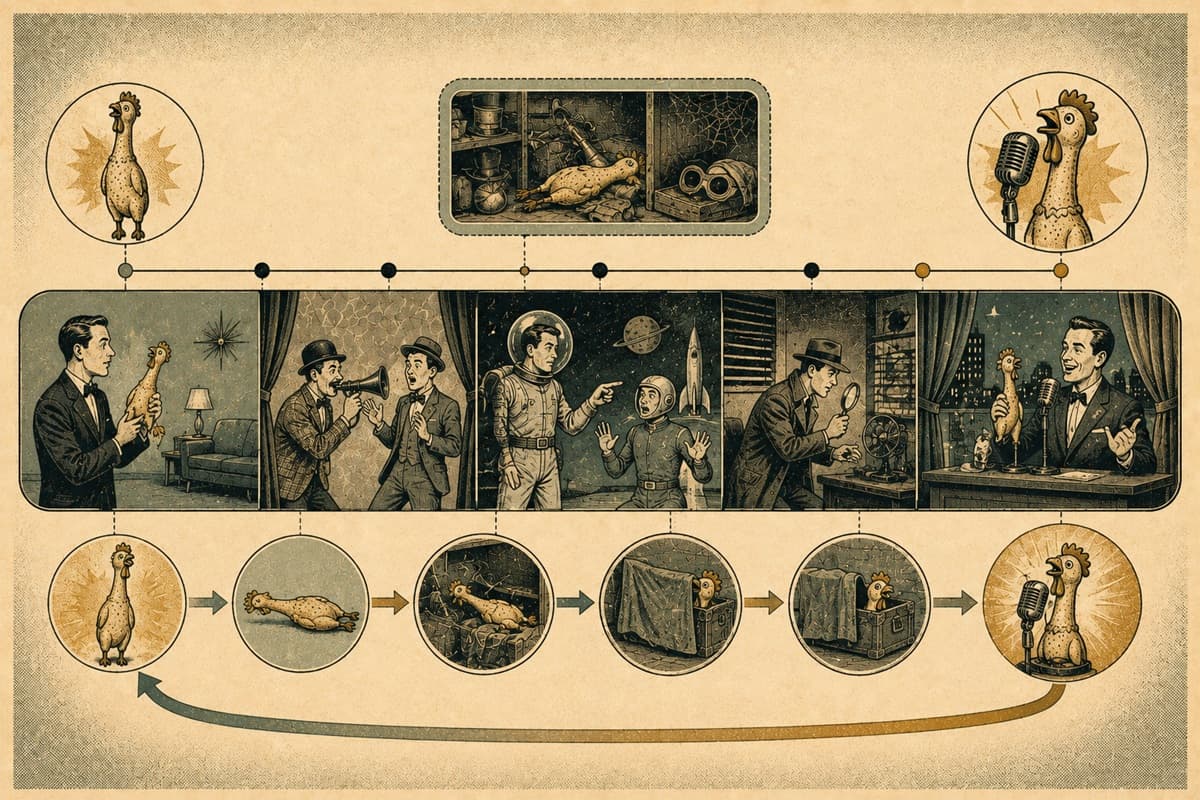
Definition
A callback is a later reference to earlier material in the same set, episode, story, series, or shared performance context. It differs from immediate repetition because distance matters. The audience must store the first element and recognize its return after attention has moved elsewhere.
How it works
The initial mention should work in its original location. Later circumstances then make it newly relevant. Recognition creates one pleasure; changed function creates another.
Original example: early in a story, a manager insists that the office emergency plan is “mostly decorative.” After a harmless but elaborate printer malfunction, the narrator ends: “The evacuation arrows finally got promoted from decorative.” The phrase returns, but events have changed its status.
Types of callback
- Phrase callback: distinctive wording returns.
- Object callback: a prop or detail becomes useful later.
- Character callback: a known habit predicts a response.
- Structural callback: a later scene mirrors an earlier arrangement.
- Audience callback: an unplanned room interaction is revisited.
Why distance matters
Too little distance makes the return ordinary repetition. Too much distance risks forgetting. Strong callbacks often arrive after the performance has created enough new material that the old detail feels inactive. The return then produces surprise and coherence at once.
Failure modes
A callback fails when the original element was generic, when the audience cannot reasonably remember it, or when the later use only points backward without adding meaning. Excessive callbacks can make a piece feel closed to newcomers or mechanically self-congratulatory.
Relationship to other mechanisms
Callbacks are a form of repetition organized across distance. They depend on timing at the scale of an entire work. In sitcoms, recurring character knowledge can function like a callback even when no exact phrase repeats.
What AI can learn
AI can track unusual nouns, phrases, promises, and unresolved details, then propose later contexts where they acquire a second function. It can score whether the reference is exact enough to recognize.
The challenge is salience. A model may call back to a detail the audience never noticed, or return to every detail and make the pattern oppressive. Human performers also use the emotional memory of a room, not just textual recurrence.
A practical test
Remove the first mention and read the return. If the later line still works exactly as well, it may be an ordinary reference rather than a callback. Then remove the return. If the first mention now feels like conspicuous setup with no local purpose, it may be too engineered. A strong pair gives each moment a job while allowing the second to alter the first.