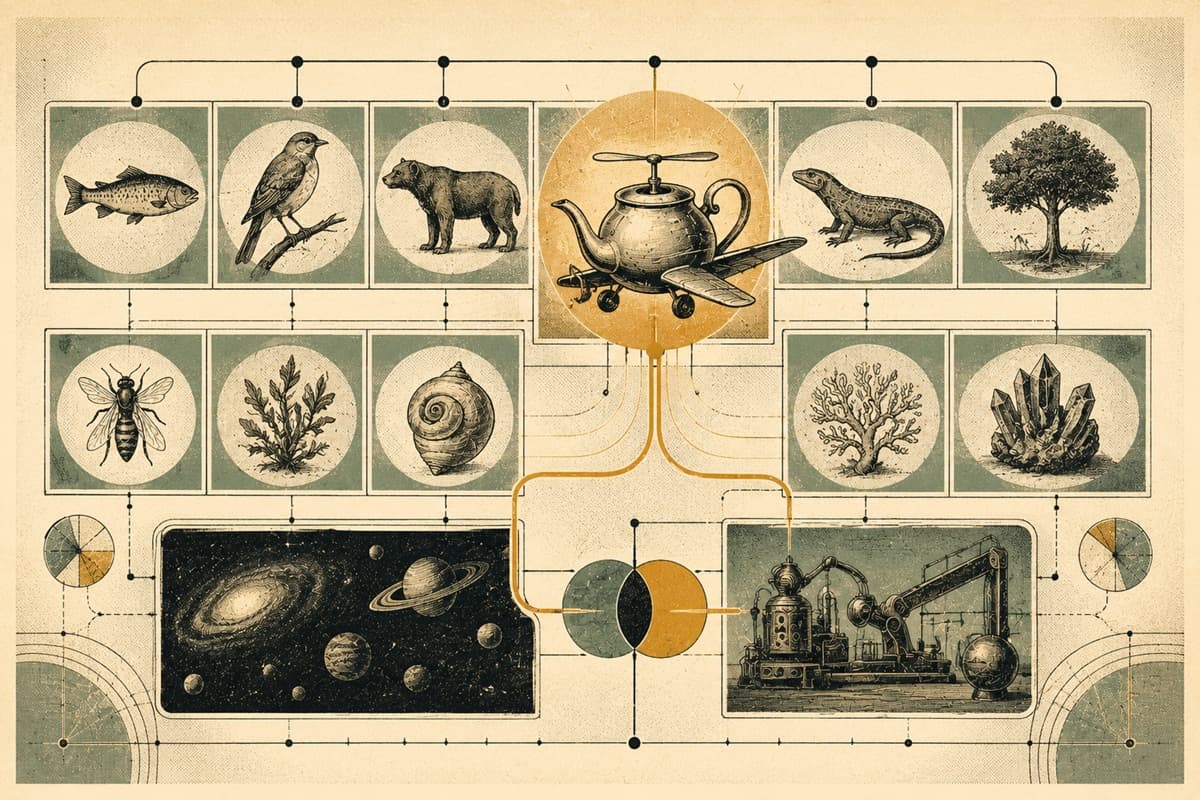
Definition
Incongruity is a mismatch among an expectation and an event, two active concepts, a style and its subject, or elements that do not ordinarily belong together. It is one of humor theory's most influential ideas, but “unexpected” is not a complete definition of “funny.” Alarms and tragedies are unexpected too.
How it works
A comic incongruity is made available within a frame that permits play or reinterpretation. The audience detects the mismatch and may resolve it by finding another rule under which the elements fit. Some absurd comedy withholds full resolution and makes sustained wrongness the pleasure.
An original example: a city council releases a 200-page “streamlined guide to brevity.” The bureaucratic scale conflicts with the declared goal. The relation is readable because both elements belong to a familiar argument about institutional language.
Levels of mismatch
- Conceptual: two categories collide, such as a solemn ritual governed by customer-service metrics.
- Linguistic: one phrase activates incompatible meanings.
- Behavioral: a response violates the emotional scale of the situation.
- Stylistic: grand language describes trivial material, or casual language describes enormous stakes.
- Physical: an object, body, or environment does not behave as predicted.
Resolution is not binary
Some jokes provide a crisp reinterpretation. Others offer partial sense: enough pattern to feel intentional, not enough to restore ordinary reality. Research on incongruity and resolution treats comprehension and amusement as related but separable processes. A person may understand the construction and still dislike it.
Failure modes
Pure randomness lacks a stable expectation to violate. An obscure reference can hide the mismatch. A threatening violation may not feel safe or playful. Repetition can also normalize the surprising element unless each return changes its function.
Relationship to other mechanisms
Misdirection engineers a path toward incongruity. Wordplay creates mismatch between meanings or sounds. Exaggeration makes degree incongruous with reality. Incongruity is therefore a broad lens, not a substitute for describing the local craft.
What AI can learn
AI can compare semantic frames, detect register mismatch, and generate combinations. It can also test whether a reader has enough context to recognize both sides. The difficult part is social framing: whether the mismatch feels playful, stale, cruel, or accidentally incoherent for a particular audience.