Definition
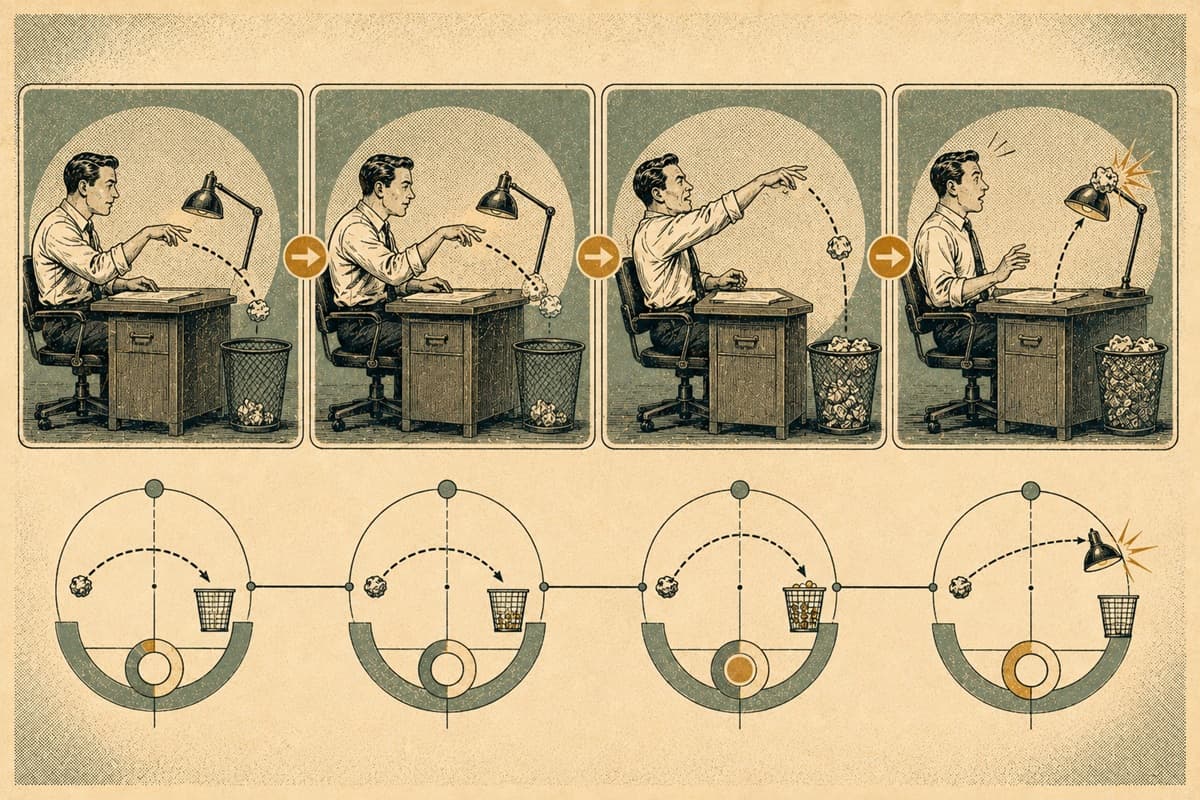
Repetition brings back a word, action, structure, character behavior, or situation. The first instance provides content. A later instance adds recognition and creates a prediction about what another return might do.
Repetition is not automatically funny. Its comic use depends on interval, variation, escalation, and the audience's memory.
How it works
The second occurrence can reveal that the first was not accidental. The next occurrence may fulfill the pattern, enlarge it, or break it. Loewenstein and colleagues describe a repetition-break structure in which recurrence guides attention before a shift supplies novelty and surprise.
Original example: a smart speaker mishears “set a timer” as “send a tire.” The second attempt sends two tires. On the third, it calmly asks whether the user is opening a garage. The object repeats, but the system's interpretation escalates from error to confident theory.
Variables that matter
- Interval: immediate repetition produces rhythm; delayed return tests memory.
- Similarity: exact return emphasizes absurd persistence; variation creates development.
- Count: too few instances may not establish a pattern; too many can exhaust it.
- Intensity: escalation changes stakes while preserving structure.
- Point of view: a new character's response can refresh a familiar event.
Failure modes
Copying the first joke without a new function asks recognition to do all the work. Long delays fail when the audience no longer remembers the setup. Short delays fail when the pattern becomes noise. A recurring catchphrase may feel communal in one context and compulsory in another.
Relationship to other mechanisms
The rule of three is one organized use of recurrence. A callback is repetition across greater distance and changed context. Exaggeration can increase each return; misdirection can make the audience expect a break that does not arrive.
What AI can learn
AI can track repeated entities, create structured variations, and test whether each return changes scale, context, or consequence. Long-context systems can preserve early details for later use.
The harder problem is audience memory and saturation. A system needs more than token recurrence; it needs a model of what remains salient, what has become expected, and whether the next return rewards or burdens attention.
A practical test
Label what changes on each return: scale, context, response, consequence, or interpretation. If the label is “nothing” every time, exact persistence must itself be the point. Otherwise remove one repetition and see whether the sequence improves. The useful count is the smallest one that makes the pattern readable and its development satisfying.