Definition
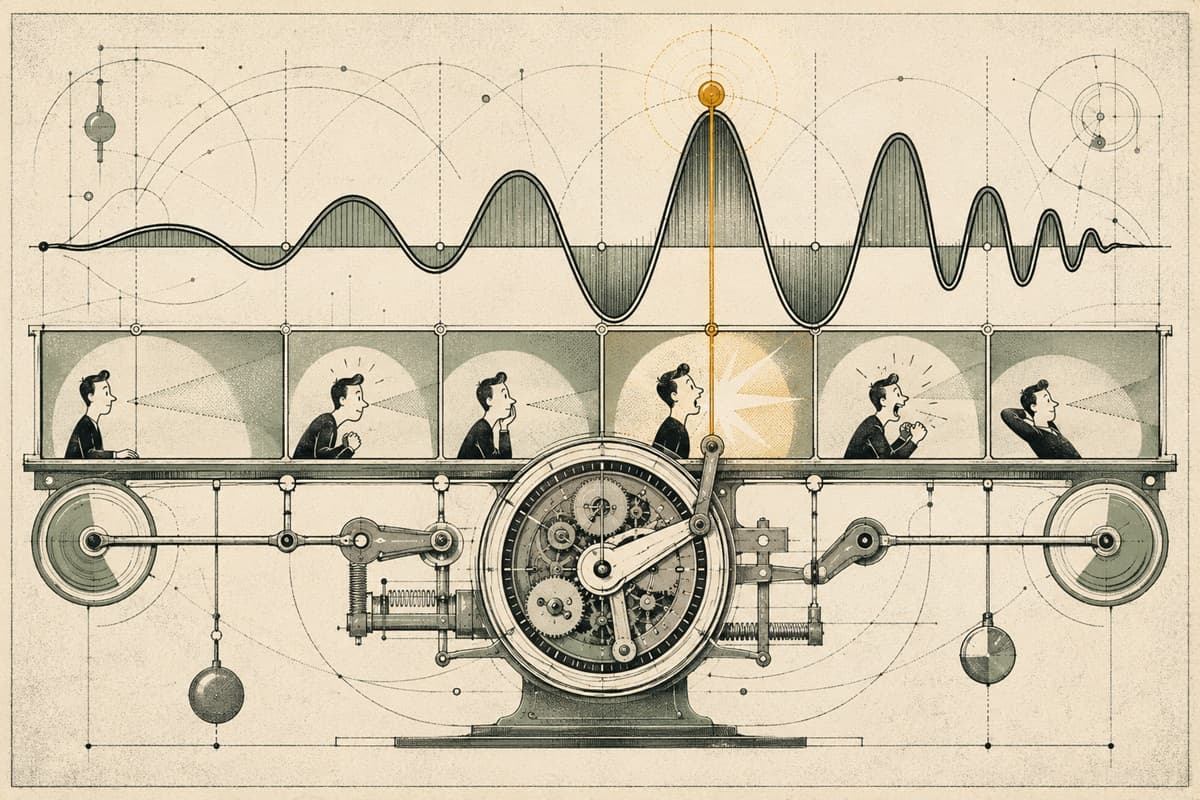
Comic timing is the placement and duration of information, action, silence, emphasis, interruption, and reaction. It operates at many scales: milliseconds inside a word, a pause before a reveal, the distance between repeated beats, or a callback near the end of a story.
Timing is not a universal fixed pause. It is a relationship among performer, material, medium, and audience.
How it works
A setup gives the audience time to form an expectation. A reveal must arrive after the expectation is available but before attention dissolves. A reaction may confirm how the event should be read or give the audience space to respond.
Original example: a presenter clicks to reveal “Our Five-Year Efficiency Plan.” Nothing happens. The presenter waits, clicks twice more, then says, “Year one is diagnostics.” The failed pause becomes evidence for the line rather than dead air.
Components
- Pace: the overall rate of speech or action.
- Pause: withheld continuation that creates anticipation or room for recognition.
- Emphasis: vocal or visual weight directing attention to a key element.
- Interruption: a beat arrives before expected completion.
- Reaction time: character and audience register the event.
- Sequence timing: material returns after enough intervening context.
Medium changes the clock
Live performers can adjust to laughter, silence, and room energy. Film can determine duration through editing and framing. Comics use panel and page boundaries. Text uses line breaks and sentence order but cannot control reading speed completely. Online video is shaped by cuts, captions, autoplay, and the possibility of replay.
Recent experimental work on conversational humor supports the importance of fine temporal coordination, but controlled findings should not be turned into one ideal number for all comedy. Style and context remain decisive.
Failure modes
Rushing can deliver the turn before the assumption exists. Excessive pause announces importance or drains tension. Continuing through laughter hides the next line. A precisely timed performance may still fail if the premise is unclear or the audience rejects the target.
Relationship to other mechanisms
Timing governs misdirection, repetition, and callbacks. Those mechanisms describe relationships among ideas; timing controls when those relationships become perceptible.
What AI can learn
AI can mark beats, estimate information density, and suggest pause or edit points. Speech systems can vary rate and emphasis. The hardest task is closed-loop adaptation: hearing a particular audience, distinguishing laughter from confusion, and changing the next beat without losing the larger structure.