Definition
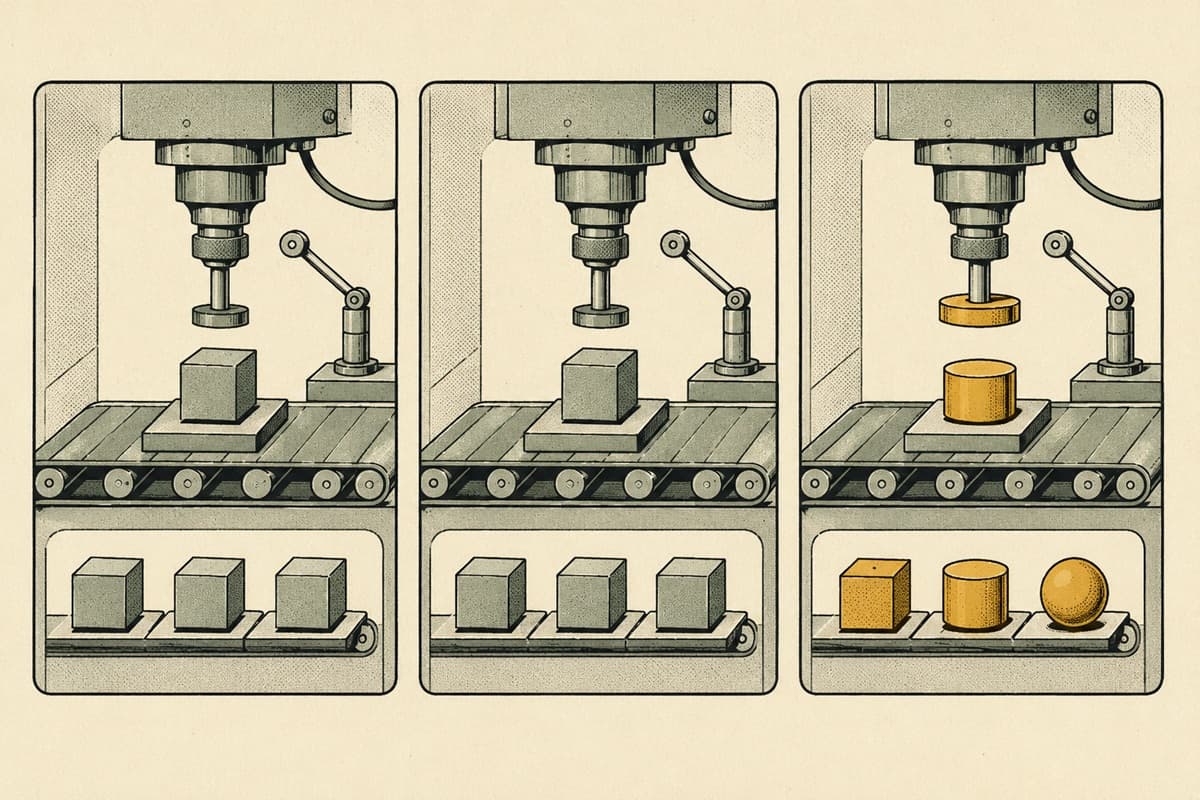
The rule of three, or comic triple, arranges three related elements so the first two establish a pattern and the third produces payoff through continuation, escalation, or disruption. “Rule” is a craft label, not a law of cognition or a guarantee of laughter.
How it works
One item is an instance. A second suggests a relationship. The third arrives after the audience has enough evidence to predict what belongs. That makes the third position useful for a turn.
Original example: “The hotel promised quiet rooms, soft pillows, and a fire alarm with a strong commitment to jazz improvisation.” The first two items establish conventional amenities; the third keeps the list grammar but changes the evaluated object and attitude.
Academic work on the comic triple uses incongruity theory to describe a linear process and notes that the technique extends beyond stand-up to visual comedy.
Variants
- Two straight, one turn: the third breaks category or register.
- Escalating triple: each beat increases degree.
- Triple repetition: the third fulfills an absurd pattern exactly when a break was expected.
- Three perspectives: different characters reveal a common situation.
Rhythm and wording
Parallel syntax helps the audience compare items. Length matters: a much longer third item can delay the key word, while a short final item can snap the pattern closed. The order should reserve the most useful semantic or sonic weight for the end.
Failure modes
If the first two items do not clearly relate, the third cannot violate their pattern. If the third is merely random, it changes category without revealing a useful connection. Overuse makes writing sound like a template, especially when every paragraph contains an identical two-normal-one-weird list.
Relationship to other mechanisms
The triple is a compact form of repetition. The third beat may use misdirection, exaggeration, or reversal. Timing exists both between beats and inside the final phrase.
What AI can learn
AI can classify the shared dimension of the first two items and generate a third that retains syntax while changing meaning. It should test semantic relationship rather than select arbitrary novelty.
The difficult part is freshness. Because the structure is easy to detect, models overproduce it. A writer still has to decide whether three is the right count for this idea.