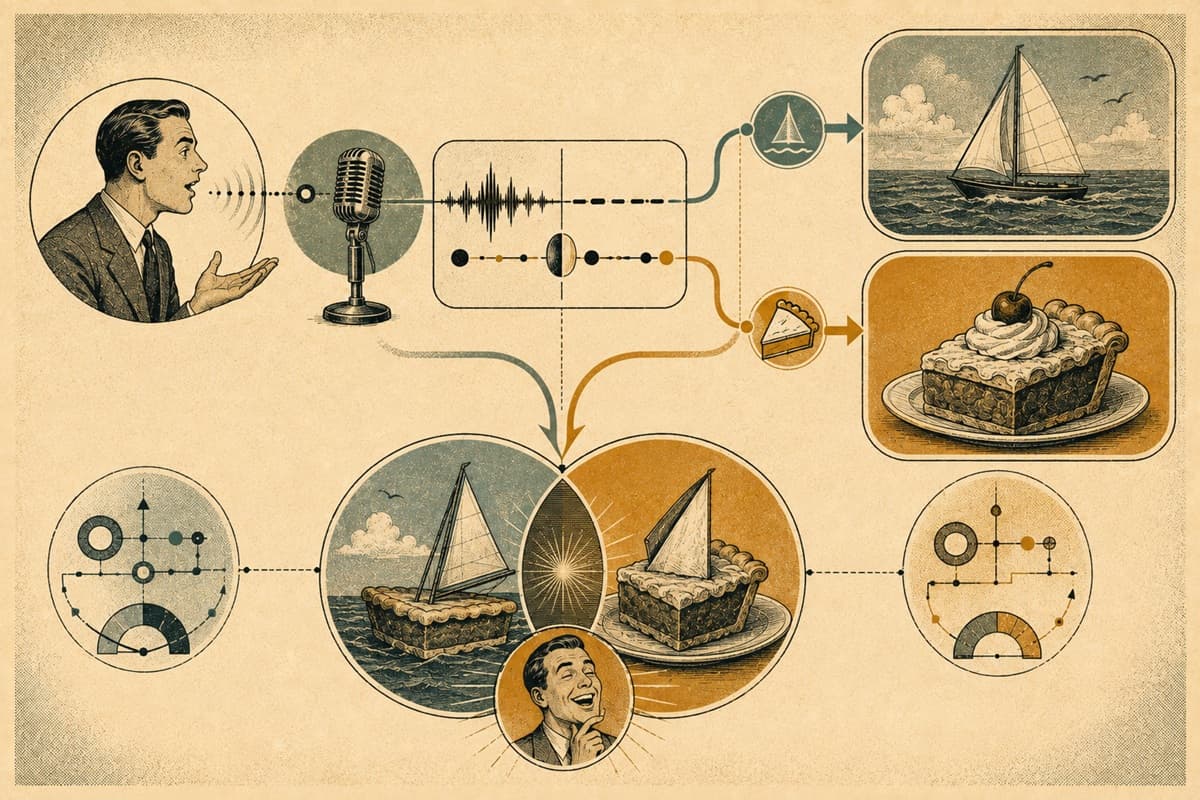
Definition
Wordplay creates an effect from the form and organization of language, not only from the situation described. It can exploit homophones, multiple meanings, syntax, idiom, spelling, register, names, or the boundary between words. Puns are a prominent subset, not the whole category.
How it works
A word or phrase activates two interpretations. Context makes one likely; a later cue makes the other newly relevant. In the best cases, both readings remain available for an instant.
Original example: “The calendar's days are numbered.” The phrase is literally true of a calendar and idiomatically predicts an ending. The pleasure is compact because the same sequence of words supports both scripts.
Computational research on puns has found that measures related to ambiguity and the distinctiveness of meanings correlate with human funniness judgments. That does not reduce wordplay to a score, but it supports the idea that both multiplicity and semantic distance matter.
Common forms
- Homophonic: similar sounds support different words.
- Polysemous: one word carries related but distinct meanings.
- Syntactic: sentence structure permits more than one grouping.
- Idiomatic: a fixed expression is restored to literal meaning.
- Register shift: technical, formal, or casual language is reassigned.
Failure modes
If the secondary meaning is too remote, the audience must solve rather than discover it. If both meanings are equally obvious from the start, there may be no turn. Translation can destroy the sound or ambiguity. Accessibility also matters: spelling-based play may not survive speech, and sound-based play may not survive captions without adaptation.
Relationship to other mechanisms
Wordplay often uses misdirection and produces incongruity. It can power a reversal when one definition displaces another. Timing controls how long the dominant meaning remains active before the alternate arrives.
What AI can learn
Language models are well placed to retrieve ambiguous words, idioms, and phonetic neighbors. They can test multiple contexts and explain both readings. The weakness is meaningful selection: generated puns may be technically valid but irrelevant, familiar, or tonally wrong. Cross-language wordplay adds the need to recreate function rather than translate vocabulary literally.
A practical test
Write both meanings in plain language. Confirm that one context naturally encourages the first and that the turn activates the second without extra facts. Then read the line aloud and on the page. If it works in only one medium, presentation should support that version rather than pretending the mechanism transfers unchanged.