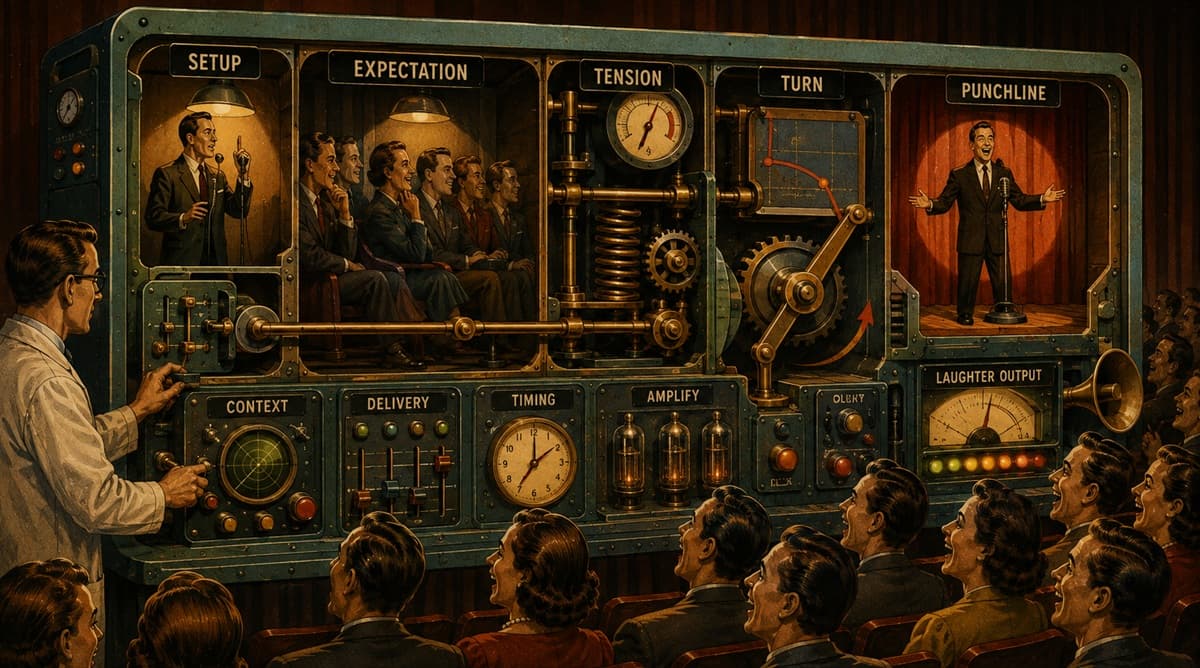
The setup and punchline are often described as question and answer, problem and surprise, or straight line and sudden turn. Each metaphor catches part of the relationship. None should make the form look more rigid than it is.
The setup manages knowledge and attention. The punchline changes the active interpretation, reveals a consequence, or concentrates the comic point. Their effectiveness depends less on occupying two labeled boxes than on controlling the order in which the audience can know things.
What the setup must accomplish
A setup establishes enough of a world for the audience to make useful predictions. It may identify a speaker, situation, desire, rule, or piece of vocabulary that will later acquire another meaning.
“I bought a planner to take control of my week” establishes an object and a goal. It also activates familiar expectations about productivity. A possible punchline—“It has assigned me several tasks about using the planner”—turns the tool into a source of administrative work.
The setup’s jobs include:
- making the literal situation understandable;
- guiding the audience toward a likely interpretation;
- planting language or detail that can support another interpretation;
- establishing tone and point of view;
- withholding what would reveal the turn too early.
Not every setup must be brief. A story may need character and stakes. Economy means that details contribute, not that every sentence has the dimensions of a fortune cookie.
The setup creates assumptions without stating them
Audience inference is the hidden engine. If the setup says, “The restaurant promised a deconstructed sandwich,” many listeners assume a fashionable presentation. A turn might reveal that the ingredients arrived in separate grocery bags. The setup never explicitly promised a plate; convention supplied it.
This is the fairness test in many misdirection jokes. The first interpretation should be reasonable, and the second should remain compatible with the language or world. A punchline that requires discarding the setup can feel arbitrary rather than revealing.
What the punchline changes
The punchline can change meaning, status, scale, cause, or point of view.
| Turn | What changes | Original example |
|---|---|---|
| Reversal | expected advantage becomes a problem | “The self-checkout recognized me. We’ve both made mistakes.” |
| Reframing | one domain is described as another | “My inbox is a museum of intentions.” |
| Literalization | figurative wording becomes concrete | “I was told to follow my dreams. They have terrible directions.” |
| Scale | minor material receives extreme treatment | “The group chat formed a subcommittee about choosing an emoji.” |
| Character | the speaker’s priority is exposed | “I support work-life balance, provided work stops moving the line.” |
The table identifies mechanisms, not formulas. Replacing nouns inside an existing frame may produce grammatical imitations without a fresh point of view.
Punchline placement matters
The strongest revealing word often benefits from arriving near the end. That position prevents later language from draining its emphasis.
Less focused: “Because it behaved like a disappointed supervisor, I stopped wearing my fitness watch.”
More focused: “I stopped wearing my fitness watch. It had become a disappointed supervisor.”
The second order lets the ordinary action arrive first and preserves the reframing for last. It also gives “supervisor” the final stress. This is a craft observation, not proof that every audience prefers the revision.
Sometimes the turn belongs in the middle because a tag needs to explore its consequences. Sometimes the audience predicts the nominal punchline and the real laugh arrives from how a character responds. Placement follows function.
Compression versus clarity
Writers often improve short jokes by removing explanations the audience can supply. “The app sent me a reminder that I had disabled reminders, which was ironic” reports the mechanism after performing it. “I disabled reminders. The app reminded me” lets the contradiction stand.
The original one-liners collection provides compact examples with the setup, turn, and mechanism visible on one page.
Compression can go too far. If the audience cannot identify the situation or the alternate meaning, the turn becomes a private shortcut. The useful question is not “Can a word be deleted?” but “Does the remaining information still guide the intended inference?”
Timing lets the setup settle
A pause before the punchline can give the first interpretation time to become active. A pause after it can give the audience time to reconstruct. Yet a conspicuous “comedy pause” may announce that a punchline is coming and weaken surprise.
Timing also occurs inside the setup. Rushed details may prevent the audience from building the necessary picture. Overextended details may allow it to predict the turn. Research mapping repeated live performances demonstrates that pauses and speech segments vary with interaction and venue while retaining recurring structure (PNAS Nexus). The words are only one layer of the event.
On the page, punctuation and paragraph breaks perform some of this work. A line break can withhold a word, but excessive visual staging can make the mechanism visible from orbit.
Punchlines can resolve—or preserve—an incongruity
Many jokes invite reconstruction: the punchline reveals a second interpretation that makes the setup newly coherent. But not every comic form resolves its mismatch. Absurdist comedy may maintain an impossible rule and make commitment itself the pleasure. Anti-jokes may deny the expected kind of punchline with a literal answer.
Research on resolved and unresolved incongruity suggests multiple processing paths rather than one compulsory template (Frontiers in Psychology). For a writer, the practical distinction is whether the audience is meant to say “Ah, that’s what it meant” or “I accept that this world has become magnificently wrong.”
Tags, buttons, and what comes after
A tag extends the premise after the main turn. If the planner has become an administrator, a tag might be: “It scheduled a review of my planning performance.” The audience already knows the rule, so the tag can move faster.
A button is a strong final word, image, or short phrase that ends a section. Ending on administrative language in the planner example preserves the mismatch. Adding “and that is why it was funny” would be a button in the sense that it switches off the room.
The more explanation required after a punchline, the more likely the setup did not prepare the path—or the reference is too narrow for the audience.
Forms without conventional punchlines
Not all comedy announces a single turn. Observational pieces can accumulate recognition. Character comedy can make every neutral event evidence of a worldview. Sketches can establish a game and escalate it. Deadpan can sustain contrast between content and expression. Satire may organize an entire invented system around a criticism.
Setup-and-punchline remains useful as a local pattern inside these forms. A scene can contain many small expectation shifts without one final “joke ending.”
Editing the relationship
When revising, inspect the setup and punchline together:
- Write the intended first interpretation in plain language.
- Write the second interpretation or changed status.
- Identify which words support both.
- Remove details that reveal the second too early.
- Add only the context required to make the first interpretation reasonable.
- Move the reveal toward a position with emphasis.
- Read it aloud for rhythm and unintended stress.
- Test whether the joke still works for someone without your private context.
Then ask the uncomfortable question: Is the underlying observation specific enough to deserve the structure? A flawless hinge attached to an empty door remains impressive hardware.
The Joke Autopsy station will eventually make this inspection interactive. For now, compare the structure with misdirection in comedy and comedic timing.