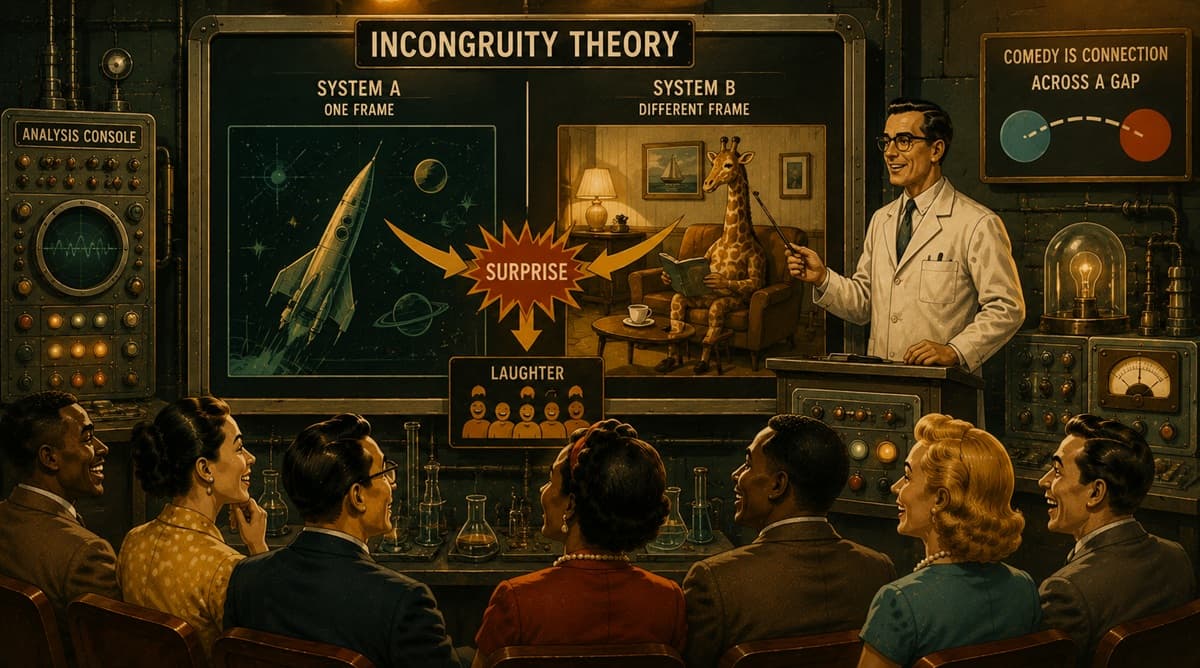
Incongruity theory begins with a familiar comic event: an audience expects one pattern and encounters another. A sentence changes meaning, a dignified character meets an undignified obstacle, or an ordinary rule produces an impossible consequence.
The idea is powerful because expectation is central to many forms of comedy. It is incomplete because broken expectations also produce fear, annoyance, error messages, and weather forecasts.
The basic claim
Incongruity is a mismatch among concepts, events, rules, or interpretations. The Stanford Encyclopedia of Philosophy traces versions of the theory through philosophers including Kant and Schopenhauer and notes earlier observations about creating and violating audience expectation.
In a simple joke, a setup encourages one interpretation. The punchline makes a second interpretation active:
“The library introduced express checkout. The books seem nervous.”
The first sentence activates borrowing speed. The second treats “checkout” as a threatening departure and personifies the books. The mismatch is supported by shared vocabulary.
Incongruity and resolution
The incongruity-resolution model adds a second step. First the audience detects a mismatch; then it finds a rule or alternate frame that makes the mismatch intelligible. The pleasure may include reconstructing how the setup supported both readings.
Resolution need not restore ordinary logic completely. A cartoon animal may speak without explanation; the audience accepts the genre and resolves only the specific joke. A pun maintains two meanings rather than choosing one.
The distinction between detection and reconstruction helps explain why an ending can be surprising but unsatisfying. If no relationship can be found, the audience receives novelty without a usable turn.
Absurdity complicates resolution
Some absurd humor preserves rather than solves incongruity. An impossible rule may remain impossible while the performance commits to it. Research proposing a dual-path model distinguishes humor involving resolvable incongruity from absurd humor in which residual incongruity remains (Frontiers in Psychology).
This does not mean randomness becomes sufficient. Absurdist comedy often provides tone, repetition, escalation, or internal consistency. The audience may not resolve why the world operates this way, but it learns how the comic world behaves.
Why surprise is not enough
A random alarm during dinner is incongruous. It is not automatically comic. Several additional conditions may matter:
- the mismatch must be noticed;
- the audience needs a frame for treating it as play rather than threat;
- the new interpretation may need coherence;
- the target and consequence must be acceptable to that audience;
- wording, timing, and delivery must make the relationship available.
The benign-violation model addresses part of this gap by asking whether an event is perceived as both wrong and acceptably safe. Other theories emphasize play, social comparison, or relief. Incongruity often describes structure better than motivation.
Scope and limitations
Incongruity theory is especially useful for puns, reversals, analogy, misdirection, parody, and many visual gags. It is less complete when humor arises from familiar recognition, affectionate repetition, pure performance energy, or group belonging.
It can also become circular: if researchers define every funny event as containing some mismatch, the theory cannot be tested meaningfully. “The incongruity is that the audience found a normal thing funny” explains nothing.
Use the lens specifically. Name the expectation, the conflicting event, and the proposed route between them. Then ask what the lens leaves out.
Applying the theory
When analyzing a joke:
- Identify the active expectation before the turn.
- Locate the mismatching word, event, status, or rule.
- Describe whether a second interpretation resolves it.
- Note any incongruity that deliberately remains.
- Identify the cultural or linguistic knowledge required.
- Separate structural success from personal enjoyment.
This produces a falsifiable description: another reader can disagree about which expectation was active or whether the reconstruction is supported.
Incongruity and AI
Computational systems can model surprise, recognize contrasting meanings, and generate common reversal patterns. That makes incongruity a practical tool for computational humor. Yet a statistical signal of unexpectedness is not identical to an audience’s situated judgment. The same sequence may be novel because it is inventive, nonsensical, culturally unfamiliar, or simply wrong.
AI humor evaluation therefore needs human context and careful definitions. Explore the issue in Can AI Understand Humor?, or compare resolved and unresolved forms in absurdist comedy.