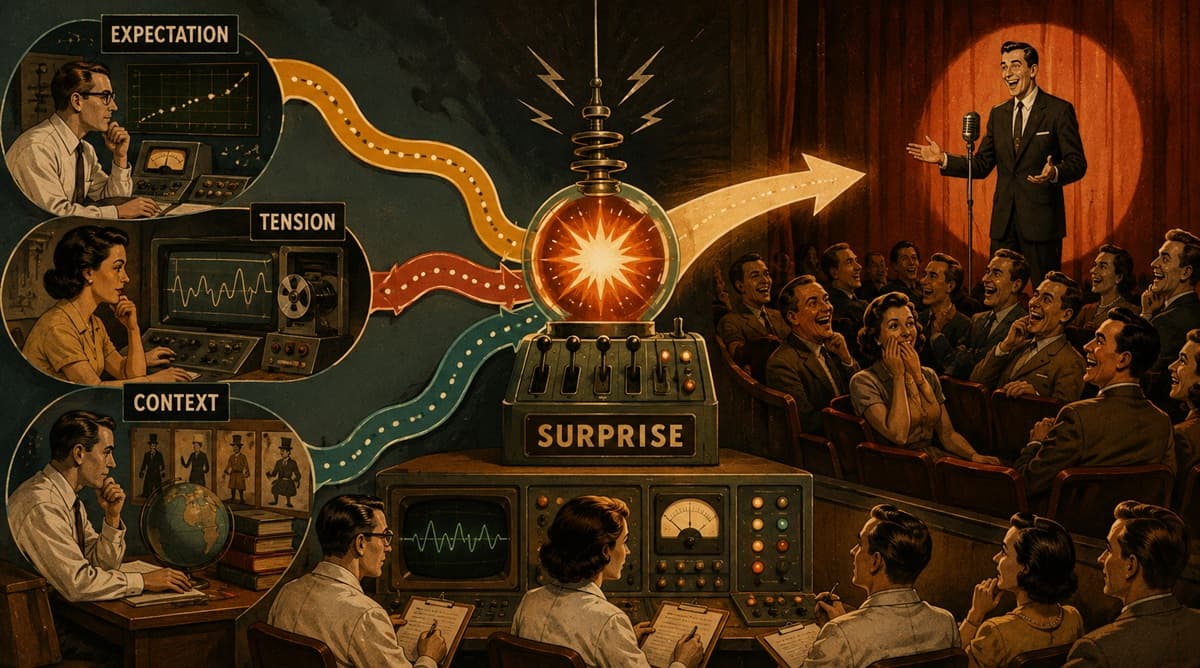
If funniness had one reliable cause, comedy writing would be a manufacturing problem. Insert cause, receive laugh. Instead, the same line can succeed in one room, fail in another, improve after a pause, collapse when explained, and return years later as a reference nobody expected to remember.
Theories of humor identify recurring patterns. Craft turns those patterns into choices. Audiences supply language, memory, expectation, mood, and social permission. Something becomes funny, when it does, through the interaction of all three.
No single theory owns the laugh
Philosophers and psychologists have proposed many explanations. The traditional trio—superiority, relief, and incongruity—remains influential, while play accounts, linguistic theories, and the benign-violation model add other perspectives. The Stanford Encyclopedia of Philosophy offers a useful history and critique of several major approaches.
These theories are lenses, not ingredient labels. A joke may contain incongruity without requiring resolution. A satirical line may combine status, aggression, and recognition. A silly sound may work through play and repetition more than conceptual surprise. A complete analysis can use several lenses while admitting what they do not explain.
Incongruity: the pattern changes
Incongruity accounts begin with a mismatch between expectation and event, concept and object, or one interpretation and another. A setup makes one route easy to follow; the turn reveals a route the audience had not prioritized.
Consider: “The office installed a suggestion box. It’s locked, for efficiency.” The first sentence activates participation. The second preserves the physical object while reversing its social purpose. The contradiction is not random: bureaucracy supplies a recognizable logic.
Unexpectedness alone is insufficient. “The office installed a suggestion box. Refrigerator.” is less predictable but offers little to reconstruct. Some absurdist comedy can make unresolved mismatch rewarding, yet even apparent randomness usually gains force from tone, repetition, or an established world.
Relief: pressure changes
Relief accounts emphasize tension, inhibition, or nervous energy. Comedy can approach a charged subject indirectly, let uncertainty build, and then provide a safer or more manageable frame. A performer may say what a group has been avoiding, allowing recognition and release to arrive together.
But pressure does not guarantee comedy. Relief after a near accident may produce a laugh; relief after receiving good medical news may produce tears. The lens is most useful when analysis identifies what created the tension and how the comic form transformed it.
Superiority: status moves
Superiority accounts locate humor in feelings of triumph, comparison, or sudden elevation over another person—or over an earlier version of oneself. Slapstick, ridicule, competitive banter, and stories about past foolishness can all involve changing status.
The limitation is obvious: not every laugh is a victory, and perceived superiority can become cruelty. Self-deprecation complicates the picture because the performer can lower a stage persona while gaining control, affection, or authority as the writer of the scene. Status often moves in several directions at once.
Play: the rules become flexible
A play frame allows actions, words, and conflicts to be treated differently from their ordinary use. Exaggeration, imitation, nonsense, teasing, and deliberate mistakes can all announce, “For this moment, interpret the rules flexibly.”
Play helps explain why context matters. The same insult may function as affectionate ritual among close friends and as aggression from a stranger. The wording is not the whole event. Relationship and permission help determine whether the comic frame is shared.
Benign violation: wrong and acceptable at once
The benign-violation theory proposes that humor occurs when something is perceived simultaneously as a violation and as benign. A pun violates an expected use of language while preserving an alternate meaning. A fictional disaster can be comic when genre, distance, and consequence make it feel safely unreal.
“Benign” is not a permanent property. Distance in time, fictional framing, audience identity, and power can change the judgment. The model explains why timing and perspective matter, but it should not be used to tell an offended audience that the violation was objectively safe.
Recognition: the audience completes the circuit
Observational comedy often produces the feeling, “I have seen that but never named it.” The pleasure is partly recognition and partly compression: a complicated shared behavior is captured in a small image.
Specificity strengthens recognition. “Online meetings are awkward” is a topic. “Everyone stays silent until two people unmute at once and begin the politest duel in modern business” creates a scene, a pattern, and a social rule. The audience supplies remembered examples.
Recognition also sets boundaries. A joke about a niche interface, profession, or community may be precise for insiders and invisible to everyone else. Explaining the reference can restore comprehension while sacrificing speed and discovery.
Craft makes the mechanism available
Even a strong premise can fail through wording. Comedy craft directs attention and manages information.
- Order determines which interpretation arrives first.
- Compression removes details that dilute the turn.
- Specificity gives recognition a concrete object.
- Repetition establishes a rule that can escalate or break.
- Timing controls how long expectation has to settle.
- Delivery contributes voice, expression, status, and intention.
- Placement gives the strongest word or image room to land.
Compare “My calendar is very demanding even though I created all the events” with “I built my calendar myself. It has become a hostile work environment.” The second version gives the calendar a role and places the sharper reframing at the end. That does not make it universally funny; it makes the attempt structurally clearer.
Context can rewrite the same sentence
“Excellent timing” can be sincere praise or sarcasm. A pause can signal thought, fear, disbelief, or technical delay. A repeated phrase can be comforting, irritating, or a callback. Audiences infer meaning using the surrounding conversation, the speaker’s persona, and what they know about the situation.
This is why transcripts are incomplete records of performed comedy. They preserve words and order but only approximate pace, emphasis, gesture, room response, and the social position of the speaker.
Taste remains a real variable
Subjectivity is not an excuse to stop analyzing. It is a reason to state conclusions accurately. We can identify a reversal, trace an ambiguity, compare two phrasings, and describe required context. We cannot infer that every person should enjoy the result.
Taste can depend on genre preference, familiarity, values, mood, and appetite for predictability or risk. One person admires the precision of a pun; another experiences the same precision as machinery they can hear clicking into place.
Those differences extend beyond comedy without being identical to it. Belief Atlas explores how values, identity, experience, trust, and psychological framing can lead sincere people to interpret the same subject differently.
A practical test
When examining a comic attempt, ask:
- What expectation or pattern appears first?
- What changes—and is the change coherent, unresolved, or merely random?
- What must the audience already know?
- What tension, status, or rule is involved?
- How do wording, timing, and delivery shape the effect?
- Who is included in the play frame, and who bears the cost?
- Which explanation is evidence, and which is interpretation?
The answer may combine several mechanisms. That is not analytic failure. Comedy is often a layered event disguised as a short sentence.
Use the experiment laboratory to compare your response with a structural reading, or continue with how jokes work.