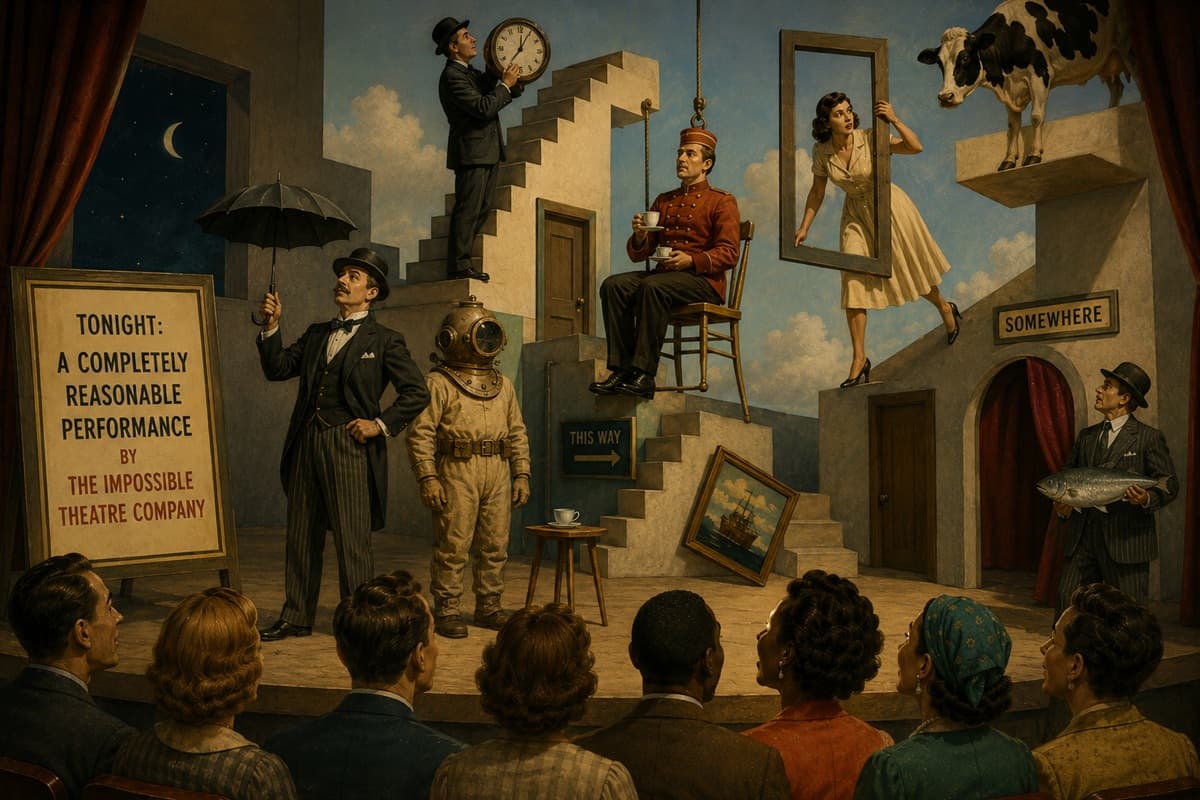
Exaggeration makes something too large, too small, too intense, too frequent, or too consequential. Comedy uses that distortion to reveal a pattern: a minor inconvenience becomes an institution; a nervous habit becomes a full-time occupation; a tiny achievement receives a monument.
The literal claim is false. The relationship can still feel accurate.
Emotional truth and factual scale
“My inbox contains many unread messages” reports quantity. “My inbox has developed its own weather system” exaggerates scale and gives accumulation a physical image. The value comes from recognition, not meteorology.
Purposeful hyperbole signals its nonliteral frame. Problems arise when unsupported factual claims are presented as evidence rather than comedy. Satire and commentary must preserve that distinction, especially around real people and consequential topics.
Specificity makes scale visible
“The line took forever” is conventional exaggeration. “The line had a reunion while we were waiting” creates a particular consequence. Specific images let audiences measure the impossible scale against ordinary experience.
Details can include time, bureaucracy, architecture, social status, or physical consequence. The more exact the image, the less the writer needs intensifiers such as “literally,” “insanely,” and “the most ever.”
Escalation creates a sequence
Escalation applies the same comic rule at increasing levels. A neighbor’s detailed recycling instructions become a handbook, certification program, and international tribunal for mislabeled cardboard.
Each step should add a new consequence. Simply repeating larger numbers can become predictable. The strongest escalation often changes domain while preserving the premise.
Understatement is the mirror
Exaggeration is not always loud. Understatement creates comic mismatch by describing a major event as minor. “The kitchen ceiling is now participating in dinner” treats structural collapse as a social inconvenience.
Both techniques manipulate scale. Delivery and persona decide whether the distortion feels panicked, dry, boastful, or resigned.
Ethical and contextual limits
Exaggeration can clarify criticism, but it can also intensify stereotypes or misrepresent a target. The benign-violation framework highlights how distance and perceived safety affect humor judgments; those judgments differ across audiences.
Writers should ask whether the exaggeration enlarges a behavior or merely enlarges contempt. A fictional system may provide safer and sharper focus than a vague claim about a whole group.
Revision questions
Identify the ordinary truth beneath the claim. Choose a scale that reveals that truth. Replace generic intensity with a concrete consequence. Escalate through distinct steps. Make the nonliteral frame clear. Stop before the audience can complete every next move unaided.
Apply the method to observational comedy, compare its extreme edge with absurdist comedy, or adjust the premise in the experiment laboratory.
Exaggeration across media
Performance can enlarge an emotion through voice, posture, repetition, and pace without changing the factual wording. Visual comedy can alter physical scale directly. Prose often relies on metaphor and consequence, while editing can turn a small action into an epic sequence through music, cuts, and reaction.
The medium changes what must remain believable. A stage performer can describe a thousand-page restaurant menu and let the audience build it; an illustration must choose which impossible detail to show. In either case, internal consistency matters. If the first escalation treats inconvenience as bureaucracy, later steps should develop that relationship rather than jump to unrelated spectacle.
Exaggeration also benefits from contrast. One restrained sentence after a large escalation can reset the scale and reveal character: after describing an international dispute over the office thermostat, the narrator admits they were only trying to avoid wearing a sweater.