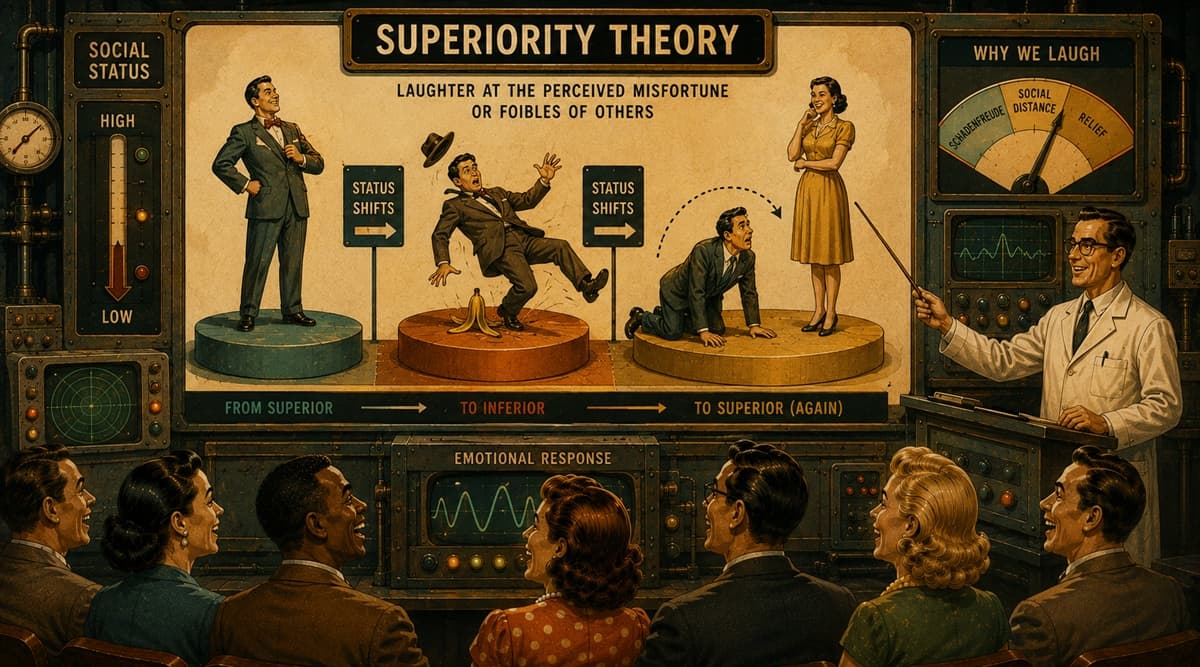
Comedy frequently rearranges status. A pompous character slips, an expert misunderstands the obvious, or a narrator exposes the confident person they used to be. Superiority theory treats this movement as central: people laugh from a sense of triumph or favorable comparison.
The theory captures real comic behavior. It becomes misleading when turned into the claim that every laugh says, “I am better than you.”
The historical idea
Accounts connecting laughter with derision appear early in Western philosophy. The Stanford Encyclopedia of Philosophy surveys versions associated with Plato, Aristotle, and Hobbes, while also showing how later theories challenged the idea that laughter is fundamentally hostile.
The basic structure is comparative. Someone appears ignorant, clumsy, pretentious, defeated, or lower in status. The observer experiences a momentary elevation.
Slapstick makes the structure visible when a controlling character loses physical control. Satire may lower an institution’s claimed dignity. Banter can turn conversation into a temporary contest.
Status moves in more than one direction
Comedy rarely contains only a target and a victor. A performer can ridicule a fictional version of themself while demonstrating authorship, timing, and control. The stage persona loses status; the craftsperson gains it.
“I created a budget so detailed that I can now identify exactly which spreadsheet is disappointed in me.” The speaker admits failure but controls the frame. Audience identification may replace simple superiority: people recognize their own attempts at responsible adulthood.
Affection also complicates ridicule. Friends may tease one another inside relationships that supply permission and reciprocity. The same wording from a hostile stranger can become aggression.
Why the theory is useful
The superiority lens encourages specific questions:
- Who begins with authority?
- Who knows more than whom?
- Whose body, language, or values become the object of attention?
- Does the joke challenge power or reinforce it?
- Does self-deprecation invite recognition or demand reassurance?
- Is the audience laughing at a character, with a performer, or both?
These questions expose social mechanics that structural labels such as “reversal” can miss.
Why it is not enough
Puns, playful nonsense, affectionate callbacks, and surprising analogies can be enjoyed without a meaningful loser. Even ridicule may involve incongruity, tension, recognition, and performance. The sense of superiority might be one consequence rather than the cause.
The theory can also overread every difference as hierarchy. Finding a mistaken interpretation funny does not always mean despising the person who made it. Audiences can laugh at the fragility of everyone’s reasoning, including their own.
Ethical stakes
Because status is real, comedy can intensify humiliation. A clever structure does not erase power differences. The same joke “punching up” at an institution and “punching down” at a vulnerable individual may use identical grammar while creating different consequences.
Those labels are useful shortcuts, not automatic rulings. Context includes who speaks, who is present, what history surrounds the material, and whether the target can participate in the frame.
Analysis should distinguish description from judgment. We can identify that a joke lowers someone’s status. Deciding whether the move is insightful, affectionate, lazy, or harmful requires more evidence.
Self-directed comedy
Self-deprecation is not socially simple. It can build trust by acknowledging imperfection, protect the speaker by naming a weakness first, or create a persona whose failures generate material. It can also become repetitive, invite an audience to endorse genuine contempt, or conceal a boast inside apparent humility.
The useful distinction is agency. Does the speaker control the frame and transform experience, or does the performance merely confirm a degrading label?
Superiority and machines
AI comedy sometimes relies on familiar targets: the machine is socially awkward, the human is irrational, or each side misunderstands the other. These frames can be effective because status shifts quickly. They can also become predictable.
A fair AI-versus-human comparison should not define the human as soulful and the machine as incompetent before the first line appears. Authorship is one contextual variable, not a quality score.
Superiority theory is most useful when it reveals a relationship. Use it alongside incongruity, relief, and audience context rather than as a universal diagnosis.