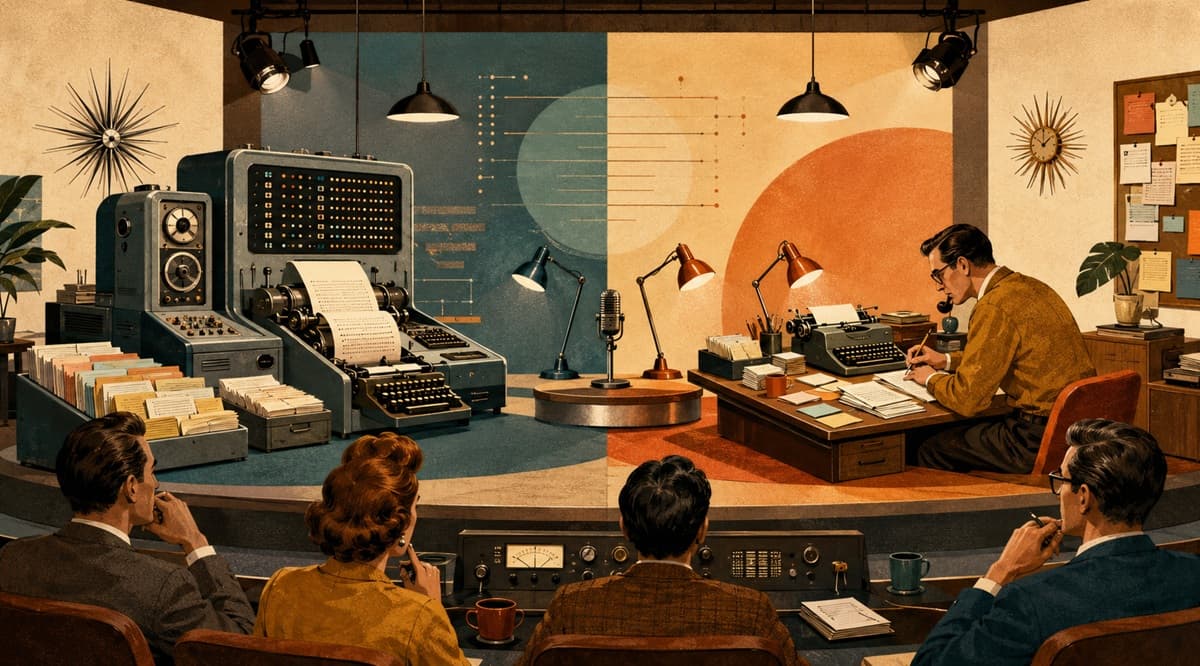
A fair AI-versus-human comedy test should not cast the human as soulful genius and the machine as clumsy appliance—or reverse the roles for spectacle. Both attempts need a real chance to work. Authorship should be revealed after the audience encounters the material, and the result should remain modest.
Compare outputs, then processes
At the output level, ask the same questions: Is the premise specific? Is the turn supported? What context is required? Does wording help? Human work is not automatically original, and machine work is not automatically generic.
Process explains differences. A human writer can draw on personal experience, intention, embodied performance, and a continuing persona. A language model can produce rapid variation from learned patterns and prompt context. A human editor may select and reshape the machine candidates.
Speed is not taste
Generation speed makes exploration cheap. It does not decide which line suits a particular room. Selection can become the dominant creative act when hundreds of candidates are available.
Human writers also generate and discard material, though usually through less visible internal and social processes. Comparing one polished human line with the first machine output would test workflow choices more than creative limits.
Experience and persona
Human comedy can arise from a life, relationship, body, place, and long-running public voice. Models can reproduce persona-like consistency inside context, but that behavior should not be confused automatically with lived biography or personal stakes.
Machine collaboration may still help a human develop persona by supplying contrast: rejected suggestions clarify what the writer would never say.
Evaluation remains subjective
Human panels disagree, and panel composition matters. A review of humor-generation evaluation argues that demographic and methodological transparency are especially important for humor, irony, and sarcasm (ACL Anthology). A blind preference result reports this group, material, and setting—not the permanent winner of comedy.
What a machine win means
If readers prefer the machine-associated line, it means that line succeeded for those readers under those conditions. It does not prove consciousness. If the human line wins, it does not prove machines can never improve. Repeated, transparent comparisons can reveal patterns without turning each round into a metaphysical championship.
Try that discipline in the human-versus-machine exhibit, and examine generation in Can AI Write Jokes?.
Designing a fair comparison
Use original material on matched topics and formats. Give both sides comparable constraints and editing opportunities. Randomize which side appears as specimen A. Ask for preference before revealing authorship, then ask whether the reveal changes interpretation. Record disagreement instead of turning it into one universal winner.
Analysis should examine mechanism, specificity, required context, strengths, and weaknesses for both entries. It should disclose whether machine candidates were selected from a larger pool and whether human entries were revised. Without that information, the comparison can reward invisible asymmetry.
Authorship reveal is itself an experiment. Some readers may reassess intention, effort, or originality after learning the source. That change is part of the study of comedy reception, not evidence that the first response was false.