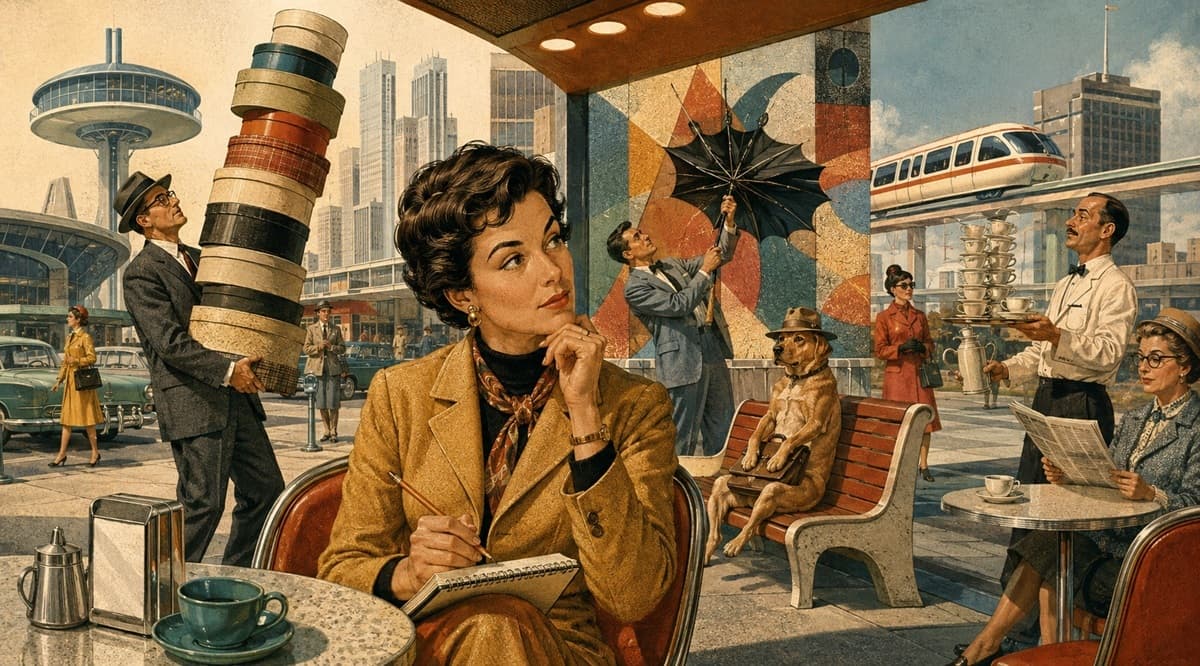
Observational comedy begins with a quiet act of selection. The world supplies endless habits, objects, rituals, and minor contradictions. The comic decides which detail deserves a frame.
“Airports are stressful” is a subject. “Boarding groups turn a printed number into a public estimate of your worth” is an observation: it identifies a procedure, an emotional interpretation, and a point of view.
Recognition is the invitation
The classic response to observational material is “I’ve noticed that too,” though often the audience had not consciously named it. The writer compresses a repeated experience into a portable image.
Recognition does not require universality. Specific material can be powerful precisely because it reveals one household, job, city, body, or community. The writer should know whether the audience needs more context and avoid presenting a local habit as human nature.
Specificity separates material from topic
General statements produce agreement more easily than comedy. Specific details produce scenes:
- General: video calls are awkward.
- Specific: everyone waits silently until two people unmute together and begin the politest duel in office history.
The second version gives the audience behavior to replay. “Polite duel” reframes the collision without requiring a conventional punchline.
Useful details include sequence, physical behavior, exact wording, status, and the small rule nobody admits following.
Point of view creates the comic frame
Two writers can observe the same self-checkout machine and produce different material. One sees failed automation, another sees unwanted teamwork, and another sees a machine assigning blame through increasingly disappointed beeps.
Point of view answers: What does this detail mean to this speaker? A catalogue of accurate observations can remain flat if nothing organizes them.
Persona adds constraints. An impatient narrator, cautious optimist, or administrative obsessive notices different parts of the same event. The observation reveals the observer.
Compression and escalation
Observational comedy often compresses many experiences into one representative scene. It may then exaggerate the logic: the hallway pile of delivery boxes becomes a small recycling enterprise; an app notification becomes a supervisor checking attendance.
Exaggeration works when it preserves emotional truth. The image is literally false but structurally recognizable. Without that connection, scale becomes decoration.
Shared experience has boundaries
“Everyone does this” is usually an unverified claim. Audiences differ by culture, age, ability, profession, technology, and resources. Broad framing can exclude the people who do not share the reference while hiding the specificity that made it interesting.
A better stance is concrete: “At my grocery store…” or “Some group chats develop…” The narrower claim often produces stronger material because it permits accurate detail.
From notebook to joke
An observation can be developed by asking:
- What exactly happened, in what order?
- What unofficial rule did people follow?
- What did the behavior resemble?
- What status or emotion was hidden inside it?
- What detail would another observer overlook?
- Can the scene be compressed without losing recognition?
Then test several mechanisms: analogy, personification, reversal, exaggeration, or a character response. The mechanism should reveal the observation rather than substitute for one.
Observation and AI
Language models can reproduce common observational forms and combine familiar domains. Their risk is generic recognition: material about meetings, coffee, and phones may be structurally competent but detached from a particular lived scene. Human prompting and editing can add context, but the distinction between patterned output and experience remains relevant.
For practical comparisons, inspect ARTFunny's observational jokes about everyday life and the more narrowly focused collection of original work jokes.
Explore it in AI vs. Human Comedy, or compare curated attempts in the experiment laboratory.