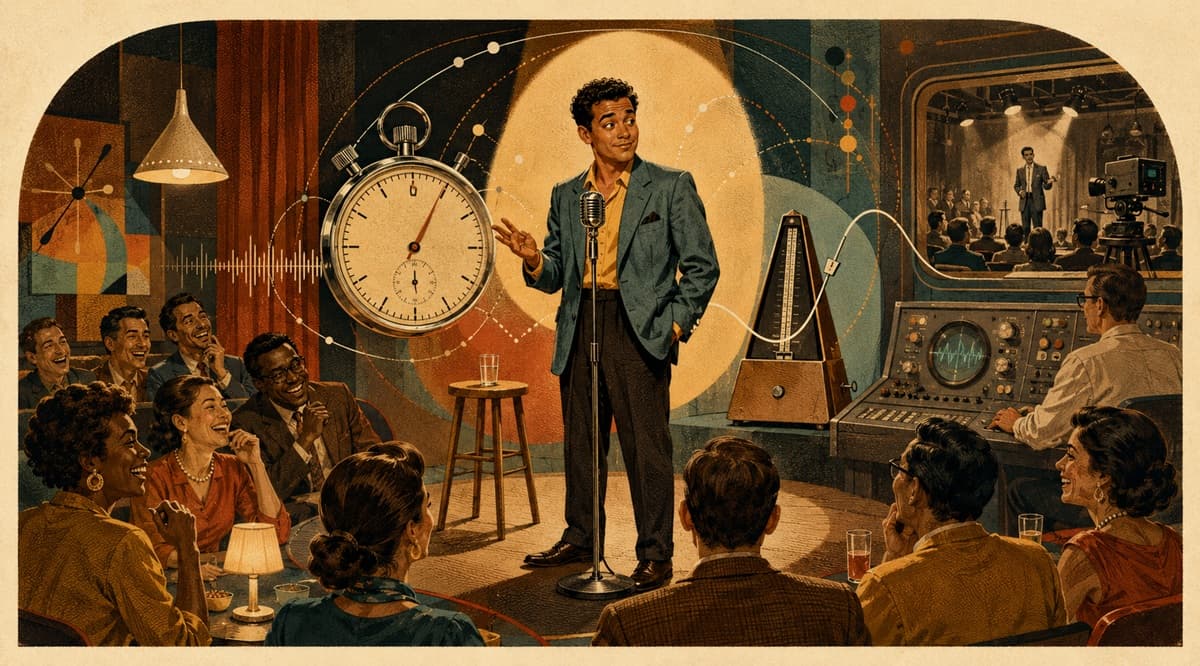
Timing is often described as instinct: a performer either has it or does not. That description protects the mystery but hides the craft. Timing consists of choices about pace, order, pause, emphasis, interruption, reaction, and the moment an audience is ready to revise an interpretation.
The choices are not universal settings. A pause that creates anticipation in one room may feel like hesitation in another. A fast line may conceal a turn or bury it. Timing is a relationship among material, performer, medium, and audience.
Timing begins inside the sentence
Word order determines when information becomes available. “My alarm clock and I have trust issues because it knows I’ll negotiate” reveals the relationship early. “Every morning I negotiate with the only witness who knows I set the alarm myself” delays the identity and gives “myself” final emphasis.
Neither structure is automatically funnier. The point is that syntax has a clock. A revealing word placed early cannot be made late by pausing dramatically after it.
Writers often improve timing by moving necessary explanation before the turn, shortening the path between reveal and final word, and removing a sentence that translates what the audience has already understood.
A pause gives the audience work time
A pause can allow an image to form, an assumption to settle, or a prior laugh to subside. Before a punchline, it may deepen commitment to the first interpretation. After a punchline, it can leave room for reconstruction.
But pauses communicate intention. A conspicuous silence may announce that a “joke moment” is arriving. Deadpan performers sometimes avoid the expected pause precisely to keep extraordinary material inside ordinary conversational rhythm.
The useful unit is not “a two-second pause.” It is the time required for this audience, in this setting, to perform the intended inference.
Pace controls visibility
Fast delivery can create momentum and hide a key detail among familiar language. It can also turn a carefully built premise into a list nobody can retain. Slow delivery can create tension and authority, or expose a predictable mechanism long before the line arrives.
Pace changes at several scales:
- syllables and emphasis within a phrase;
- the gap between setup and turn;
- the rhythm of lines inside a bit;
- the arrangement of sections across a set;
- the interval before a callback returns.
Timing therefore includes architecture. A callback after thirty seconds is repetition. The same callback after the audience has forgotten to expect it can feel like a hidden circuit closing.
Audiences alter the clock
Live comedy is interactive even when only one person is speaking. Laughter delays the next line. Silence may invite adjustment. A performer can hold, accelerate, repeat, or abandon material in response.
A 2026 study using matched sequences across repeated live performances found both recurring temporal structures and variation connected to audience interaction and performance conditions (PNAS Nexus). Such mapping does not reduce timing to a winning number. It shows that pauses and speech segments are part of the performance’s structure.
Recorded comedy adds editing. A cut can create interruption, withhold a reaction, or compress dead time. Radio uses silence differently because listeners cannot see whether the performer is thinking, staring, or falling through a trapdoor.
Delivery changes meaning
Stress can decide which contrast the audience hears. Compare:
- “I said I finished the report.”
- “I said I finished the report.”
- “I said I finished the report.”
The words remain stable while responsibility and credibility shift. Tone can create sarcasm, uncertainty, false confidence, or character status. Gesture and expression add another timing track: a delayed look may become the real punchline.
Timing on the page
Written comedy uses sentence length, punctuation, paragraph breaks, and visual sequence. A short sentence after a long buildup can create a drop in scale. A line break can withhold information, though overuse trains readers to expect a reveal after every blank space.
Readers also control pace. They can reread, skim, or see the next line in peripheral vision. Good page timing shapes the path without pretending it has complete control.
Why machines struggle with timing
A language model can learn common placements, produce concise turns, and revise a line when asked. Text generation, however, does not automatically include a live room, vocal prosody, shared attention, or knowledge of how long a particular listener needs. A model may generate words with plausible structure while an editor or performer supplies the temporal intelligence.
This is not proof that AI cannot contribute to comedy. It identifies where “write a joke” and “perform a joke here, now” become different tasks. Explore the distinction in Can AI Write Jokes?.
A timing checklist
Read the material aloud and ask:
- When can the audience first predict the turn?
- Does the setup provide enough time to form the intended assumption?
- Is the revealing word placed where emphasis can reach it?
- Does a pause enable processing or advertise machinery?
- What happens if laughter overlaps the next line?
- Can a sentence be removed after the turn?
- Would a different medium require a different rhythm?
Timing cannot rescue an empty premise, but it can determine whether a real premise becomes perceptible. Examine the other half of the relationship in setup and punchline, then listen for timing inside the experiment specimens.