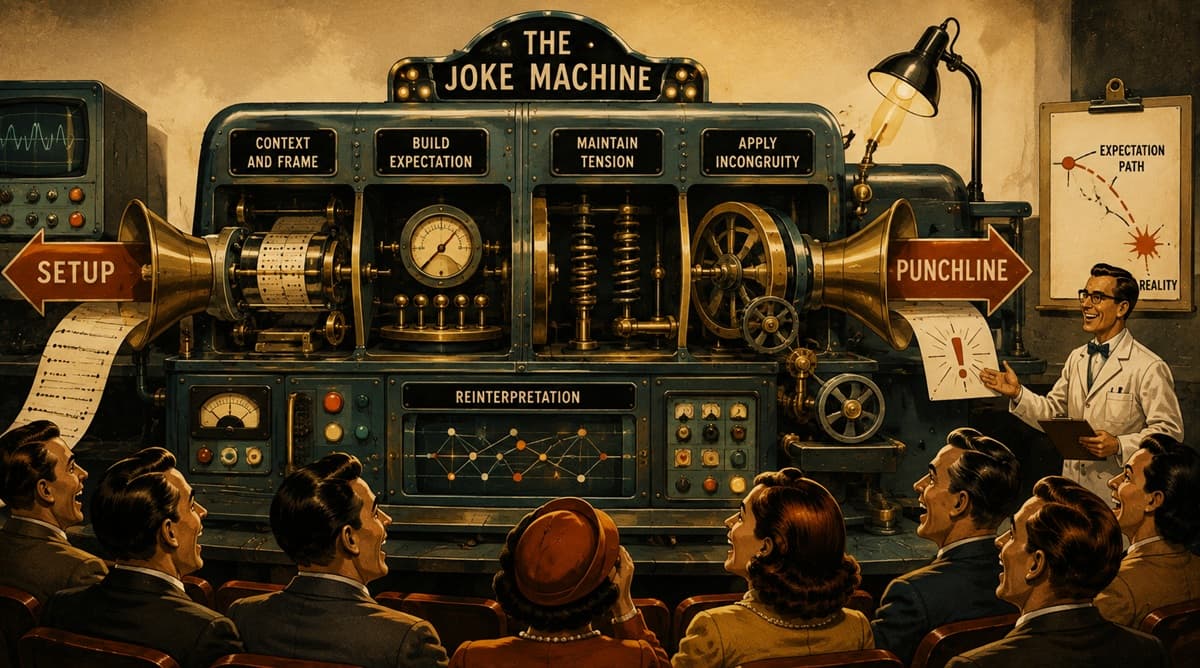
A joke is not a container with “setup” in one compartment and “punchline” in another. It is a sequence of attention. The audience hears or sees information in an order, forms expectations, supplies unstated knowledge, and then encounters something that changes the value of what came before.
That process can happen in one sentence or across an entire performance. The familiar setup-and-punchline structure is useful because it makes the movement easy to inspect. It is not the only form comedy can take.
The premise defines the comic territory
The premise is the central comic proposition or point of view. “My smart home is becoming too judgmental” is a premise. It suggests a relationship between ordinary automation and social disapproval. A finished joke still needs a particular scene, wording, or turn.
A premise is stronger when it contains tension or a useful mismatch. “I own a thermostat” is information. “My thermostat schedules energy-saving reminders for the exact hour I begin questioning every life choice” gives the device behavior, timing, and a target for escalation.
Premises can come from observation, character, analogy, conflict, language, or an invented rule. They do not need to be unprecedented subjects. Coffee, airports, and meetings remain available; specificity and point of view determine whether the treatment feels borrowed or newly noticed.
The setup manages information
A setup gives the audience what it needs to follow the turn. It establishes people, situation, vocabulary, and often an apparently ordinary interpretation. Good setups are not necessarily short, but every detail should have a job.
Consider: “The productivity app asked me to list my distractions.” The sentence introduces a tool, a task, and a familiar self-improvement context. It also creates several possible assumptions: the app will help, the speaker will confess, and the list will contain other activities.
Add the turn: “I appreciated its willingness to be first.” The app itself becomes the distraction. The earlier wording still makes sense, but the implied relationship changes.
The setup did not lie. It allowed the audience to make a reasonable assumption. That fairness helps the reconstruction feel satisfying.
Assumptions are invisible material
Jokes depend on what they do not state. The audience completes social scripts, word meanings, cause-and-effect relationships, and genre conventions. A writer manages those assumptions by choosing which details to foreground.
If a line says, “The hotel advertised a quiet room,” audiences may anticipate noise. That expectation comes from a familiar complaint structure, not the literal sentence. A surprising turn must either use that anticipation or deliberately replace the whole frame.
Analysis becomes more useful when it names the hidden contribution: What must the audience know about hotels, status meetings, dating apps, or family group chats? If the required knowledge is too obscure, the joke may need more setup. If it is overexplained, the audience loses the pleasure of supplying it.
The turn changes direction
The turn is the point where the active interpretation changes. In a one-liner, it may coincide with the punchline. In a story, the turn can happen several times as details acquire new meaning.
Common turns include:
- Reversal: the apparent winner becomes the loser, or cause becomes effect.
- Reframing: an event is described through an unexpected domain.
- Literalization: figurative language is treated as physical fact.
- Scale change: a minor issue receives epic treatment, or a major issue is reduced to paperwork.
- Ambiguity: another meaning of a word or sentence becomes active.
- Character reveal: the speaker’s priorities become stranger than the situation.
A turn is stronger when it is both surprising and retrospectively supported. Randomness can work in absurdist comedy, but even there tone and established rules often create a different kind of coherence. Research on incongruity and absurd humor suggests that resolved and unresolved incongruity can take different paths; “resolution” should not be treated as mandatory in every form.
The punchline concentrates the change
The punchline is the portion designed to deliver or complete the comic turn. Placement matters because audiences process sentences over time. A revealing word at the end receives more emphasis than the same word buried in explanation.
Compare:
- “Because it sends so many notifications, I think my meditation app is anxious.”
- “My meditation app sends six reminders a day. It seems anxious.”
The second version lets the evidence arrive before the diagnosis and ends on the personification. Whether it is funnier is subjective, but its information path is cleaner.
Punchlines are often shorter than setups because the audience should be able to complete the reconstruction quickly. Extra explanation after the turn can compete with the laugh or reveal that the setup did not prepare enough.
Tags extend a discovered pattern
A tag is an additional short laugh point after the main punchline. Once the audience understands the comic rule, a tag can apply it again, escalate it, or reveal a consequence.
Main line: “My meditation app seems anxious.”
Possible tag: “Yesterday it asked whether I was ignoring it.”
The tag works inside the established personification. It should add information rather than translate the original line. Too many tags exhaust the pattern; a strong rule can become a form the audience completes before the performer does.
Repetition and callbacks use memory
Repetition establishes expectation. Each return can increase scale, change context, or prepare a later break. The rule of three often works because two examples make a pattern and the third has room to satisfy or violate it.
A callback revives earlier material after the audience has moved on. Its effect comes partly from recognition and partly from efficiency: an old detail now performs a new job. The audience experiences the pleasure of memory being rewarded.
Callbacks are not automatically superior writing. A return must fit the new moment. Repetition without development feels like an echo asking for credit.
Timing shapes processing
The words do not exist outside time. A pause can let an assumption settle, give an image room, or signal that the speaker has noticed something. Faster delivery can conceal a key connection until the sentence ends. Interruption can create a turn before language does.
Research comparing repeated live performances finds recurring structures and variation in pauses, speech, and audience interaction, illustrating that timing is part of the performed material rather than decoration added afterward (PNAS Nexus, 2026).
Written comedy uses punctuation, line breaks, paragraph order, and visual withholding to manage similar effects. It cannot fully encode voice and room response.
Delivery adds a second text
Tone, expression, gesture, pace, and persona can reinforce or contradict the words. Deadpan delivery invites the audience to notice a gap between extraordinary content and restrained presentation. Sarcasm often depends on a mismatch between literal praise and contextual disapproval.
Delivery can also repair or damage structure. A performer may clarify an assumption with emphasis or bury the turn through rushed wording. An effective transcript can fail aloud; an ordinary sentence can become comic through precisely observed behavior.
Why a correct joke can fail
A line can possess premise, setup, and punchline without producing useful tension. The turn may be predictable, the language generic, the target unappealing, or the assumed knowledge absent. The audience may recognize the mechanism before the material earns a response.
Structure organizes an attempt. It does not compel taste.
That distinction matters for AI-generated comedy. Language models can reproduce common forms and propose many variations. Human selection can find useful material among them. But producing a structural pattern does not establish that a system shares the audience’s context or experiences amusement. Explore that difference in Can AI Write Jokes?.
A practical joke autopsy
To inspect a joke without announcing a universal verdict, identify:
- Premise: What comic proposition organizes the material?
- Setup: Which facts and vocabulary are supplied?
- Assumption: What does the audience add?
- Turn: What interpretation, status, or scale changes?
- Punchline: Where is that change concentrated?
- Mechanism: Reversal, ambiguity, exaggeration, analogy, or another lens?
- Delivery and context: What exists beyond the words?
- Possible failure: What might another audience lack or reject?
The point of the autopsy is not to prove the joke alive. It is to see how its parts were asked to cooperate. Try the site’s specimens in the experiment laboratory, then examine setup and punchline in detail.