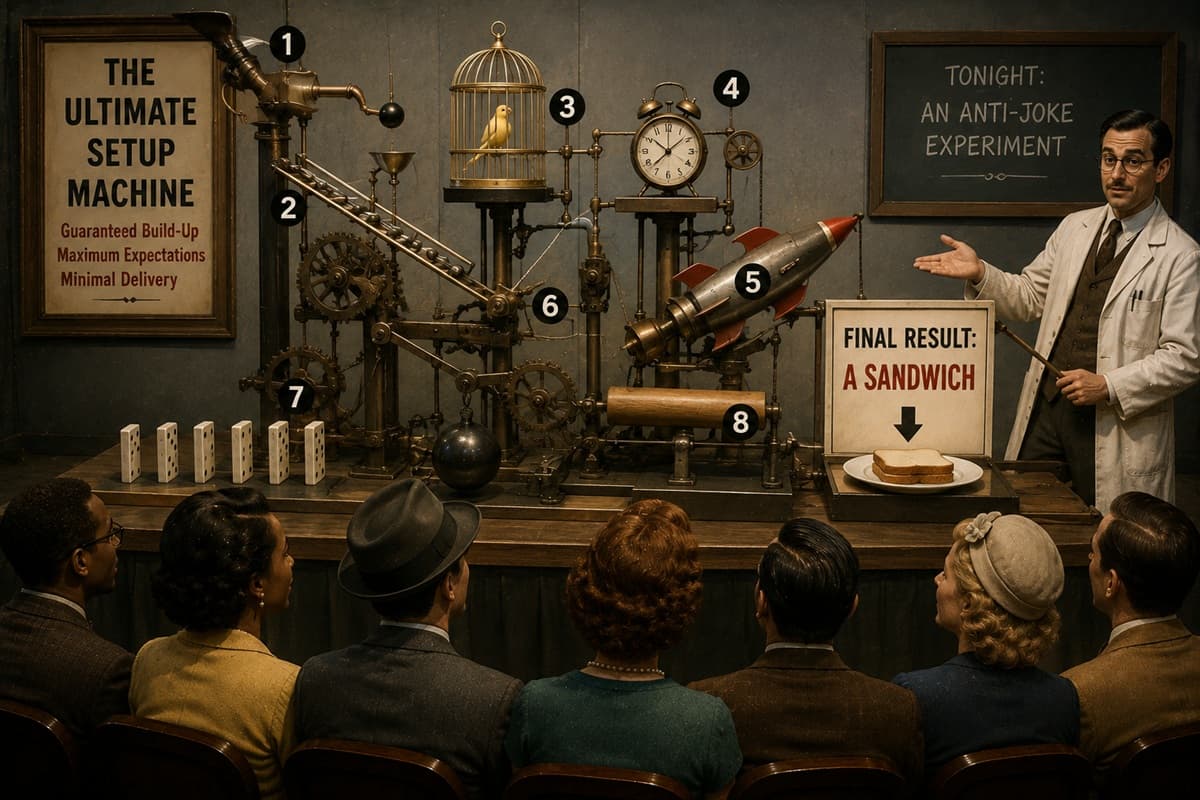
An anti-joke builds a familiar runway and then declines to take off. The setup signals a riddle, pun, or narrative turn. The response arrives as literal information, deliberate bathos, or an answer that exposes the artificiality of the question.
The refusal becomes the event.
Expectation is required
Anti-jokes depend on knowledge of ordinary joke forms. If an audience does not recognize the setup pattern, the literal answer may look merely literal.
Original example: “Why did the committee cross the road? The meeting room had been changed.” The setup invokes a familiar riddle form. The answer supplies plausible logistics instead of wordplay.
The effect is not the absence of structure. It is a structure about absent payoff.
Literal answers and bathos
Literal anti-jokes replace a figurative or comic answer with ordinary causation. Bathos drops from elevated expectation to trivial reality. Other anti-jokes comment on the setup, delay the refusal, or repeat a non-joke until the audience’s relationship to it changes.
Delivery matters. Deadpan can preserve the setup’s apparent seriousness. An exaggerated wink may make the refusal too obvious.
Failed jokes are not automatically anti-jokes
A conventional joke with a weak punchline is still attempting a conventional payoff. An anti-joke deliberately makes the denial legible. The audience should be able to identify the expected form and the choice to refuse it.
Intent cannot always be recovered, so classification remains interpretive. Repetition and context often provide evidence: a series may establish that literal disappointment is the governing rule.
Anti-jokes and incongruity
The mismatch occurs between genre expectation and actual response. The answer can be perfectly congruent with ordinary reality while incongruent with the promised joke. This shows why analysis must identify the level at which an expectation operates.
The form can also turn into absurdity when a literal answer is excessively detailed or when the refusal itself escalates.
Writing an anti-joke
Choose a recognizable setup, understand the conventional range of answers, and refuse it precisely. Keep the literal response concise unless excessive explanation is the intended game. Do not mistake random irrelevance for anti-humor.
The form is sensitive to novelty. Once an audience expects the non-punchline, a second reversal or escalation may be needed.
Compare the machinery with setup and punchline, inspect the literal resolutions in the original anti-jokes collection, and then decide whether the experiment lab is operating normally. That would be unusual.
Why repetition changes the form
One literal answer may surprise. A sequence teaches the audience to expect literal refusal, which means the anti-joke must develop. It can increase the administrative detail, reveal that a character is trapped inside the form, or suddenly deliver a conventional punchline after the audience has stopped expecting one.
This is why anti-humor depends on placement. A plain answer at the beginning of a set and the same answer after five elaborate riddles are not the same event. The audience’s memory becomes material.
Anti-jokes can also expose the transaction of joke telling. A setup appears to promise effort from the speaker and interpretive reward for the audience. Refusing that exchange can feel mischievous, hostile, or refreshing depending on persona and permission. The form works best when the refusal looks chosen rather than careless.