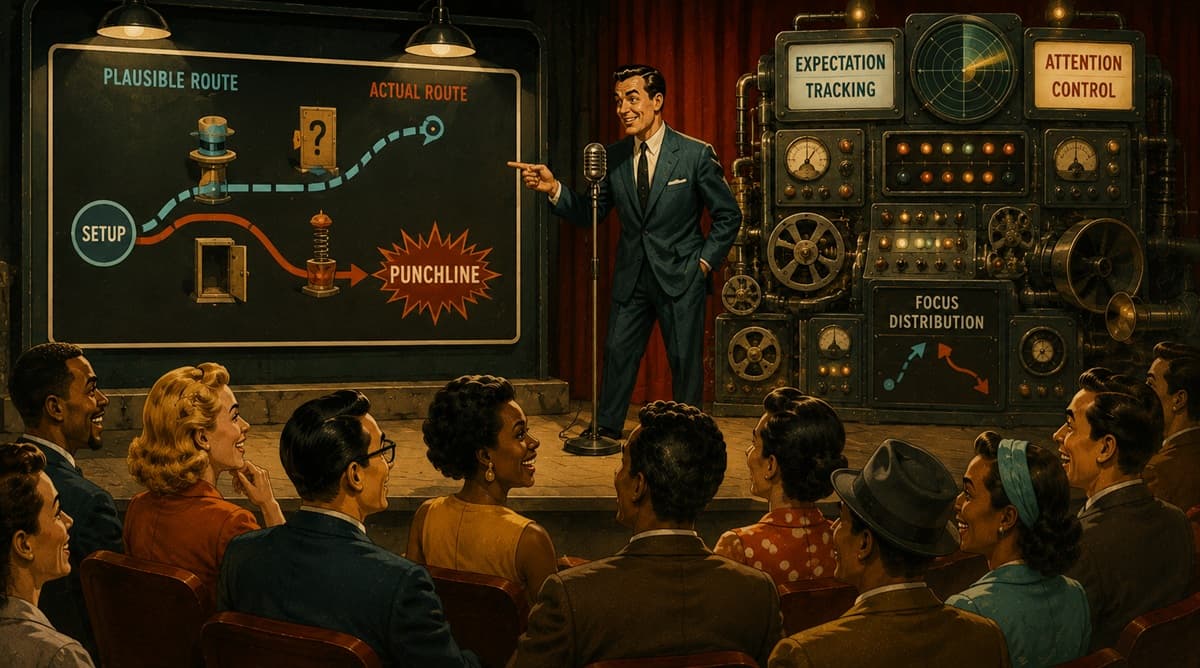
Misdirection is not simply hiding an answer. It is the craft of making one answer feel natural while another remains available. The audience participates by choosing the obvious route. The punchline reveals that the route was not the only one.
That participation distinguishes a satisfying turn from random interruption. A good reveal sends the audience backward through the setup: the same words now support a second map.
Attention, not dishonesty
Comic misdirection rarely requires a false statement. It works by controlling emphasis, sequence, and convention. If a speaker says, “My landlord finally fixed the building’s communication problem,” listeners may anticipate notices, email, or interpersonal conflict. “The doorbell now screams” preserves “communication” while changing its scale and source.
The setup was incomplete, not fraudulent. It invited a familiar assumption. The audience supplied the rest.
This is close to stage magic in one limited sense: attention is guided. But the goals differ. A magician may conceal a method so the event appears impossible. A comic reveal often displays its method in retrospect. The audience enjoys discovering how its interpretation was recruited.
The first interpretation must be plausible
Misdirection needs an attractive path. Writers create it through common phrases, familiar scenarios, genre patterns, and the order in which details arrive.
“I told the hotel I needed a room with character” activates architecture or charm. “They gave me one that refused to cooperate” personifies the room and converts “character” into difficult personality. The alternate meaning existed inside the phrase.
If the setup points nowhere, the ending cannot redirect it. A random word is unexpected, but surprise without relationship asks the audience to abandon rather than reinterpret.
Ambiguity keeps two doors unlocked
Lexical ambiguity gives one word multiple meanings. Syntactic ambiguity lets a sentence be grouped in more than one way. Pragmatic ambiguity leaves speaker intent or reference unsettled. Puns make these possibilities visible, but misdirection can operate without overt wordplay.
Research modeling puns found that ambiguity and distinctiveness helped characterize successful examples while leaving substantial variation unexplained (Kao and colleagues). That is a useful reminder: dual meanings provide machinery, not a guaranteed response.
A writer can test ambiguity by stating both readings plainly. If one reading requires a dictionary expedition or contradicts the setup, the hinge may be too stiff.
Assumptions do the quiet work
Many turns depend less on ambiguous vocabulary than on a social script. “The interview went well; they asked when I could leave” initially borrows the convention that employers ask when someone can start. The final verb changes the status of the conversation.
The joke relies on knowledge of interviews and on the expectation that the speaker will present success optimistically. An audience without that script can understand every word and still miss the turn.
Misdirection analysis should identify that required knowledge. “The audience didn’t get it” may mean the setup failed to activate the intended assumption, not that the audience lacked intelligence.
Fair surprise versus concealed homework
A fair turn feels newly obvious after it arrives. This does not mean every clue must be conspicuous. It means the setup contains enough support that the audience can reconstruct the path without accepting an arbitrary exception.
An unfair reveal often depends on information the speaker never made available: “The surprising thing is that the character was secretly on the moon.” Unless the setup prepared the possibility, the reveal is merely new data.
There are comic forms that delight in anti-fairness. Absurdism can introduce rules that resist ordinary explanation. Even then, commitment, rhythm, and internal pattern usually replace conventional reconstruction.
Timing protects the alternate meaning
The longer an audience holds the first interpretation, the more established it becomes—but also the more time it has to predict a familiar twist. Timing balances investment against suspicion.
A pause can let an assumption settle. It can also raise a large sign reading PUNCHLINE APPROACHING. Fast delivery may conceal a key word until the sentence is complete. In writing, sentence order and line breaks control similar access.
Misdirection is therefore not only what information appears. It is when the audience can use it.
Reversal, reframing, and scale
Several mechanisms can create a redirect:
- Reversal changes who benefits, knows, or controls the event.
- Reframing maps the event into a different domain.
- Literalization treats figurative language as physical description.
- Scale shift makes a minor event institutional or a major event petty.
- Perspective shift reveals that the narrator’s values are the unusual part.
“I created a five-year plan. Year one is devoted to understanding the spreadsheet” shifts the plan from an instrument of confidence to an obstacle. The subject stays stable; its status changes.
Character can misdirect the audience
A narrator may appear sensible until the turn reveals a peculiar priority. In character comedy, the audience’s mistaken assumption concerns the speaker rather than the situation.
“I would never hold a grudge. I keep detailed minutes” begins with moral reassurance and ends with administrative evidence against it. The character does not recognize the contradiction, while the audience does.
This form becomes richer across a story because every new choice can revise what the audience believes about the persona.
Ethical direction matters
Misdirection can also conceal who or what a joke targets. A setup may invite an audience to expect a stereotype, then turn the joke against that expectation. Or it may appear harmless before directing contempt toward someone with less power.
The presence of a clever turn does not settle the ethical judgment. Writers should ask who bears the consequence, what assumptions are being activated, and whether the reveal challenges or merely rewards them.
Context determines whether a violation feels playful, critical, or hostile. That context cannot always be recovered from structure alone.
Editing a misdirection joke
Use this diagnostic:
- Identify the first interpretation in one sentence.
- Identify the second interpretation in one sentence.
- Underline the setup details that support each.
- Remove clues that announce the second too early.
- Add any missing information required for fair reconstruction.
- Place the revealing word where it receives emphasis.
- Check whether the turn changes interpretation rather than only adding oddity.
- Test with people who do not share your drafting history.
The goal is not to make the audience feel foolish. It is to make their reasonable inference become part of the instrument.
Try applying the diagnostic to a specimen in the experiment laboratory, or investigate the theoretical background in incongruity theory.