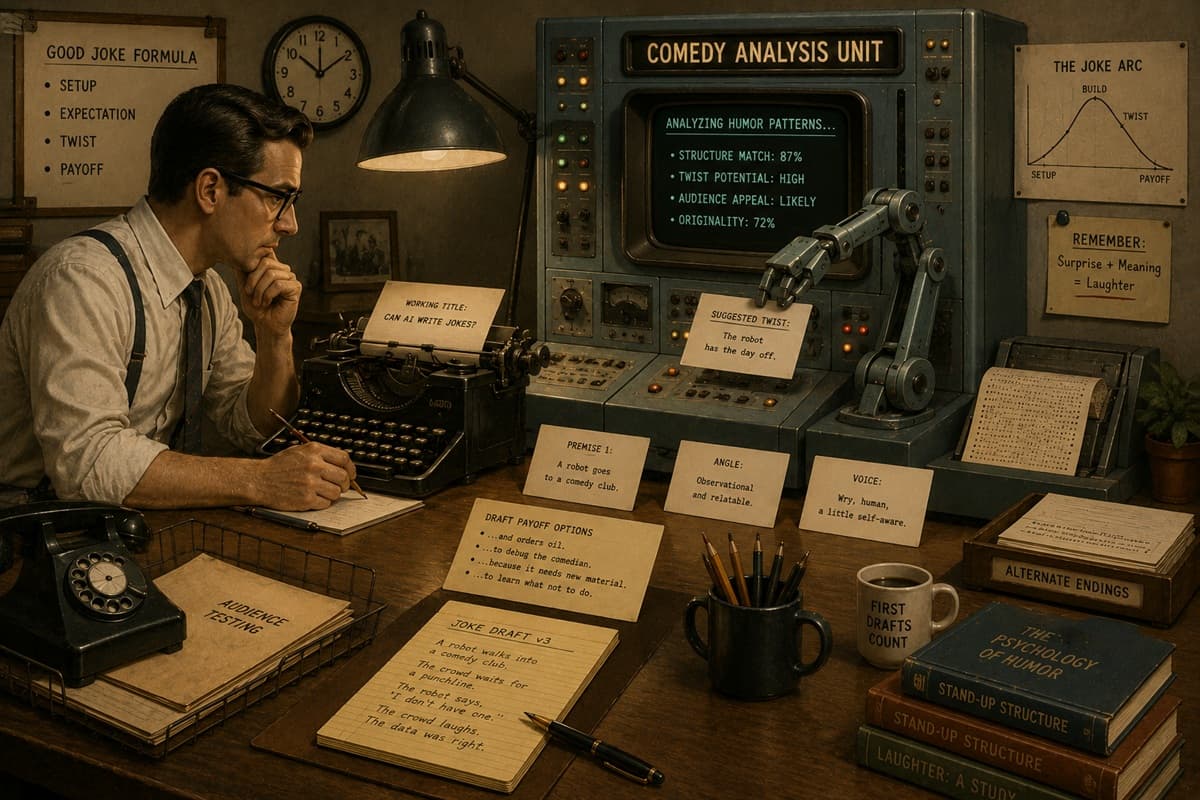
AI can write text with recognizable joke structure. It can propose setups, punchlines, puns, analogies, and stylistic variations. Whether that counts as “writing” depends partly on how the word is being used—and on how much human direction and selection disappear from the story.
From prompt to candidates
A prompt supplies subject, format, tone, audience, constraints, and sometimes examples. The system generates a continuation based on learned patterns and the immediate context. Different sampling choices can produce different candidates.
Specific prompts usually outperform “be funny” because they define a problem: “Write a dry one-liner about a calendar that behaves like a supervisor; avoid productivity clichés.” The constraint creates material for comparison.
Curation is part of the process
A person may generate twenty lines, reject nineteen, combine two, and move the revealing word. Presenting the survivor as untouched machine output would hide important authorship. Presenting the whole process as entirely human would also hide the system’s contribution.
Transparent labels can distinguish raw generation, edited AI-associated material, and human writing. ARTFunny’s approach is described in the AI Disclosure.
What systems do well
They can produce volume, vary a premise, apply familiar structures, suggest alternate language, and help a writer escape fixation on one draft. Earlier computational humor used templates and lexical resources; newer learned systems broaden the range, as reviewed in A Survey on Approaches to Computational Humor Generation.
Where candidates fail
Common weaknesses include generic premises, predictable reversals, strained wordplay, excessive explanation, unstable context, borrowed-sounding phrasing, and no coherent point of view. A line can possess setup and punchline while giving the audience nothing worth reinterpreting.
One 2023 system-specific study found substantial repetition among generated jokes (ACL Anthology). That finding should not become a timeless statement about all models, but it illustrates the need for originality checks and dated claims.
Writing is more than first output
Human comedy writing includes observation, intention, taste, revision, performance, audience feedback, and responsibility. AI can participate in several steps without sharing the full process. The most productive comparison may be workflow rather than authorship mythology.
Try judging curated candidates in the experiment laboratory, then read How AI Generates Humor for the technical path.
Revision reveals the real contribution
Keep a record of the prompt, raw candidates, and edits. The comparison shows whether the system supplied the premise, a useful phrase, the final turn, or merely contrast that helped a human find another direction.
Revision can test the material systematically: replace generic nouns with concrete detail; move the revealing word; remove explanation; check that both sides of an ambiguity are real; read aloud; and search distinctive phrasing for accidental reproduction. A model can assist each step, but it should not grade its own originality or safety without independent review.
The final label should describe the process accurately. “AI-generated and human-edited” conveys something different from “human-written with AI brainstorming,” even when the resulting sentences look similar.