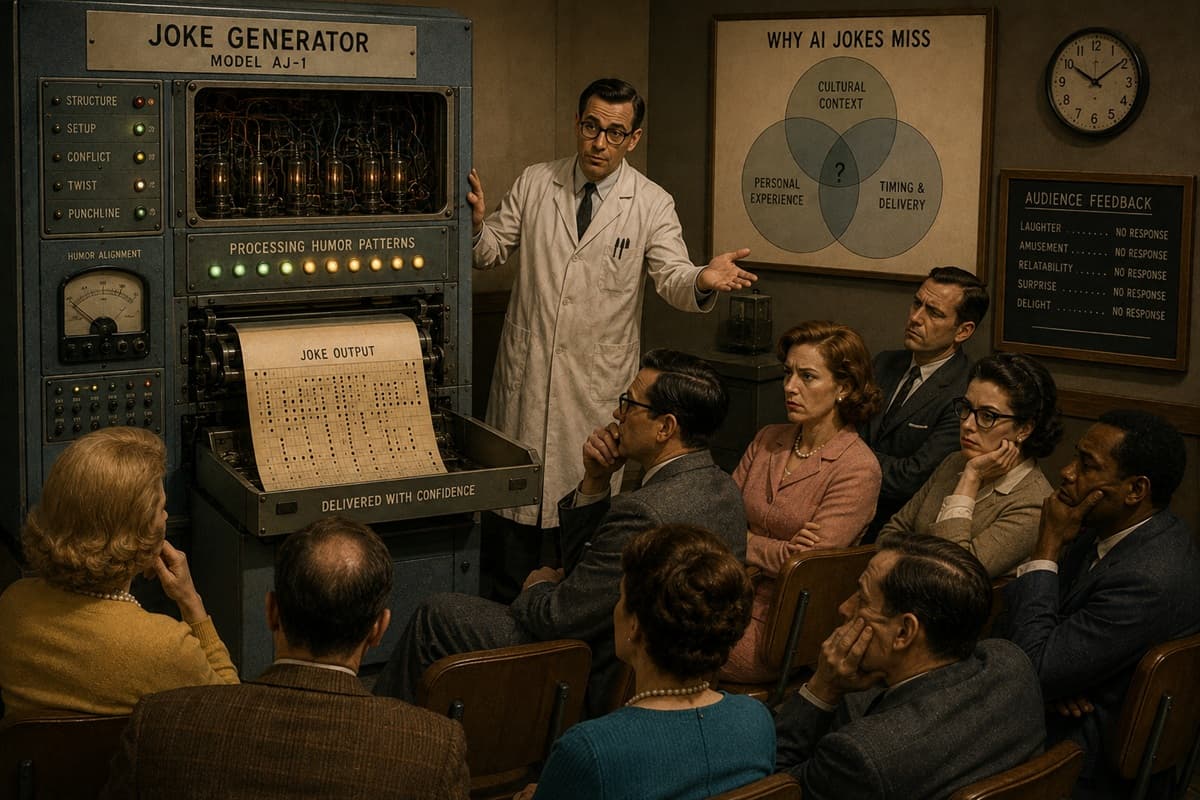
An AI joke can be grammatically clean, visibly structured, and completely inert. That is not mysterious. Human jokes fail under the same conditions. AI adds characteristic ways of arriving there: averaging toward familiar patterns, losing local context, explaining too much, and presenting uncertainty with polished confidence.
Generic premises
Broad prompts encourage broad material. Coffee, meetings, and technology are not exhausted subjects, but a line needs a specific relationship or observation. “My computer is smarter than me” supplies hierarchy without a scene.
Predictable turns
Models learn common joke forms and may choose high-probability reversals. The result signals comedy before delivering new information. A setup can become so conventional that the audience predicts the domain of the punchline.
Overexplaining
Generated text often continues after the turn, naming the irony or restating why the line should work. Comedy depends on audience inference; explanation can remove the participation. Explanations are useful in analysis mode, but they should not leak into the specimen.
Missing context and persona
A system may not know the room, relationship, local reference, or speaker history. It can produce an acceptable generic audience model while missing why this audience reads a line as affectionate, stale, or hostile. Read more in Does AI Understand Context?.
Repetition and imitation
One 2023 exploratory study found that a tested system repeated a small set of familiar jokes across many generations and sometimes explained invalid jokes confidently (Jentzsch and Kersting). Newer or different systems require new evaluation; the lesson is methodological, not permanent.
Safety and stereotype pressure
Humor often approaches violations, which can make harmful stereotypes look like an easy route to contrast. A 2026 study found interactions among humor optimization, toxicity, and stereotyping in its evaluated models and tasks (EACL). Its measurements are study-specific, but the risk is practical: engagement is not an ethical filter.
No delivery layer
Text does not supply timing, expression, gesture, or live adaptation. An editor or performer can add those layers, but raw output should not be evaluated as though it arrived in a room with perfect delivery.
Better failure analysis
Instead of “AI is not funny,” identify the defect: generic observation, unsupported turn, missing knowledge, predictable wording, poor target, or wrong medium. Then compare revisions. This treats the output seriously without treating it as conscious.
Inspect curated successes and failures in the experiment laboratory, or compare processes in AI vs. Human Comedy.
Failure can be useful evidence
A failed line can reveal which part of the pipeline needs work. If several candidates share the same turn, the prompt or learned pattern may be narrowing variation. If readers understand the structure but reject the target, generating more versions will not solve the judgment problem. If a line works on the page but not aloud, timing and performance—not semantics—may be the missing layer.
Documenting failure also resists selective demonstrations. A polished showcase should disclose that candidates were curated rather than implying every generation succeeds. This makes comparison fairer and gives writers a practical revision record.
The correct response to failure is not always a stronger model. A more specific premise, different audience assumption, human observation, or decision not to publish may be the better tool.