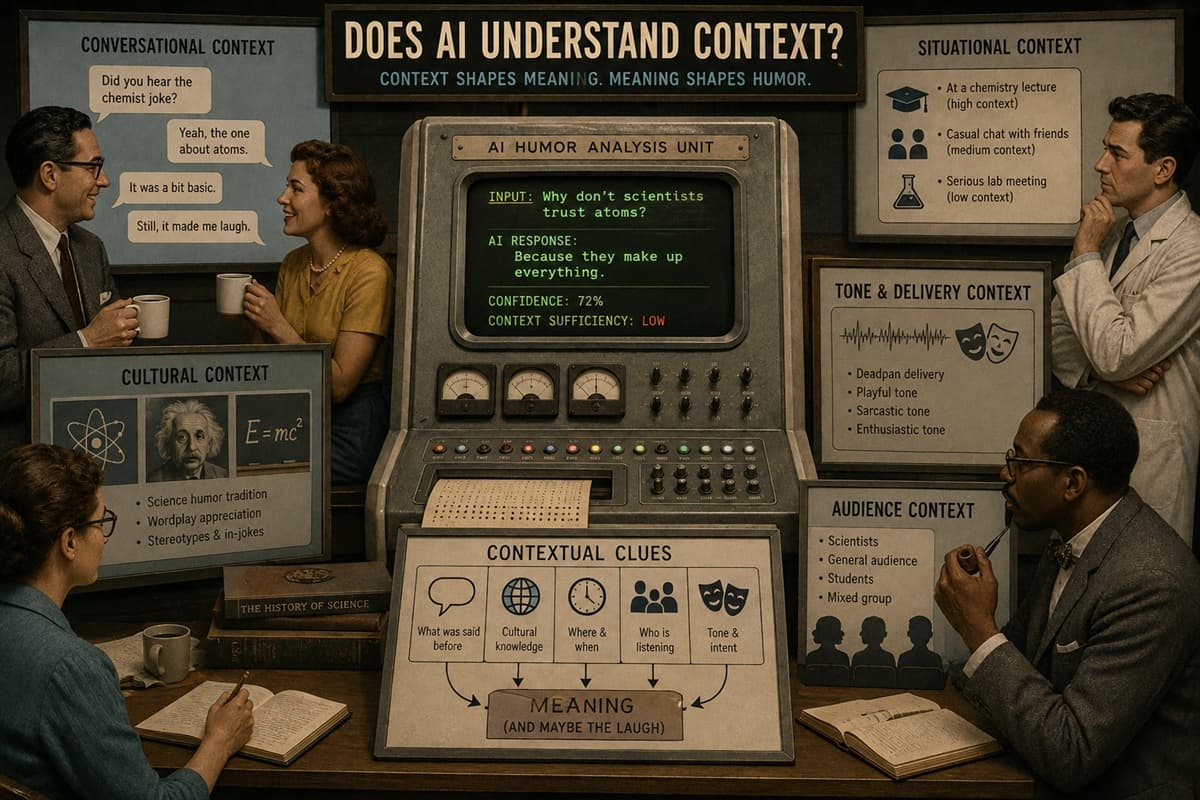
“Context” can mean the words before a sentence, the current conversation, a physical setting, cultural history, shared memories, or knowledge of who is speaking to whom. Saying that a model has a large context window addresses only part of that list.
Prompt and conversational context
Language models use tokens supplied in the current input to shape later predictions. Transformer attention helps represent relationships across sequence elements (Attention Is All You Need). This supports callbacks, instructions, examples, and local reference.
A window can contain text without guaranteeing correct use. Relevant details may be overlooked, contradicted, or overwhelmed by unrelated material.
Cultural and situational context
Comedy relies on norms, interfaces, events, language varieties, and shared references. Training patterns can encode substantial cultural information, unevenly and with biases. A system may reproduce what is common in data while missing a small community’s current meaning or the stakes of a live room.
Physical context matters too. “Nice entrance” means something different after a graceful arrival, a collision, or a stage cue. Text descriptions can supply evidence, but they are representations selected by someone.
Relationship and memory
A callback between friends may depend on years of history. A sarcastic line may be affectionate only because mutual trust exists. Systems can use stored or supplied records where a product permits it, but data availability is not identical to participating in the relationship.
Performance is not a settled philosophy
Bender and Koller caution against equating success on form with human-like grounded meaning (ACL 2020). Other scholars argue for different accounts of machine meaning. Productive evaluation should state the task: did the model use the supplied dialogue, infer the reference, or act appropriately?
In sarcasm research, context improves identification while human disagreement and model differences persist (Jang and colleagues). That is a more informative result than declaring context “solved.”
Better context claims
Specify which context was available, which inference was required, what evidence supports the answer, and where uncertainty remains. For visitor-facing AI, avoid sending sensitive context casually and follow the Privacy Policy and AI Disclosure.
Explore the implications for humor understanding and sarcasm.
Context can conflict
More context may introduce incompatible evidence. A speaker’s current sentence, earlier behavior, cultural convention, and private relationship can point in different directions. Humans resolve such conflicts imperfectly; models may privilege whichever pattern is most salient in the prompt.
Good system design distinguishes unavailable context from ambiguous context. “I need more information” is more accurate than inventing a relationship. Retrieval can supply documents, and tools can supply current facts, but both introduce provenance and privacy questions. The system still needs to connect evidence to the specific inference.
For comedy, a context checklist can include speaker, audience, setting, medium, shared reference, intended target, and consequence. Missing items should appear as qualifications in the analysis rather than silently becoming generic assumptions.
The same discipline improves prompting. Supplying a concrete audience and situation can produce better candidates, but personal data should not be added casually. Useful context is relevant, consented, and proportionate to the task.