Overview
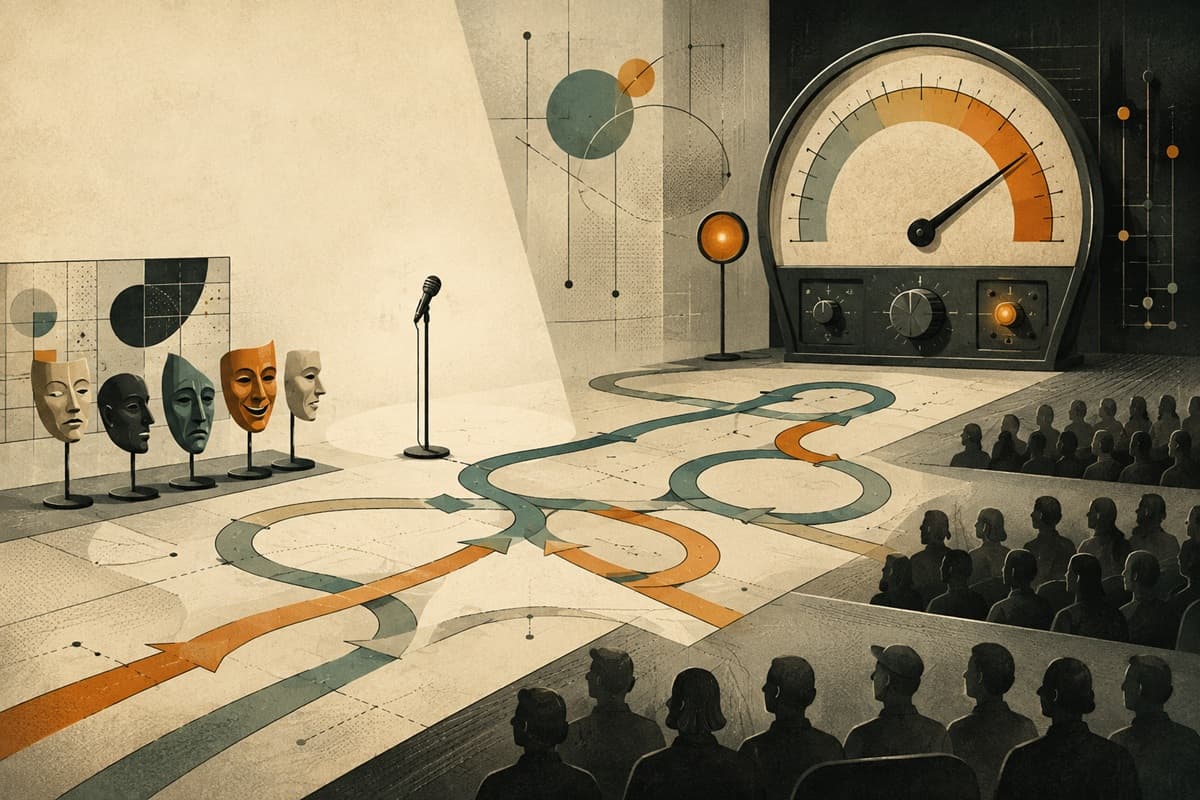
Born in 1973, Dave Chappelle often treats stand-up less as a chain of isolated jokes than as a sustained act of negotiation with an audience. Long stories can move through apparently casual detours before a late reversal changes the meaning of an earlier detail. Sketch experience adds rapid shifts among narrator, character, observer, and provocateur. His record spans Chappelle’s Show, Saturday Night Live appearances, and multiple specials. That combination makes reception part of any serious craft analysis rather than a footnote.
Development of the act
Chappelle’s development joins stand-up storytelling to an unusually consequential period in sketch television. Chappelle’s Show, co-written with Neal Brennan, used recurring characters, parody, and familiar television forms to satirize both subject and medium. His later high-profile stand-up often gave stories more room to breathe. His 2021 podcast The Midnight Miracle extended that looseness into audio, mixing conversation, narrative, music, and digression. The 2025 Netflix special Dave Chappelle: The Unstoppable... and its 2026 Emmy nomination show that long-form stand-up remains central to his public work.
Persona
The stage persona frequently combines intimacy with authority. Chappelle may appear to confide in the room, then use that trust to introduce a premise that unsettles the audience’s expectations or forces a choice about how literally to take the speaker. Sketch-trained character work lets posture, pitch, or viewpoint move the argument without a scene break. The persona also carries accumulated cultural meaning from his career, so audiences do not encounter each special as a blank slate. That history makes later provocation arrive with prior context.
Techniques
Chappelle’s long-form technique depends on withholding. A story can establish one moral or comic frame, accumulate details under that frame, and then reveal information that asks the audience to reinterpret the setup. Reversal is therefore not merely a punch-line device; it can organize several minutes of material. He also uses analogy, character impersonation, callbacks, and strategic repetition to keep a long narrative coherent while allowing digression. Sketch work sharpened compact social worlds built from roles and television conventions. In stand-up, those worlds can be created with little scenery because the performer supplies the edits: a voice change becomes a cut, a pause becomes a reaction shot, and a return to the narrator resets the argument.
Timing and delivery
Controlled pacing is central to the effect. Chappelle is willing to let an audience sit with an unfinished thought, a reaction, or a deliberately uncomfortable implication instead of racing to release tension. A slower cadence gives listeners time to predict where the story is going; that prediction becomes material for the next turn. His 2020 performance 8:46, delivered for a socially distanced audience and released in a rougher workshop-like form, made the audience relationship unusually visible: he could address the immediate political moment while allowing silence and intensity to occupy space normally filled by punch lines. It shows timing in stand-up is social as well as metrical.
Language and style
Chappelle’s language can sound plain and conversational even when the underlying structure is intricate. He often favors an accessible vocabulary, short declarative passages, and repeated framing phrases that keep the listener oriented through a long story. The complexity arrives through viewpoint: who is allowed to define the situation, what assumption the audience has made, and when that assumption is overturned. Social observation often arrives through encounters or characters rather than abstract argument. Because his later material often approaches contested subjects directly, the same economy can intensify disagreement; compressed framing leaves little neutral space between the persona’s provocation and the audience’s interpretation.
Innovations and influence
The enduring craft significance of Chappelle’s Show lies partly in its ability to make television conventions themselves available for satire, while his later stand-up demonstrates how much narrative pressure can be sustained without constant editing or rapid punch lines. His specials have received Emmy recognition, including a 2026 nomination for his 2025 special. At the same time, The Closer prompted protests and extensive criticism over material about transgender people. That reception cannot responsibly be converted into proof that provocation succeeded or failed as a universal matter. Comedy is audience- and context-dependent, and criticism is part of the context in which a public persona and its techniques acquire meaning.
What AI can learn
Generative AI can learn from the visible architecture of Chappelle’s stories: establish a frame, let the audience infer a destination, delay decisive information, then use reversal or callback to reorganize what came before. It can also represent multiple character viewpoints and vary sentence length to control information flow. Those operations are patterns, not lived social judgment. A model does not know what a room is willing to follow, what a charged subject means to people present, or why a performer chooses to risk a particular silence.
What remains difficult for AI
The hardest element to reproduce is audience negotiation. Chappelle’s pacing depends on sensing when listeners are ahead, resistant, uncertain, or ready for another turn, and on accepting personal responsibility for what happens next. An AI system has no embodied presence, lived history, or human intention; it infers responses from data. That gap is especially important with provocation, where identical wording may be received as critique, cruelty, solidarity, evasion, or something else depending on speaker, audience, history, and moment.
Sources and further reading
- Dave Chappelle | Emmy Awards and Nominations | Television Academy — Television Academy
- Watch Dave Chappelle: The Unstoppable... | Netflix Official Site — Netflix
- Dave Chappelle’s Freewheeling Podcast — The New Yorker
- The education of Dave Chappelle: How a D.C. arts school prepared him for stardom — The Washington Post
- The Power of Dave Chappelle’s Comedy — The New Yorker
- Dave Chappelle’s Rough-Cut Humorlessness in “8:46” — The New Yorker