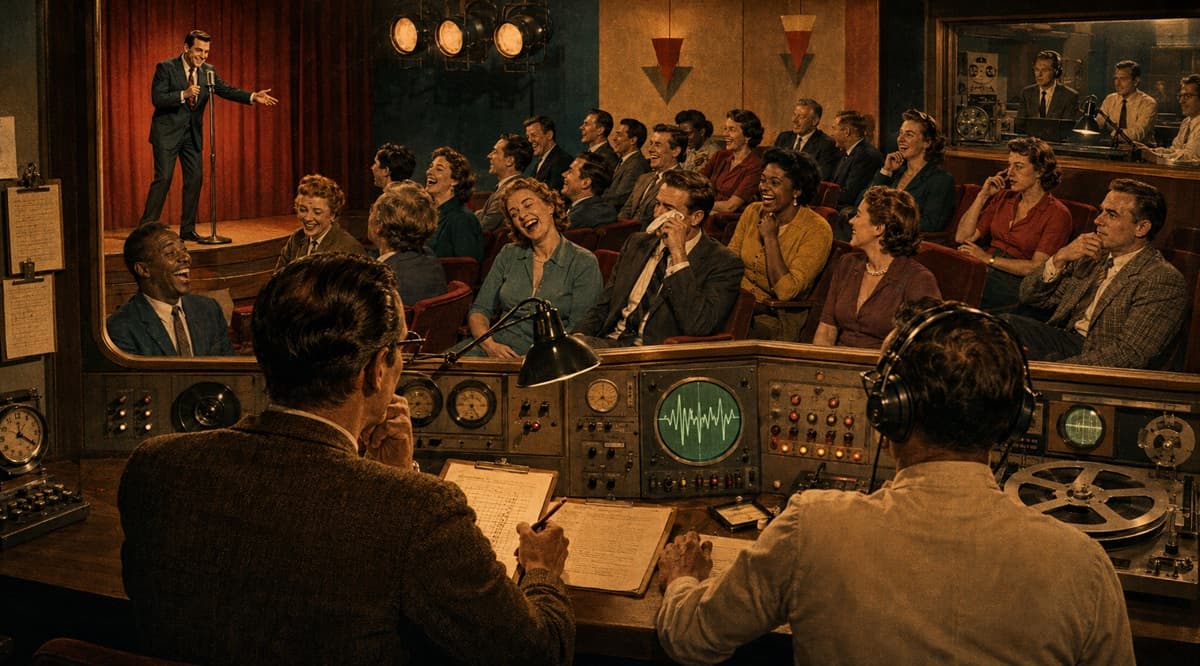
A laugh can answer a joke, soften a disagreement, signal affection, release tension, fill an awkward gap, or arrive at exactly the wrong solemn moment. That range should make us suspicious of any explanation beginning, “People laugh because…” The sentence may describe one cause. It is unlikely to describe the whole behavior.
Laughter is connected to humor, but it is not a built-in applause meter. People can find something funny without laughing aloud. They can laugh without finding anything funny. They can also laugh because other people are laughing, because a conversation needs a signal, or because emotion has exceeded the available vocabulary.
Laughter is behavior, not a rating
When a comic line works, laughter is visible evidence that something happened. It is not a clean measurement of what happened or why. Volume may reflect group size, acoustics, alcohol, permission, surprise, or one especially contagious person. Silence may mean confusion, disapproval, concentration, fatigue, or quiet amusement.
This is why ARTFunny avoids presenting laughter as an objective score. A response can be observed, compared, and described, but interpretation remains necessary. Even a room that laughs together may not be laughing for identical reasons.
The social life of laughter
Laughter often belongs to interaction. The review The Social Life of Laughter describes laughter as strongly influenced by social context and distinguishes more spontaneous laughter from more communicative forms. In ordinary conversation, a laugh can show recognition, invite affiliation, manage uncertainty, or indicate that a remark should be treated playfully.
Imagine two colleagues facing an impossible printer. One says, “It has entered its management phase: no output, strong opinions.” A laugh can register the analogy, but it can also say, “I share your frustration,” “We are allowed to treat this as absurd,” or “Let us not throw the printer through a window.” The comic line and the social signal work together.
Laughter can also enforce boundaries. A group’s laughter may reward a speaker, test a newcomer, reinforce shared knowledge, or make a target feel excluded. Calling laughter social is not the same as calling it harmless.
Play and safety
Several accounts connect laughter with play. Play temporarily changes the meaning of actions: a chase can resemble pursuit without carrying the same threat; mock aggression can remain inside a shared frame. Human comedy often performs a similar conversion. It introduces conflict, violation, or embarrassment while signaling that the audience may examine it at some distance.
The signal can fail. If the situation feels too real, too harmful, or too poorly framed, laughter may disappear or become nervous. The benign-violation proposal describes humor as more likely when something is perceived as both a violation and benign. It is one useful model, not a universal law. What feels benign depends on relationship, distance, timing, culture, and power.
Surprise, recognition, and reconstruction
Some laughter follows a rapid change in interpretation. A setup guides attention toward one meaning; a punchline makes another meaning visible. The audience does not only register surprise. It often reconstructs the earlier wording and sees how both interpretations fit.
That brief mental movement can be pleasurable. Yet surprise is not sufficient. A fire alarm is surprising. A random noun at the end of a sentence is unexpected. Comedy usually gives the shift a frame, a pattern, or a social purpose.
Recognition can work without a sharp reversal. Observational comedy may make an ordinary behavior newly visible: the way everyone presses an elevator button that is already lit, as though the previous person lacked conviction. The audience laughs partly because it recognizes itself.
Relief and emotional pressure
People sometimes laugh after tension breaks: when a feared outcome proves harmless, when an awkward truth is finally stated, or when a performance gives permission to approach difficult material indirectly. Relief theories of humor grew from the idea that laughter releases nervous energy or inhibition. Modern discussion is more cautious, and relief does not explain every comic response.
Still, tension is a useful craft variable. A pause allows uncertainty to accumulate. A taboo creates pressure around what can be said. A long pattern creates a desire for release. The laugh may accompany that release without being reducible to a pressure gauge.
Embarrassment, nervousness, and mixed emotion
Laughter can manage moments that are not comfortably funny. A person may laugh after making a mistake, receiving unexpected attention, or hearing a remark whose intent is unclear. The behavior buys time and proposes a frame: perhaps this can be treated lightly.
Such laughter should not be overinterpreted as consent or enjoyment. In unequal social situations, people may laugh because rejecting the frame feels costly. An ethical analysis asks who had permission to define the moment as playful.
Why laughter spreads
Hearing laughter provides information. It tells us that other people have detected play, incongruity, or a socially acceptable moment to respond. That signal can shift our own interpretation and readiness. Contagious laughter is therefore not mysterious magic; it is part of a broader human sensitivity to other people’s vocal and emotional behavior.
Recorded audience laughter exploits this social cue, though its effect varies. It can help clarify rhythm or make a solitary viewer feel a group response. It can also feel coercive when the comic material has not earned the signal.
Babies, development, and learned context
Laughter appears before children understand sophisticated wordplay, which is another reason it cannot be equated with joke comprehension. Early laughter can emerge in social games, surprise, repetition, and physical play. Over time, children acquire language, cultural rules, genre expectations, and knowledge about what other people know.
The capacity to laugh develops alongside an expanding library of possible frames. A toddler may enjoy a repeated sound. An older child can appreciate a deliberately wrong answer. An adult may recognize a parody only after identifying the style being imitated. The behavior persists while its triggers and meanings become more layered.
Laughter across audiences
There is no abstract audience. People differ in language, attention, sensory processing, mood, experience, and willingness to respond publicly. Some cultures and settings encourage audible participation; others reward restraint. A stand-up room, classroom, family table, and text-message thread create different expectations.
These differences matter for both humans and machines. A model trained to predict a generic “funny” label may be learning patterns in a particular dataset, not a universal human response. A roomful of laughter remains richer evidence than a label—but it still requires context.
What a laugh can tell us
A laugh can tell us that a person responded. With careful observation, it may also reveal timing, group coordination, recognition, discomfort, or delight. What it cannot do alone is explain the joke, certify the speaker’s intention, or prove that everyone ought to agree.
For comedy analysis, the useful question is not “Did laughter occur?” but “What relationship among material, delivery, audience, and situation made this response possible?” Explore that relationship through what makes something funny or test your own reactions in the experiment laboratory.