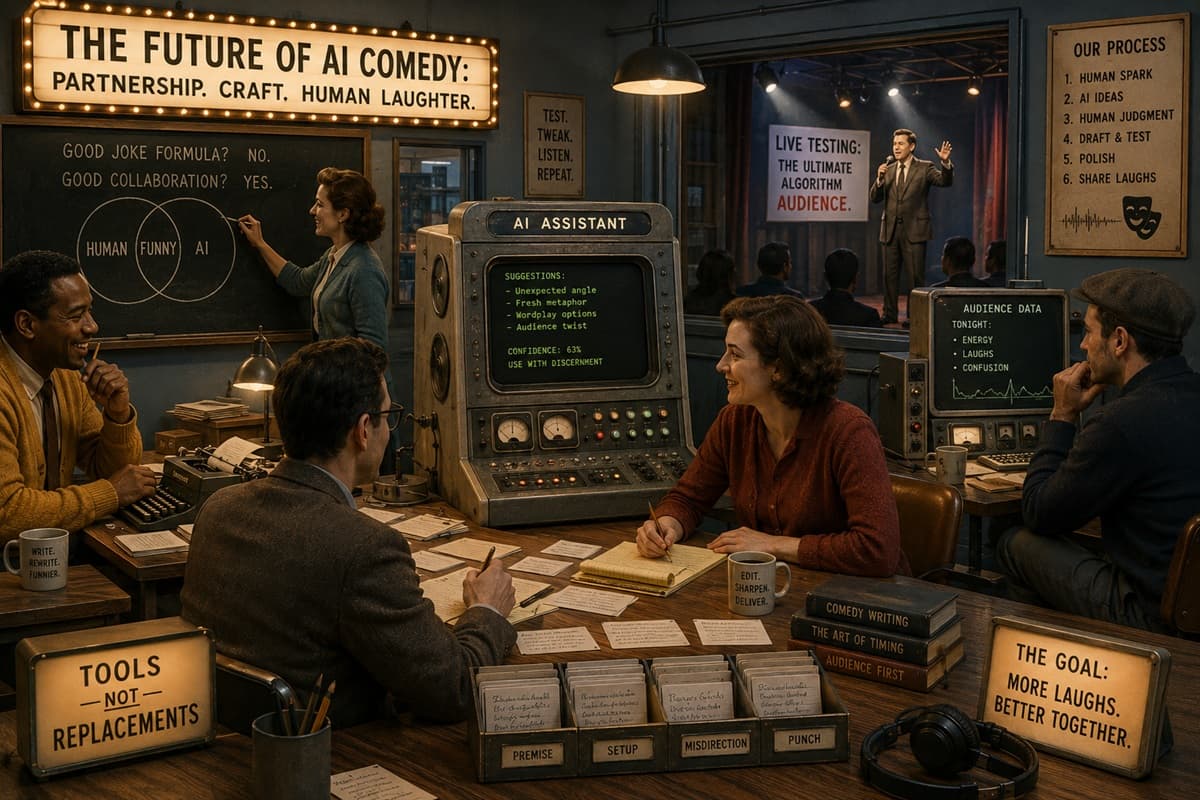
The future of AI comedy is not one prediction. It is a set of choices made by model developers, writers, performers, publishers, audiences, regulators, and the people whose work becomes training material. Technical capability will matter, but so will ownership, taste, labor, and permission.
Collaboration is the nearest scenario
AI already supports candidate generation, transformation, brainstorming, and analysis. Future tools may become better at maintaining project context, offering controllable variations, and learning a creator’s constraints without pretending to replace a lived voice.
The creative value may lie in friction: a writer rejects the obvious machine suggestion and discovers what the piece actually needs.
Live systems create new demands
Improvised tools could respond to audience topics, performance timing, or multimodal cues. That creates latency, privacy, moderation, and attribution problems. A fast unsafe line is not a successful live system. Human override and clear labeling remain essential.
Personalization has a narrow edge
Comedy adapted to a person’s references can feel precise. It can also become surveillance, stereotyping, or unwanted targeting. Personalization should rely on meaningful consent and minimal data, with special caution around private text and inferred traits.
Culture may expand or flatten
Models can support multilingual experimentation and expose creators to unfamiliar forms. They can also average language toward dominant patterns, detach references from communities, and make generic imitation cheaper than careful engagement.
Recent computational-humor surveys emphasize sparse coverage beyond some familiar forms and continuing subjectivity and ethical challenges (Loakman and colleagues). Progress should be measured across languages and communities, not one leaderboard.
Safety and engagement can conflict
Humor approaches social violations, and systems optimized for engagement may reward stereotypes or toxicity. A 2026 study found such interactions in its evaluated models and tasks (EACL). The finding is not a universal constant, but it rejects the assumption that “funnier” automatically means safer or better.
Labor, credit, and provenance
Future comedy tools will affect writers, editors, performers, and rights holders. Transparent production records can distinguish prompting, raw output, editing, and final responsibility. Attribution norms should not disappear because the interface makes generation easy.
Open questions
Can systems adapt without caricaturing audiences? Can originality be assessed without turning creativity into one score? Can creators opt out or be credited meaningfully? How should live failures be moderated? Which forms will emerge because machines and humans have different strengths?
ARTFunny treats these as research questions, not inevitabilities. See the current AI Disclosure, examine the generation process in How AI Generates Humor, and test today’s modest machinery in the experiment laboratory.
What responsible progress would look like
Useful evaluation would publish prompts, selection procedures, human-review methods, audience characteristics, and failure cases. Creative tools would distinguish suggestions from sources, support provenance, and let users control whether private material is retained or reused. Interfaces would make uncertainty and AI involvement visible without forcing readers through a technical manual.
Creators should be able to choose assistance rather than have it imposed. Audiences should know when a live response may be generated. People represented or targeted by material need practical ways to report harm. These are product and institutional decisions, not properties that emerge automatically from a larger model.
The most interesting future may contain neither replacement nor rejection. It may produce forms built around comparison, revision, and visible disagreement—the machine proposes, the human redirects, and the audience notices where each process becomes strange.