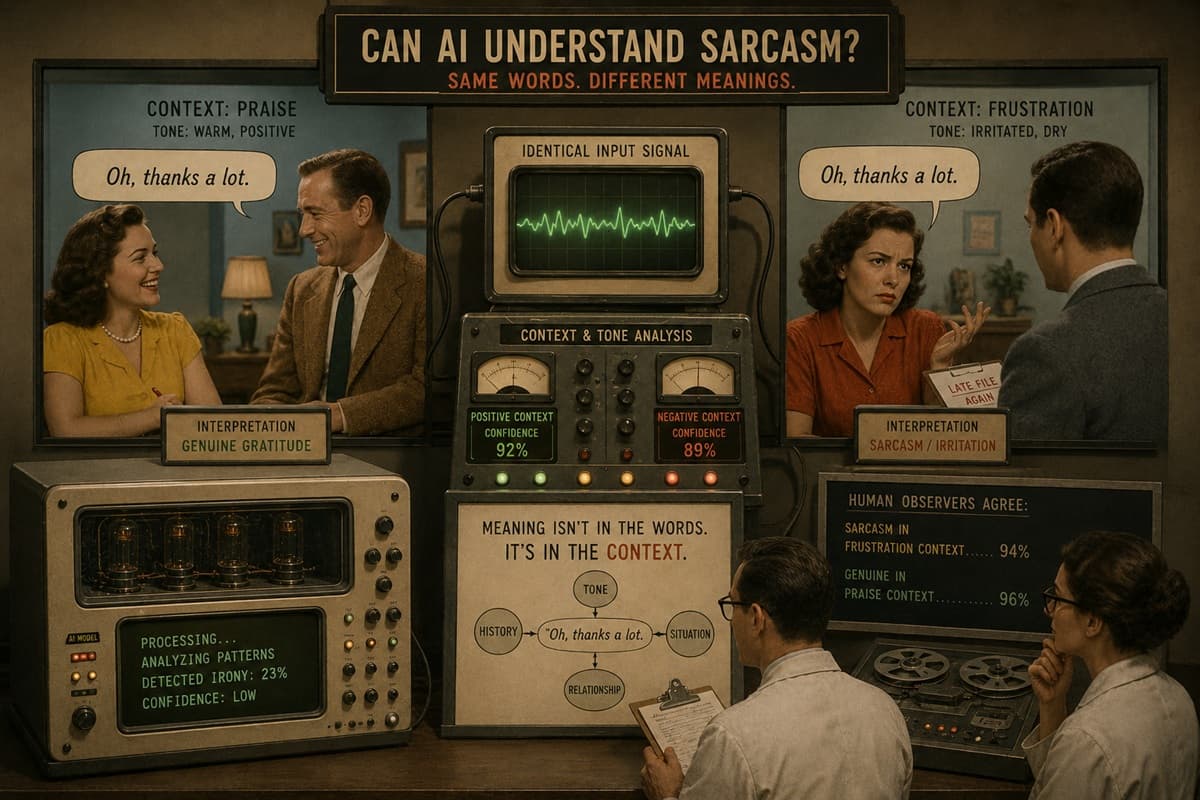
Sarcasm often says something positive while communicating criticism: “Excellent timing” after a late arrival. The literal words are easy. The intended attitude depends on the event, speaker, relationship, and tone.
What systems can detect
Models can learn textual signals such as contrast, exaggerated praise, sentiment mismatch, punctuation, and conversational response patterns. With suitable data, they can classify sarcasm and generate plausible examples. That is useful operational performance.
Context changes the label
“You’re a genius” can be sincere praise, affectionate teasing, or hostility. A 2024 study found that context generally improved sarcasm identification for humans and models, while additional context did not remove disagreement and models varied on disputed cases (Jang and colleagues). More text is not the same as the right social knowledge.
Prosody and relationship
Spoken sarcasm can use pitch, duration, emphasis, facial expression, and timing. Research on verbal irony links interpretation to contrast between utterance and reality, with context and prosody contributing (Frontiers in Human Neuroscience). Text may omit these cues or replace them with conventions that vary across communities.
Relationship matters because teasing among friends and contempt from a stranger can share wording. A model may infer the likely category without possessing the relationship or feeling the attitude.
Detection is not participation
Correctly labeling a sentence shows that a system used available evidence effectively. It does not prove that it shares the speaker’s intention, understands the interpersonal cost, or experiences the implied emotion. Conversely, human disagreement means a single gold label can oversimplify the task.
Safer use
Systems should preserve uncertainty, request missing context, and avoid treating sarcasm detection as mind reading—especially in moderation, workplace, or mental-health settings. For comedy, analysis can identify cues and alternate readings without declaring one objectively true.
Compare the broader category in Irony vs. Sarcasm, or test contextual statements in the experiment laboratory.
Generation is a different risk
Generating sarcasm requires more than detecting it. The system must choose a target, infer whether the relationship permits teasing, and control intensity. A technically recognizable sarcastic sentence can still be socially inappropriate.
Useful tools can ask for explicit tone and audience, offer literal alternatives, and avoid personal targeting by default. For analysis, they can present competing readings: sincere praise if one fact holds, criticism if another context holds. That approach respects the uncertainty built into indirect language.
When sarcasm appears in consequential communication, automated labels should remain supporting evidence rather than final judgments about intention. The social cost of a false accusation is not captured by classification accuracy alone.
A responsible interface can show the literal reading, the possible sarcastic reading, and the contextual cues supporting each. That is more informative than a confidence percentage with no explanation, particularly when human readers disagree.
It also gives editors a chance to notice when the system has supplied context that was never actually present. That failure can look remarkably fluent.